





Title: From Cabinet To Far-Right Haven: Suella Braverman’s Defection Exposes Reform UK’s Extremist Links.
Press Release: Veritas Press C.I.C.
Author: Kamran Faqir
Article Date Published: 26 Jan 2026 at 17:50 GMT
Category: UK | Politics | From Cabinet To Far-Right Haven: Suella Braverman’s Defection Exposes Reform UK’s Extremist Links.
Source(s): Veritas Press C.I.C. | Multi News Agencies
Website: www.veritaspress.co.uk

Business Ads


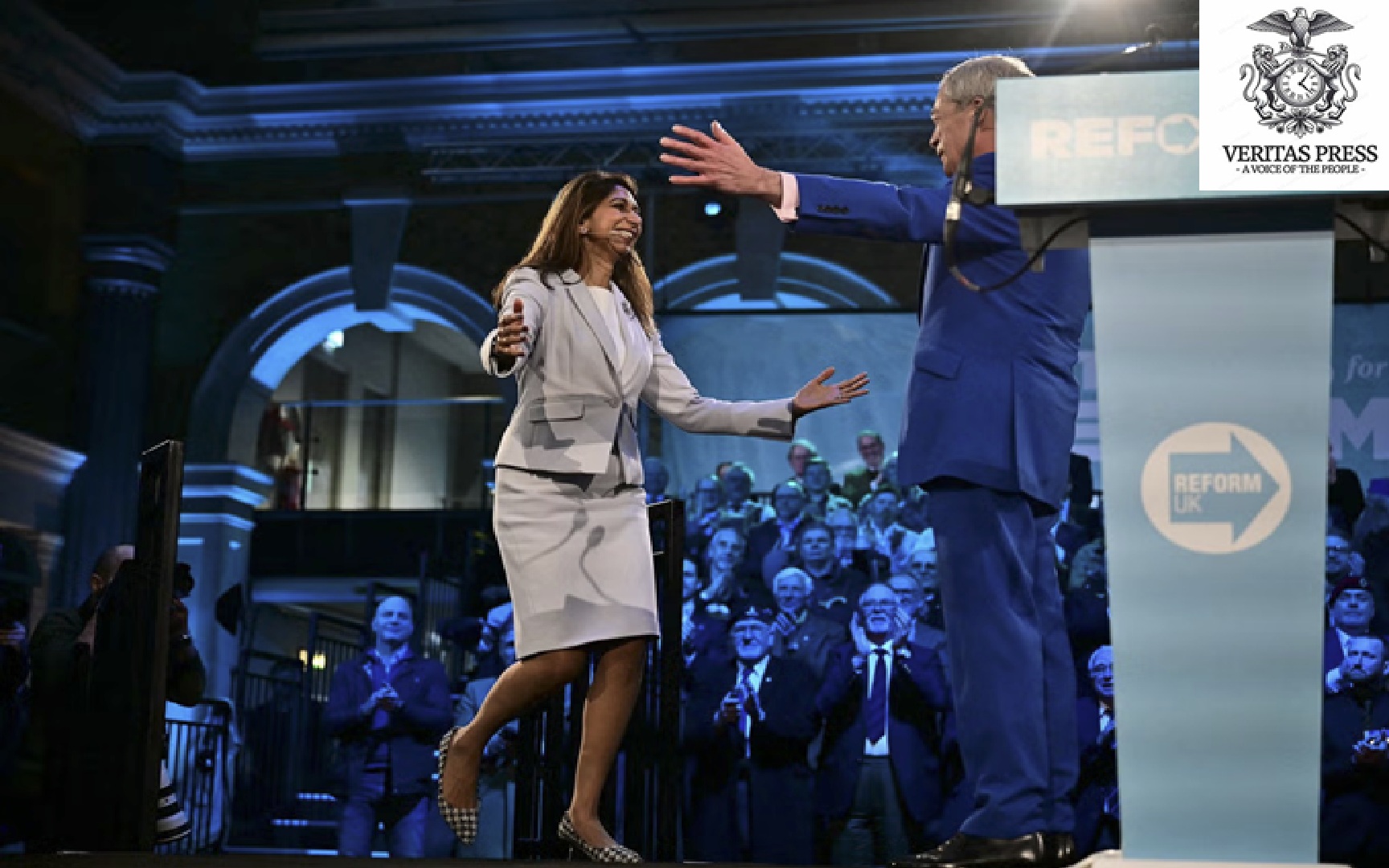
LONDON, 26 January 2026 – In a move that has sent shockwaves through Westminster, Suella Braverman, former Home Secretary under Liz Truss and Rishi Sunak, has defected from the Conservative Party to Nigel Farage’s Reform UK. Unveiled at a “Veterans for Reform” rally in London on Monday, Braverman told supporters she had resigned from 30 years of Conservative membership and that she had “come home” to a party increasingly defined by right-wing populism and extremist associations.
The defection marks a critical turning point in British politics: Reform UK now counts eight MPs, half of whom are former Conservatives, raising questions about the mainstreaming of far-right ideology within Parliament.
A Cabinet Record Shadowed By Controversy:
Braverman’s career has been characterised by a mix of ambition, controversy, and polarising rhetoric. She rose rapidly through the Tory ranks as a staunch Brexiteer, serving in the Department for Exiting the EU before becoming Attorney General and later Home Secretary. Her tenure was marked by inflammatory statements on immigration, describing migrants arriving in small boats as “invaders,” and accusations of bias against protesters, including pro-Palestinian demonstrators, that drew widespread criticism.
She was twice sacked as Home Secretary: first by Liz Truss over the mishandling of official documents, and again by Rishi Sunak in 2023 after publishing a comment in The Times about “hate marches,” which critics accused of inciting far-right violence.
Despite her tumultuous record, Braverman framed her move to Reform UK as a moral stand against a “broken” Conservative Party, claiming that Britain is “suffering” and “standing at a crossroads.”
Farage’s Platform: Sanctuary For The Right-Wing And Extremists.
Nigel Farage, who introduced Braverman to the crowd, has long positioned Reform UK as a populist alternative to mainstream parties. Yet investigative reporting over the past several years has revealed the party’s reliance on networks with far-right and extremist ties. Reform has attracted activists and donors who have publicly advocated anti-immigrant, xenophobic, islamophobic and authoritarian policies, and several of its current MPs, including defected Tories, share histories of supporting or promoting such agendas.
Farage justified Braverman’s welcome despite previously calling her “absolutely pathetic” on immigration during her time in government, telling reporters, “She was utterly useless, as they all were, because they were stuck within the ECHR.” His framing presents Reform as a party where failed Conservatives can legitimately continue policies that were constrained by law and convention, creating a conduit for the far-right to influence parliamentary politics.
The Ideological Convergence Of Mainstream Conservatism And Extremism:
Braverman’s arrival at Reform UK is part of a broader trend: a migration of Conservative MPs who espouse hard-right views into a party increasingly aligned with extremist ideas. The rhetoric she used at the rally, attacking immigration, human rights safeguards, and public institutions, mirrors language historically deployed by far-right groups across Europe and the Americas.
Analysts warn that the line between mainstream conservatism and far-right ideology is blurring, with Reform UK functioning as a repository for disaffected politicians who failed to implement their right-wing agendas within the Conservative Party. Reform’s platform on leaving the European Convention on Human Rights (ECHR) and restricting immigration dovetails with far-right calls for authoritarian sovereignty and the curtailment of civil liberties.
Labour and the Liberal Democrats have criticised the move. Anna Turley, Labour chairwoman, said, “Nigel Farage is stuffing his party full of the failed Tories responsible for 14 years of chaos and decline. Braverman’s defection shows Farage is willing to accept the very worst of the Conservative Party and exposes his complete lack of judgment.”
Yet political analysts note the problem goes deeper than party squabbles: it reflects a structural failure in British democracy, where extremist-adjacent politics are normalised through the migration of senior politicians.
Conservative Collapse And The Mainstreaming Of Extremism:
The Conservative Party’s response, including a now-withdrawn reference to Braverman’s mental health, underscored a broader failure to police ideological boundaries. By allowing prominent ex-Tories to join Reform UK without consequence, the party has effectively legitimised a space for authoritarian, xenophobic, and far-right ideologies to enter Parliament under the guise of populist reform.
This is not just a matter of political realignment; it is a dangerous signal about the erosion of accountability and the mainstreaming of extremist views in British politics. Reform UK is no longer merely a protest party; it is increasingly a conduit for the right-wing and far-right to influence policy and public discourse.
Implications For British Democracy:
Braverman’s defection illustrates the convergence of failed mainstream politicians with extremist ideologies, raising the stakes for Britain’s democratic institutions. Reform UK is emerging as a vehicle where far-right rhetoric intersects with mainstream political credibility, potentially reshaping voter perceptions and the boundaries of acceptable debate.
As more Conservative figures contemplate crossing the floor, the UK faces a dangerous recalibration of political norms, where populist spectacle and far-right ideology may become central to parliamentary strategy. The real story is not just about a single MP leaving her party; it is about the infiltration of extremist networks into the heart of British politics, under the guise of Reform UK.
Reform UK Mps: From Conservative Cabinet To Far-Right Networks.
| MP | Former Conservative Role | Year Defected | Far-Right / Extremist Links / Controversial Positions |
| Suella Braverman | Home Secretary (Truss, Sunak), Attorney General | 2026 | Advocated leaving ECHR; anti-immigration rhetoric (“invaders”); accused of inciting far-right tensions at Cenotaph protests; aligns with Reform’s far-right platform. |
| Robert Jenrick | Housing Secretary | 2026 | Criticised for anti-immigration stance; aligned with far-right lobbying groups; involved in Afghan refugee resettlement controversies. |
| Nadhim Zahawi | Chancellor of the Exchequer | 2026 | Supported strict immigration policies; has campaigned with nationalist groups; promotes anti-ECHR policies. |
| Andrew Rosindell | Backbench MP | 2026 | Long-standing anti-EU activist; promoted nationalist messaging; connected to anti-immigration lobby groups. |
| Lee Anderson | Former Minister | 2025 | Has supported far-right rhetoric in public statements; ties to nationalist and anti-migrant organisations. |
| Nadine Dorries | Former Culture Secretary | 2025 | Ally of right-wing populists; promoted controversial far-right media narratives; associated with nationalist networks. |
| Andrea Jenkyns | Former Deputy Chief Whip | 2025 | Anti-EU, nationalist-leaning; supports Reform’s hardline immigration platform. |
| Jonathan Gullis | Backbench MP | 2025 | Advocates restrictive immigration and law-and-order policies; engaged with far-right community groups. |
Notes on the Table:
- Far-right / Extremist Links are based on public statements, affiliations with nationalist or anti-immigrant organisations, or investigative reports from media such as The Guardian, BBC, and Reuters.
- This table highlights a pattern: Reform UK is systematically recruiting ex-Conservative MPs with histories of hard-right rhetoric, creating a parliamentary bloc that blends mainstream credibility with extremist ideologies.
- The defection of Braverman, Jenrick, and others demonstrates the normalisation of authoritarian, anti-ECHR, and anti-immigration stances within a party now occupying formal parliamentary seats.
Conclusion: The Mainstreaming Of Extremism.
Suella Braverman’s defection to Reform UK is not a mere political reshuffle or the flight of a disgruntled minister. It is a symptom of a more serious, systemic threat to the norms of British democracy: the mainstreaming of far-right ideology through established political channels.
By welcoming Braverman, a figure whose tenure in government was marked by inflammatory rhetoric, anti-immigrant posturing, and repeated clashes with human rights frameworks, Reform UK has signalled that failure in Conservative politics is no barrier to influence in a party increasingly aligned with authoritarian populism. Her move, alongside the earlier defections of Robert Jenrick, Nadhim Zahawi, and others, demonstrates a deliberate strategy by Farage to consolidate right-wing dissent, legitimise extremist positions, and normalise authoritarian policies within Parliament.
Reform UK’s growing parliamentary presence highlights a stark reality: the ideological boundaries between mainstream conservatism and far-right politics are eroding. Policies once considered radical, dismantling human rights protections, demonising migrants, and weakening civil liberties, are now being advocated by MPs with cabinet experience, presenting these extremist positions as credible and politically acceptable.
This convergence of political failure, ambition, and far-right ideology represents a critical threat to Britain’s democratic institutions. As Reform UK absorbs more defected Conservatives, the party transforms from a protest movement into a platform for authoritarian nationalism, undermining the checks and balances that protect individual rights and civil liberties.
Braverman’s rhetoric, framing Britain as “broken” and “humiliated on the world stage”, mirrors far-right populist narratives across Europe, yet her presence in Parliament legitimises these narratives in mainstream discourse. The danger is clear: if left unchecked, Reform UK’s fusion of experienced political figures with far-right ideology could reshape Britain’s legislative landscape, emboldening extremist policies and weakening democratic accountability.
In short, Braverman’s defection is not just a story of personal ambition; it is a signal of the creeping authoritarianisation of UK politics, where the line between mainstream governance and far-right ideology becomes ever more indistinct. The real story is not who leaves the Conservative Party, it is what these defections reveal about the ideological direction of British politics, and the vulnerability of its democratic institutions to far-right infiltration.

When Lieutenant Colonel Ebrahim Zolfaqari, spokesman for Iran’s Khatam al-Anbiya Central Headquarters, issued a warning

The historic Christian presence in Palestine, dating back to the earliest centuries of Christianity, is

JERUSALEM – For the first time since the aftermath of the Six-Day War, the courtyards

TEHRAN – As the sun rose on Eid al-Fitr, a day meant for celebration and

HUNGARY – As Benjamin Netanyahu prepares to travel to Hungary this weekend, a mounting legal

LONDON — In the polished corridors of 10 Downing Street, the language remains meticulously calibrated:

On March 20, 2026, the Pentagon quietly announced what amounts to a fundamental restructuring of
WASHINGTON / ISLAMABAD — A fresh warning by US Director of National Intelligence Tulsi Gabbard