


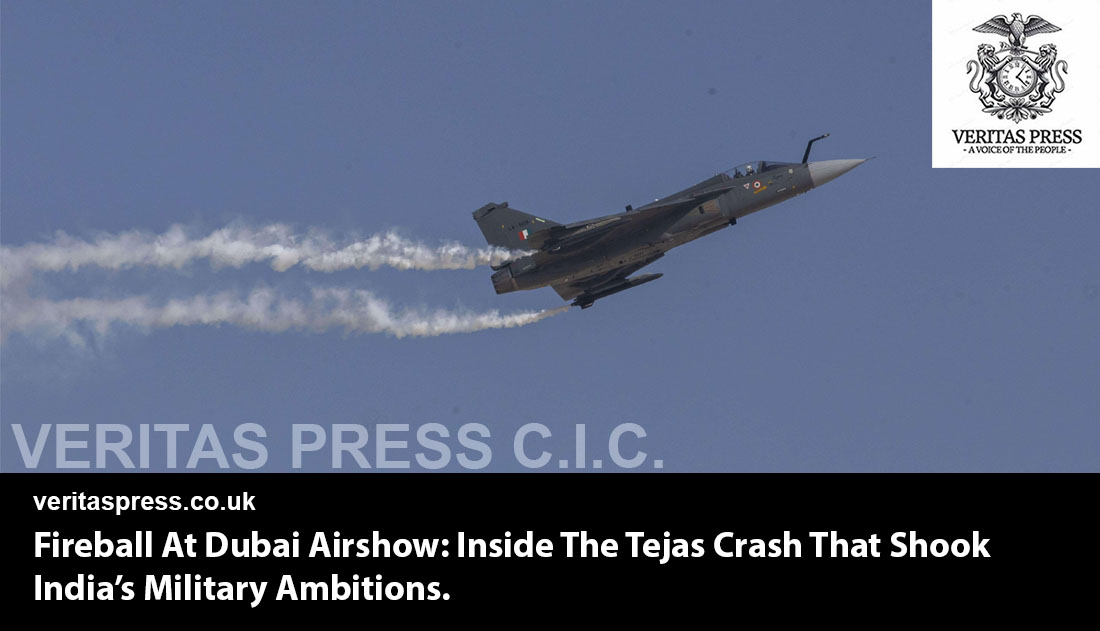

Title: Fireball At Dubai Airshow: Inside The Tejas Crash That Shook India’s Military Ambitions.
Press Release: Veritas Press C.I.C.
Author: Kamran Faqir
Article Date Published: 21 Nov 2025 at 14:10 GMT
Category: Middle-East | UAE-India | Inside The Tejas Crash That Shook India’s Military Ambitions.
Source(s): Veritas Press C.I.C. | Multi News Agencies
Website: www.veritaspress.co.uk

Business Ads


India’s Best Fighter Crashed At The World’s Top Airshow.
Dubai / New Delhi — At 2:14 p.m. on 21 November 2025, thousands of spectators at the Dubai Airshow watched India’s pride, the HAL Tejas light combat aircraft, arc into a low manoeuvre before plunging nose-first into the tarmac in a violent fireball. A wall of black smoke rose above Al-Maktoum International Airport, drawing gasps and screams. Seconds later, silence.
The pilot, a decorated Indian Air Force (IAF) officer, died instantly. Emergency crews swarmed the wreckage. Within minutes, governments scrambled to shape the narrative of a disaster that unfolded on the world’s biggest aerospace stage.
This exposé pieces together eyewitness accounts, independent analysts’ assessments, government statements, archival accident data, and industry sources to explore not just how the aircraft crashed, but why this tragedy could redefine India’s future fighter strategy, export ambitions, and military credibility.
I. The Crash: What Witnesses Saw
A Sudden Dive, Then Impact
Videos verified by Reuters and AP News show the single-seater Tejas flying unusually low during a display sequence. Spectators interviewed by Gulf News described an audible “whine,” a short hesitation, and then a sudden downward plunge.
“The jet just dipped, straight down, like something failed,” said an Emirati aviation enthusiast standing near the east grandstand.
“People started running and screaming when the explosion went off.” — Reuters eyewitness.
Several witnesses noted that the aircraft did not appear to attempt a recovery; none reported seeing an ejection.
UAE’s Ministry of Defence confirmed that emergency crews had extinguished the blaze within minutes. The Dubai Media Office later released images of firefighters hosing charred fragments scattered across the tarmac.
II. The Official Line, And What’s Missing
India’s Response: Controlled, Cautious, Incomplete
The IAF issued a short statement confirming the pilot’s death and announcing a court of inquiry, standard practice after military aviation disasters. Notably absent were any preliminary findings, even though videos strongly suggested a catastrophic system or engine failure.
India’s Ministry of Defence declined to answer specific questions from multiple outlets regarding prior mechanical issues on the aircraft.
A Pre-Crash Controversy
Just days before the accident, Indian officials had aggressively dismissed viral social-media posts alleging an “oil leak” from the same Tejas aircraft. The Ministry insisted the fluid seen beneath the jet was “normal drainage and condensation.”
Now, that denial sits uneasily against the backdrop of a fatal accident, prompting analysts to question whether authorities were overly defensive about reputational risks.
UAE Investigation: Parallel And Independent.
Emirati officials have confirmed they will conduct their own technical probe. Aviation lawyers interviewed by Al Jazeera point out that because the crash occurred on Emirati soil during a public event, the UAE’s findings may carry unusual weight, and might not align neatly with India’s.
III. What The Videos Tell Us: Key Technical Fault Lines
A review of available footage and expert interviews points investigators toward several critical lines of inquiry:
1. Low-Altitude Recovery Envelope
International display guidelines warn that single-engine fighters have minimal recovery margins when performing high-G manoeuvres under 300 feet.
A European airshow safety consultant told this investigation:
“The Tejas was operating at an altitude where any control or engine anomaly becomes unrecoverable within seconds.”
Analysts note that the jet’s sudden nose-down pitch resembles either engine flameout, flight-control malfunction, or pilot incapacitation.
2. Engine Reliability
The Tejas Mk-1 and Mk-1A variants rely on a GE F404 engine. India suffered a Tejas accident in Rajasthan in March 2024, attributed to engine problems.
A former HAL engineer, speaking anonymously, said:
“If this is another engine-related failure, it’s systemic, not isolated.”
3. Maintenance History And Pre-Flight Checks
Investigators will scrutinise:
- recent servicing records
- deferred defects
- hydraulic and fuel system logs
- ground crew reports of anomalies
The earlier “oil leak” controversy now raises high-stakes questions: were warning signs dismissed too quickly?
4. Human Factors And Display Pressures
Display pilots operate under intense marketing expectations at global airshows.
A retired IAF test pilot told The Economic Times:
“At airshows, you’re not just flying, you’re selling the aircraft. That creates pressure to push limits.”
HAL had reportedly been aggressively promoting export deals to Malaysia, Argentina, and several Gulf states.
IV. A Programme Under Stress: Why Tejas Matters Politically
The Tejas is more than a fighter jet, it is a symbol.
Strategic Pride
India has long touted Tejas as proof that it can produce world-class combat aircraft domestically. Government ministers regularly highlight the programme as the flagship of “Make in India.”
Export Ambition
Before the Dubai crash, HAL was courting multiple foreign customers. A display disaster at the world’s highest-profile airshow threatens to chill those negotiations.
A Pattern Emerging?
Until 2024, Tejas had never suffered a crash since its 2001 maiden flight. But now:
- March 2024 – Rajasthan (engine-related fire)
- November 2025 – Dubai (fatal accident)
Defence analysts interviewed by Reuters warn that “two crashes in 20 months is no longer statistically trivial.”
V. Reactions: Officials, Activists, Analysts, Industry
Politicians
Indian MPs from both ruling and opposition parties issued condolences, but several demanded transparency. A senior opposition MP posted:
“A national project of this scale requires accountability, not secrecy.”
Defence Analysts
International experts were blunt.
A UK aerospace analyst told this investigation:
“You cannot sell a fighter jet internationally if it crashes during a sales demonstration.”
Another warned that countries considering Tejas, particularly those evaluating cheaper alternatives to Western aircraft, will now insist on detailed reliability and failure-rate data.
Aviation Safety Activists
Groups that campaign against dangerous airshow practices accused India of prioritising spectacle over pilot safety.
One South Asian safety advocate told Gulf News:
“Display routines should never exceed the aircraft’s proven safety margins, especially not with a single-engine fighter.”
HAL And The Defence Ministry
Both are now under intense pressure to produce technical documentation for two investigations, one Indian, one Emirati, while also defending the aircraft’s reputation globally.
VI. The Unanswered Questions, And The Stakes
Critical Gaps Investigators Must Address
- Did the engine fail?
Telemetry and cockpit recordings must confirm whether the F404 experienced a flameout or thrust loss. - Did the pilot attempt ejection?
No canopy separation is visible in most footage, raising questions about system function. - Was the display routine approved?
Who authorised low-altitude manoeuvres, and were safety margins compromised? - Were earlier mechanical concerns ignored?
The pre-show “oil leak” denial must be revisited in light of the crash. - Will India and the UAE publish full reports?
Past military accident inquiries in India have often remained classified.
VII. The Global Fallout, Export Markets, Military Credibility, And The Future Of Tejas
Immediate Consequences
- Demonstration flights suspended
- International buyers are demanding technical briefings
- HAL is scrambling to contain reputational damage
Medium-Term Threats
Potential customers are expected to request:
- failure-rate data
- spares provisioning guarantees
- crash-sequence telemetry
- engine reliability audits
- maintenance cycle transparency
Defence economists warn that India’s entire fighter-export strategy may face delays or renegotiations.
Long-Term Impact
If systemic issues are found in design, production, or maintenance, India may face:
- A higher reliance on foreign fighters
- Delayed Tejas Mk-2 timeline
- Erosion of credibility for other defence-industry programmes
VIII. Beyond The Wreckage, The Human Cost
Amid the geopolitical implications, a pilot died performing a routine intended to demonstrate national capability, not to risk his life for spectacle.
A senior IAF officer who trained with the pilot said quietly:
“He deserved a system that put safety above symbolism.”
The court of inquiry now carries a dual burden:
- to reveal the full, unvarnished cause of the crash
- and to ensure no future pilot, Indian or foreign, faces the same fate in the cockpit of a Tejas.