


Title: Eastern Gaza Under Fire: Legal Violations, Systematic Demolitions, And The Erosion Of Gaza’s Ceasefire
Press Release: Veritas Press C.I.C.
Author: Kamran Faqir
Article Date Published: 07 Jan 2026 at 12:50 GMT
Category: Middle East | Palestine-Gaza-West Bank-OPT | Eastern Gaza Under Fire: Legal Violations, Systematic Demolitions, And The Erosion Of Gaza’s Ceasefire
Source(s): Veritas Press C.I.C. | Multi News Agencies
Website: www.veritaspress.co.uk

Business Ads


GAZA — January 2026 Israeli occupation forces have escalated a campaign of shelling, gunfire, and systematic demolition across eastern Gaza that, according to Palestinians, international legal experts, and human rights organisations, amounts to ongoing violations of the October 2025 ceasefire agreement and international humanitarian law. Rather than a pause in hostilities, recent weeks have witnessed a resurgence of practices that closely resemble collective punishment, forced displacement, and the deliberate destruction of civilian infrastructure, conduct widely condemned as unlawful and potentially amounting to war crimes and crimes against humanity.
Far from isolated battlefield incidents, the renewed violence reflects what analysts describe as a deliberate post-ceasefire strategy: consolidating territorial control, rendering large swathes of Gaza uninhabitable, and reshaping the Strip’s geography under the cover of a nominal truce.
Renewed Violence Across Eastern Gaza:
On Tuesday, Israeli artillery pounded residential areas east of Gaza City and Khan Younis, including the densely populated Al‑Tuffah neighbourhood, in what witnesses described as indiscriminate bombardment. Tanks and armoured vehicles unleashed sustained machine‑gun fire, while Israeli warships opened fire on coastal areas of Gaza City, extending the assault across land and sea.
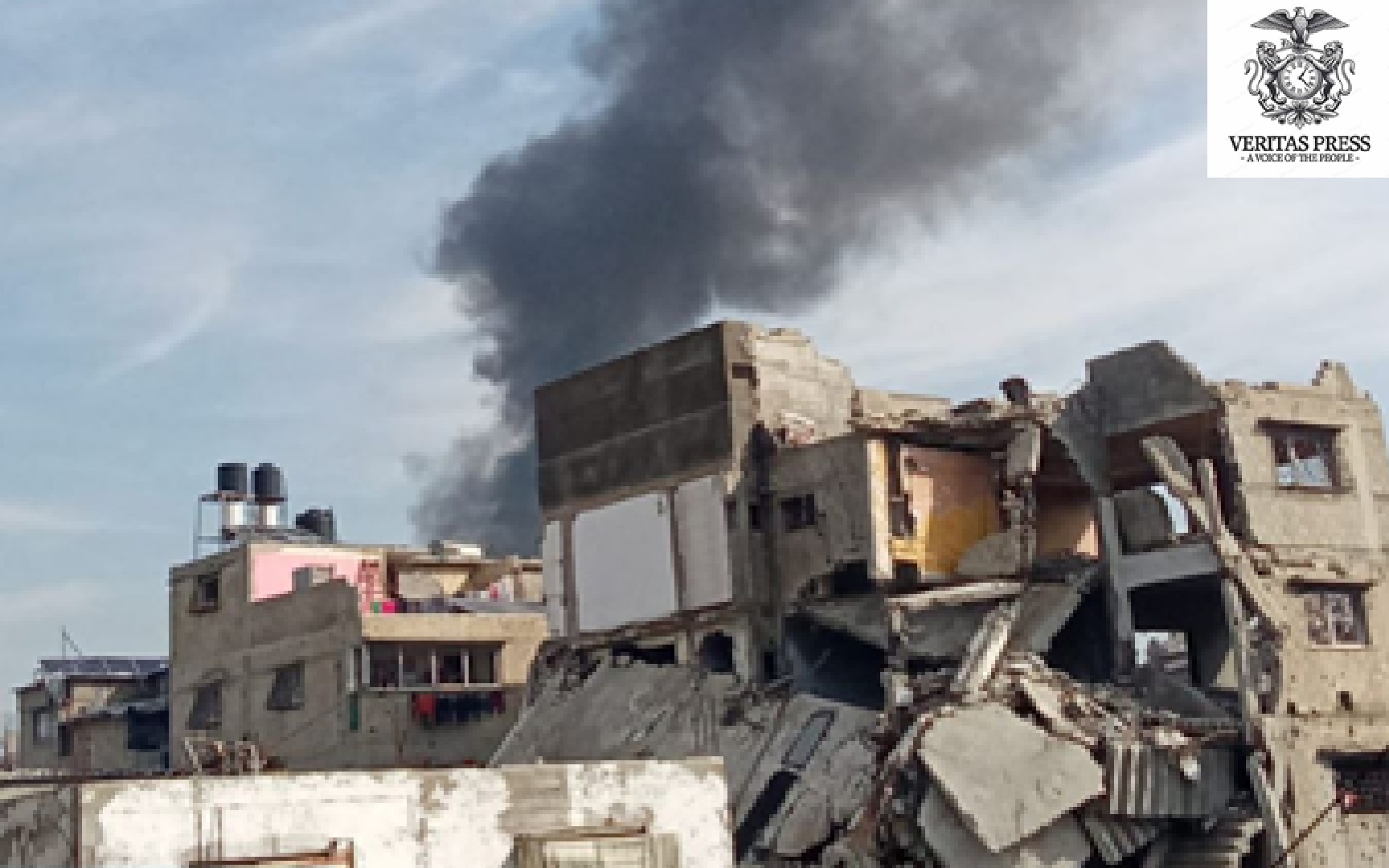
In Khan Younis, shelling struck zones nominally under Israeli control, heightening fears among residents already uprooted by years of war. Throughout the day, multiple buildings were blown to rubble, with explosions echoing across northern and southern Gaza as Israeli forces demolished homes, civilian facilities, and structures that had survived previous assaults. Thick plumes of smoke rose from targeted neighbourhoods in Gaza City, Jabaliya, Rafah, and eastern Khan Younis as bulldozers and explosives levelled entire residential blocks.
Local medical teams said it was often too dangerous to verify casualty figures amid ongoing fire and access restrictions, but confirmed that a Palestinian child was killed earlier in the week during shelling east of Khan Younis, in territory Israel had ostensibly withdrawn from under the ceasefire deal.
Ceasefire In Name Only?
The ceasefire, agreed on October 10, 2025, was meant to halt hostilities and enable a dramatic scale-up of humanitarian aid to a territory ravaged by more than two years of war. Instead, Israel’s military campaign has repeatedly contravened its core provisions.
According to the Gaza Government Media Office, Israeli forces have violated the ceasefire hundreds of times since it came into effect, including through bombardments, shootings, and the demolition of civilian properties. Al Jazeera has documented a steady pattern of lethal incidents occurring in areas designated as calm or subject to Israeli withdrawal.
UN agencies and senior officials have likewise warned that ceasefire gains have been rapidly reversed, with renewed Israeli strikes undermining any prospects for sustained calm and obstructing urgently needed humanitarian deliveries. The National reported that UN officials now view the truce as effectively hollow, lacking enforcement or meaningful civilian protection.
Eyewitnesses and Palestinian Voices:
“It feels like the ceasefire never existed,” said A’isha, a Gaza health worker. “There has not been a day without armed attacks against civilians since October 10. Children continue to be shot, homes destroyed, and aid workers banned.” (Feminine‑Perspective Magazine)
Residents of Jabaliya described watching entire residential blocks levelled with little or no warning, forcing families, many displaced multiple times, to flee yet again. The Guardian reported that those uprooted by the latest demolitions are now sheltering in inadequate tents that offer little protection from winter rains and plunging temperatures.
Journalists covering the demolitions said the destruction appeared methodical rather than reactive, targeting areas where no active hostilities were taking place at the time.
Legal Violations And International Law:
International humanitarian law, particularly the Fourth Geneva Convention, explicitly prohibits the destruction of civilian property by an occupying power unless rendered “absolutely necessary” by active military operations. Legal experts and UN bodies argue that the scale, timing, and systematic nature of Israel’s demolitions fall far outside this narrow exception.
A recent United Nations legal analysis concluded that the creation of so-called “buffer zones” through widespread demolition does not meet the threshold for lawful military necessity and constitutes grave breaches of international law and war crimes.
The UN Human Rights Office has also documented a broader pattern of repression in the Occupied Palestinian Territory, including the killing of hundreds of journalists, attacks on medical personnel, and the severe curtailment of civil society space, raising urgent concerns over accountability and the deliberate silencing of witnesses.
Human rights organisations, including Amnesty International, have described Israel’s blockade of humanitarian operations and destruction of essential infrastructure as a brazen campaign of collective punishment, warning that such conduct may meet legal thresholds associated with genocidal intent under international law.
Statements From Officials And Rights Groups:
The Arab‑Islamic Ministerial Committee condemned Israel’s demolition campaign, describing it as an illegal practice that violates international humanitarian law and urging the international community to exert real pressure on Israel to comply with its legal obligations toward civilians. (WAFA)
International legal experts and rights organisations stress that civilian protection is non-negotiable in armed conflict. According to the UN’s legal framework on occupation, the “destruction of homes and infrastructure not justified by military necessity constitutes a grave breach of the Fourth Geneva Convention and a war crime.”
Humanitarian Impact Deepens
The compounded effects of mass demolition, restricted aid access, and relentless displacement have pushed Gaza’s humanitarian crisis to new depths. Thousands of families remain exposed to the elements in fragile, overcrowded tents, while Israel’s recent decision to suspend dozens of international aid organisations from operating in Gaza threatens to block critical food, medical, and shelter assistance, The Washington Post reported.
The Palestine Shelter Cluster warned that most tents delivered for winter use are structurally inadequate, leaving hundreds of thousands of Palestinians at risk from cold, flooding, and collapse, a direct consequence, aid groups say, of Israel’s ongoing destruction of permanent housing.
Conclusion: From Ceasefire To Crime Scene.
What is unfolding in eastern Gaza is no longer credibly describable as a fragile or imperfect ceasefire. It is the systematic transformation of a truce into a permissive environment for continued destruction, where artillery fire, airstrikes, and large-scale demolitions proceed with near-total impunity. The evidence emerging from Gaza points not to accidental breaches or operational excesses, but to a coherent pattern of conduct that aligns with prohibited acts under international law: the extensive destruction of civilian property, the killing of protected persons, collective punishment, and the forcible transfer of populations.
Under the Fourth Geneva Convention and the Rome Statute of the International Criminal Court, these are not political accusations; they are criminal categories. The deliberate razing of homes during a ceasefire, the killing of civilians in areas designated for withdrawal, and the rendering of entire neighbourhoods uninhabitable cannot be reconciled with claims of military necessity. When such acts are repeated, documented, and openly carried out in defiance of ceasefire obligations and international warnings, they point toward state policy rather than battlefield contingency and an act of terrorism.
The continued absence of enforcement has transformed Gaza into a test case for the international legal order itself. Each unpunished demolition, each uninvestigated killing, further entrenches a regime of exception in which Palestinian civilian life is treated as legally expendable. As long as ceasefire violations are met with diplomatic language instead of accountability, the truce functions not as a shield for civilians but as a veil behind which crimes are committed.
At this stage, the central question confronting the international community is no longer whether international law applies in Gaza; it clearly does, but whether it will be enforced against a state that has repeatedly demonstrated its willingness to violate it. Failure to act does not preserve neutrality; it entrenches complicity. Gaza’s ruins now stand not only as evidence of destruction, but as material proof of an international system unwilling or unable to uphold its own laws.