



Title: Deforestation Dries Southern Amazon: Flying Rivers Fade And Rainfall Collapses Under Tree Loss.
Press Release: Veritas Press C.I.C.
Author: Kamran Faqir
Article Date Published: 28 Jan 2026 at 15:45 GMT
Category: Americas | Climate Change | Deforestation Dries Southern Amazon: Flying Rivers Fade And Rainfall Collapses Under Tree Loss.
Source(s): Veritas Press C.I.C. | Multi News Agencies
Website: www.veritaspress.co.uk

Business Ads


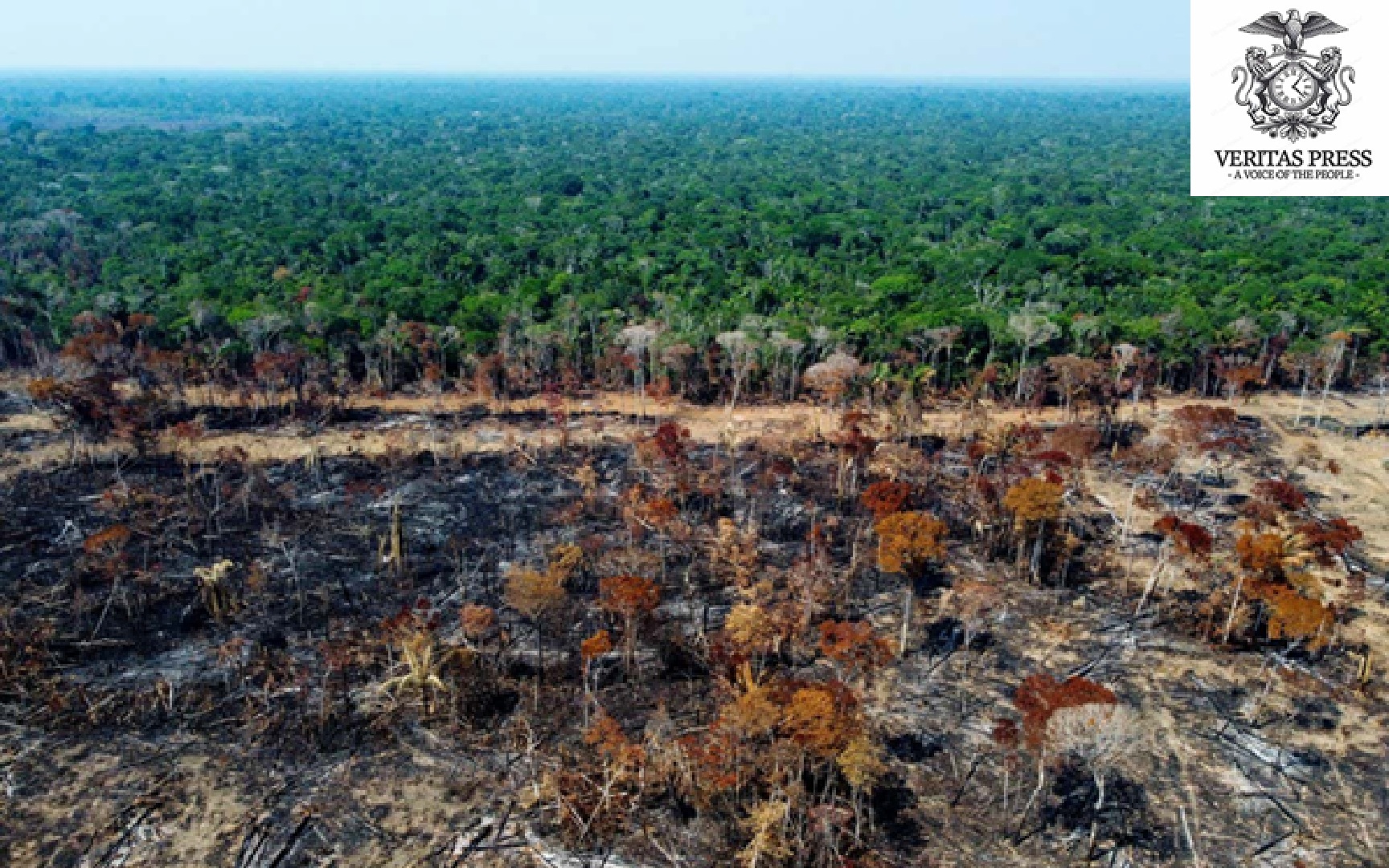
SOUTHERN AMAZON BASIN, BRAZIL & SOUTH AMERICA — The Amazon rainforest is not just a lush green wilderness; it is a colossal climate engine. By drawing water up from the soil and recycling it back into the skies, the Amazon powers the continent’s rainfall, feeds its rivers, and sustains ecosystems and farm belts thousands of kilometres away. Yet this engine, the so-called “flying rivers” of atmospheric moisture, is now weakening under relentless deforestation, triggering a cascade of drying, drought, heat, and ecological risk that scientists warn could herald a systemic collapse.
Rainfall Falling, Dry Seasons Lengthening:
New peer-reviewed climate analyses confirm a stark trend: rainfall in the Amazon’s dry season has dropped sharply, with much of that decline directly tied to forest loss. A recent BBC Science Focus Magazine report summarising the latest Nature Communications study found that about three-quarters of the dry-season rainfall decline, roughly 21 mm, is attributable to deforestation, not just global warming.
This result aligns with atmospheric physics: trees act as massive water pumps, drawing moisture from soils and releasing it into the air, a process called transpiration, which then helps form clouds and rain. As forests are cut, that recycling mechanism falters, and the region becomes drier.
Flying Rivers Weakening, Droughts Intensifying:
Central to the Amazon’s continental influence are the invisible “flying rivers”, atmospheric streams of water vapour that journey from the Atlantic Ocean across the Amazon basin, driven by trade winds. Over millennia, these aerial currents have brought much of the region’s rainfall, sustaining agriculture, forests, and livelihoods across South America.
But according to updated investigations by the Monitoring of the Andean Amazon Project (MAAP):
- Southern Brazil’s intense deforestation is shrinking the capacity of forests to feed moisture into these currents.
- In the dry season, when forests most need water, the flying rivers cross heavily cleared lands, diminishing the volume of moisture carried westward toward the Andes and beyond.
- As a result, scientists are documenting drier conditions across southern Peru and northern Bolivia, including iconic protected areas like Manu National Park.
These changes are not theoretical: field scientists report that the past two years have brought the driest conditions the Amazon has ever seen, with Indigenous ecological calendars, timing of planting, hunting, fishing, and rainy‑season cues, thrown out of sync.
Tipping Points: Nearer Than Once Thought.
One of the most urgent scientific warnings comes from the concept of ecological tipping points, thresholds beyond which the Amazon can no longer sustain itself as a rainforest and begins transforming into drier savanna-like landscapes.
Climate experts have long warned that if deforestation reaches 20–25 % of the basin, and global temperatures climb further, the forest’s hydrological engine could collapse. Recent updates, including interviews with leading figure Carlos Nobre, suggest that this tipping point may be closer than earlier estimates, given record droughts, extended dry seasons, and weakened moisture recycling.
Nobre emphasises that the Amazon’s flying rivers are central to its stability, weakened forests mean less moisture injected into the atmosphere and a diminished capacity to sustain rainfall patterns regionally and continent-wide.
Beyond The Trees: A Domino Of Drying Impacts.
Scientists and frontline researchers are now documenting a range of interconnected effects:
1. Longer, Hotter Dry Seasons
The Amazon’s dry season, once a temporary pause in rain, is now extending by weeks compared to several decades ago, amplifying heat, evaporation, and vegetation stress.
2. Fires and Forest Degradation
Dryer forests burn more easily. While agricultural clearing still drives much forest loss, fire-driven degradation has surged, damaging standing forests’ ability to recycle moisture and store carbon, a deadly feedback loop.
3. Impacts on Water & Agriculture
Diminished flying rivers threaten water supplies and rainfall for South America’s agricultural heartlands, from central Brazil’s soy fields to southern grain belts. Further east and south, reduced rains are already affecting crop yields, hydroelectric production, and water availability.
4. Indigenous and Local People’s Lives
Communities that have lived in rhythm with seasonal rains for generations are experiencing unprecedented disruption, from hunting cycles to crop timing, underscoring the human dimension of atmospheric drying.
Why This Matters Globally:
The Amazon’s flying rivers are not a regional curiosity, they are a continental water highway that feeds moisture across much of South America’s interior. Without them:
- Rainfall patterns shift dramatically.
- Rivers shrink and hydropower falters.
- Agricultural productivity falters.
- Entire ecosystems transition toward drier, less biodiverse states.
This isn’t just environmental abstraction: it’s a planetary climate mechanism that knit together rainforest, farm belts, cities, and cultures across thousands of kilometres.
Strong Scientific Consensus, Urgent Action Needed:
Across scientific communities, whether in detailed atmospheric modelling or field observations, the conclusion is consistent: deforestation is not merely a contributor to climate change; it is a direct driver of rainfall decline, drought intensification, and hydrological destabilisation.
Conservation biologists, Indigenous leaders, and climate scientists call for:
- Immediate cessation of all deforestation.
- Large-scale forest restoration to rebuild moisture recycling capacity.
- Protection of Indigenous lands, which often act as de facto forest guardians.
- Regional cooperation among Amazon nations to conserve flying rivers as a continental public good.
- Investing more in and researching low-cost energy sources.
- Cease reliance on fossil fuels.
- To invest more resources in recycling and development.
These measures, paired with emissions cuts to limit global warming, offer the best chance to preserve the Amazon’s unique climate role before it slips past a point of no return.
Conclusion: The Amazon’s Fate Is Our Future.
The drying of the Southern Amazon is no longer a theoretical projection: it is unfolding in real time, documented by satellite, measured by rain gauges, and experienced by communities across the basin. The weakening of the flying rivers, the atmospheric lifeblood of South America, signals that the rainforest’s water engine is faltering.
Whether the Amazon remains a vibrant climate stabiliser or succumbs to a degraded, drought-ridden state will be determined by urgent choices in the years ahead.
What steps should global leaders take now to protect the flying rivers and the Amazon’s climate legacy?
Tell us your perspective in the comments below.

When Lieutenant Colonel Ebrahim Zolfaqari, spokesman for Iran’s Khatam al-Anbiya Central Headquarters, issued a warning

The historic Christian presence in Palestine, dating back to the earliest centuries of Christianity, is

JERUSALEM – For the first time since the aftermath of the Six-Day War, the courtyards

TEHRAN – As the sun rose on Eid al-Fitr, a day meant for celebration and

HUNGARY – As Benjamin Netanyahu prepares to travel to Hungary this weekend, a mounting legal

LONDON — In the polished corridors of 10 Downing Street, the language remains meticulously calibrated:

On March 20, 2026, the Pentagon quietly announced what amounts to a fundamental restructuring of

WASHINGTON / ISLAMABAD — A fresh warning by US Director of National Intelligence Tulsi Gabbard