
Press Release: Veritas Press C.I.C.
Author: Kamran Faqir
Article Date Published: 12 Nov 2025 at 13:35 GMT
Category: Americas-Canada | Politics | Combat On Campus
Source(s): Veritas Press C.I.C. | Multi News Agencies
Website: www.veritaspress.co.uk

Business Ads

CANADA/TORONTO, November 2025 – When former Israeli soldier Jonathan Karten threw several pro-Palestine protesters down a stairwell at a Toronto event this month, the clash instantly ricocheted across social media and newsrooms. Within hours, duelling narratives emerged: one portraying Karten as a Jewish student hero defending against an antisemitic mob, the other depicting him as a former combatant assaulting unarmed students.
The truth, as verified by multiple videos and interviews, is more complex and raises disturbing questions about policing, media bias, university oversight, and Canada’s legal accountability for foreign combatants on its soil.
A Chaotic Scene At A Private Venue:
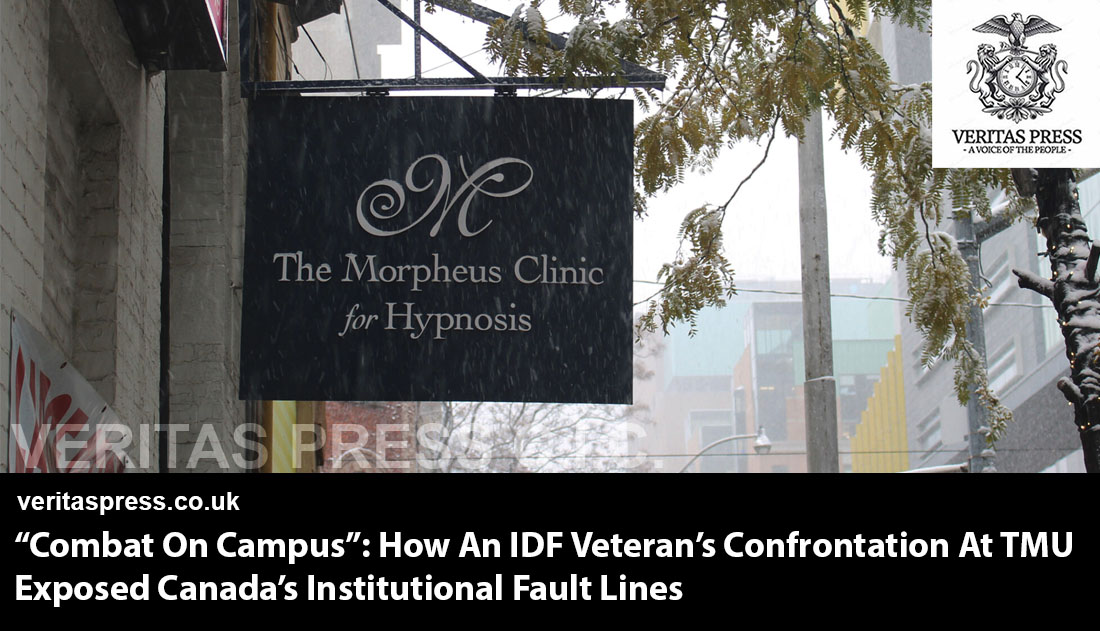
On November 5, Toronto Metropolitan University’s (TMU) student group Students Supporting Israel (SSI) hosted an event featuring former IDF soldiers, including Karten. The group had been denied permission to hold the talk on campus, prompting them to rent a room at the Morpheus Hypnosis Clinic near Elm and Bay Streets.
According to TMU, the event was off-campus and not covered by university security protocols. “TMU condemns any acts of aggression, intimidation, or violence,” the university said in a statement, adding it was “deeply concerned” and reviewing policies surrounding off-campus student events.
That lack of oversight would soon prove critical.
Shortly after noon, a handful of masked pro-Palestine protesters entered the small venue, chanting slogans against Israel’s assault on Gaza. Witnesses agree that a glass panel in the interior door was shattered, but footage does not conclusively show who broke it. SSI claimed protesters used a metal drill bit; Students for Justice in Palestine (SJP) said the glass shattered during a scuffle inside.
Moments later, the video shows Karten shouting at the protesters: “You’re being fucking brainwashed … It’s not a genocide, I was there!” Another speaker uses a derogatory Arabic term. Within seconds, Karten can be seen physically shoving and pulling multiple protesters through the broken doorway, throwing several down a stairwell as others try to film.
Toronto Police arrived shortly after 1:00 p.m., arresting five protesters on charges of forcible entry, unlawful assembly, obstruction, and assaulting a peace officer. None of the speaker-side participants, including Karten, was charged.
“Institutional Racism in Uniform”
At a press conference the next day, SJP and allied groups accused police of targeting the victims rather than the aggressor.
“One of those soldiers physically attacked students protesting their presence, and yet it was the protesters who were arrested. This is institutional racism in uniform,” said Zoe Newman, from Jews Say No To Genocide.
Activists say at least two students suffered bruises and glass cuts; others were hospitalised for stress and panic attacks. The group has demanded an independent review into police conduct.
Karten’s Defence: “I Fought Them Off”
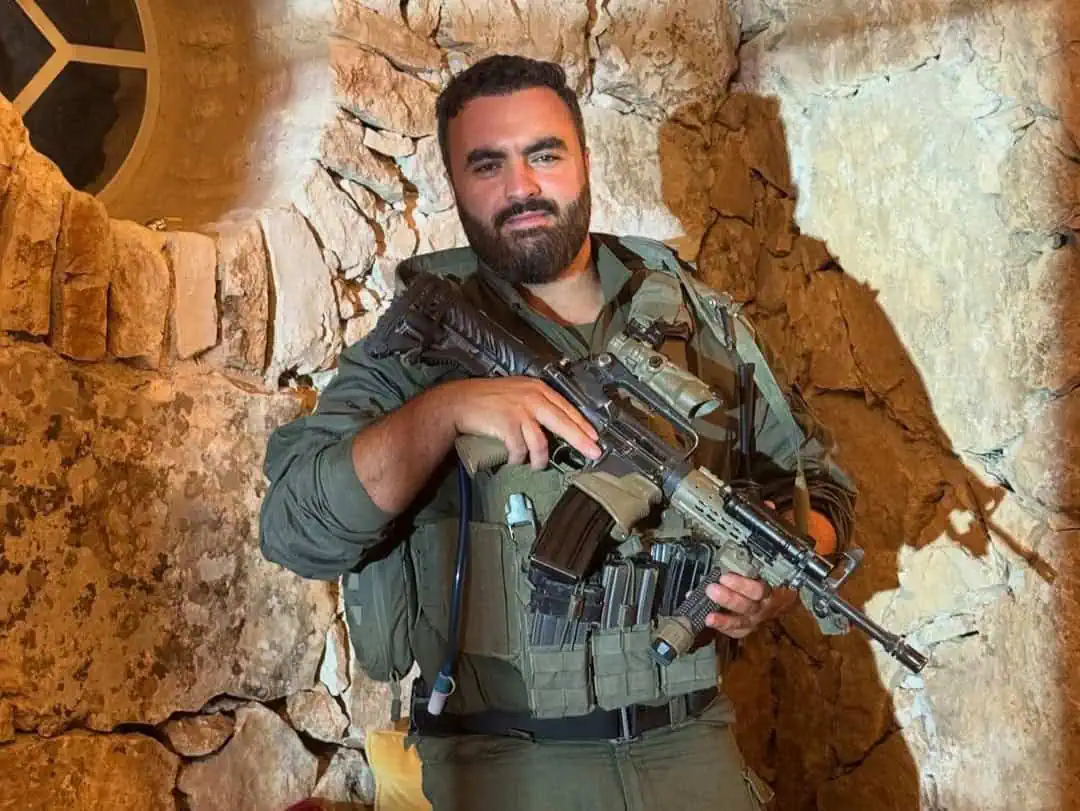
Karten, who served in Israel’s military during operations in Gaza, later described his actions as self-defence.
“They stormed a pro-Israel event on campus … Then they met an ex-IDF soldier. Folded. One after another,” he posted on social media, in a caption widely shared by pro-Israel accounts.
In interviews, he said he “fought them off, barricaded the door, and waited for police.” SSI claimed that one attendee suffered a seizure and another was injured by glass during the confrontation.
The competing footage and the selective editing by each side have since fueled outrage and misinformation across platforms. Some viral posts even contradict Karten’s own timeline, with supporters initially accusing protesters of breaking the glass, then later reposting claims suggesting Karten himself did it.
Police Framing And Discretion:
Toronto Police Chief Myron Demkiw, speaking days later, described the episode in the context of “rising antisemitic hate incidents” across the city. Yet police have not explained why only protesters were charged, despite video showing Karten using significant force.
Legal analysts argue that under Canada’s Criminal Code, “reasonable force” in self-defence must be proportionate and in response to an immediate threat. None of the public videos show protesters physically attacking Karten before he used force.
“The optics of charging only the protesters, while declining to even interview or charge a man shown throwing people downstairs, undermine public trust,” said one Toronto-based human rights lawyer. “That selective enforcement looks less like discretion and more like bias.”
A freedom-of-information request filed by The Varsity for bodycam footage and 911 transcripts is pending.
Media War: How The Narrative Split:
The incident’s coverage reflects a broader media polarisation around Israel-Palestine reporting.
Right-wing and pro-Israel outlets like The Jerusalem Post and Fox News framed the event as an “antisemitic mob attack on Jewish students.” Left-leaning and student media, including The Varsity and The Grind emphasised video evidence showing Karten’s aggression and questioned the police’s selective arrests.
Many early headlines omitted two key facts:
- The speakers were former IDF soldiers, not “Jewish students.”
- The event was off-campus, beyond TMU’s jurisdiction.
That framing shaped public opinion before the full context emerged. “It’s classic crisis PR,” said media analyst Rasha Khoury. “The faster narrative wins the first 24 hours, even if it collapses under evidence later.”
Legal And Ethical Implications: Ex-IDF Soldiers On Canadian Soil.
Beyond the violence itself, the case has reignited debate over foreign military accountability in Canada.
In 2025, the RCMP opened a structural investigation into alleged war crimes committed by Israeli forces in Gaza. The probe is designed to collect evidence under Canada’s Crimes Against Humanity and War Crimes Act, though no individual prosecutions have yet been announced.
“Structural investigations aren’t criminal charges, but they lay the groundwork,” explained Mark Kersten, a transitional justice scholar. “If Canadians or residents who served in the IDF are giving talks here, that’s potentially relevant evidence.”
Advocacy group Canadians for Justice and Peace in the Middle East (CJPME) has called for Ottawa to screen or investigate Canadians who served in the IDF, citing obligations under international law.
Accountability Gaps:
The Karten incident exposes what civil rights advocates call stacked institutional failures:
- TMU’s Denial of Campus Space: The university’s refusal forced SSI to rent a private clinic, stripping away campus security and crowd-control protocols.
- Policing Bias: Protesters were arrested; Karten was not.
- Media Amplification: Early misreporting entrenched partisan narratives before facts were verified.
- Legal Ambiguity: Canada lacks a clear policy for vetting ex-combatants invited to campus events.
- Information Transparency: Police and university officials have yet to release basic documentation, from incident reports to internal risk assessments.
What Happens Next:
Civil rights lawyers are now urging an independent legal review of police conduct and use of force, while journalists and watchdog groups have filed multiple information requests for footage and internal communications.
TMU says it is reviewing student event policies. Activists are pressing for a public apology and disciplinary action against Karten, though his current whereabouts are unclear; Israeli media reports suggest he has returned to Israel.
“Who Controls The Story?”
As the investigation unfolds, the incident continues to reverberate beyond campus.
“The fight over facts is the fight over power,” said Khoury. “Whether you see this as an antisemitic riot or an IDF assault depends on which video you watch first, and who you already believe.”
Yet beneath the headlines lies a larger question:
What happens when militarised narratives collide with student protest and the institutions meant to mediate between them step aside?
Key Quotes:
“TMU is deeply concerned by an incident that occurred at an off-campus event… TMU condemns any acts of aggression, intimidation, or violence.” — Toronto Metropolitan University statement, November 5, 2025
“One of those soldiers physically attacked students protesting their presence — and yet it was the protesters who were arrested.” — Zoe Newman, Jews Say No To Genocide
“A structural investigation is not a criminal investigation… but it can be a precursor to one.” — Mark Kersten, criminal justice scholar
Unanswered Questions:
- Did Toronto Police formally interview Karten, and if not, why?
- Who exactly broke the glass door, and where is the drill bit now?
- Why was TMU’s risk assessment withheld from students and the media?
- Should Canada vet or investigate former IDF members invited to speak publicly?
- Will police apply the same standards of proportionality to all sides?
Conclusion:
The events at Toronto Metropolitan University reflect a widening fault line in Canada’s public sphere, between a state apparatus increasingly aligned with Israeli militarism and a civil society demanding accountability for war crimes in Gaza. The violent dispersal of peaceful demonstrators, combined with the tacit police protection of an IDF soldier on campus grounds, exposes the double standard underpinning Canada’s domestic enforcement of “public order.”
Legal observers have warned that such responses are not isolated. “There’s a clear pattern of criminalising Palestinian solidarity while normalising state-linked violence,” said Maya Ansari, a lawyer with the Canadian Civil Liberties Association. “Police treat protesters as threats, but not those tied to the machinery of occupation.”
Several rights groups, including Independent Jewish Voices Canada and Canadians for Justice and Peace in the Middle East (CJPME), have called for an independent investigation into the Toronto Police Service’s handling of the protest. In a joint statement, they said the police response “mirrors a global trend of silencing dissent through intimidation and selective enforcement.”
Activists say the broader context cannot be ignored: Canada continues to supply parts for Israeli weapons systems, while universities maintain partnerships with Israeli institutions complicit in the occupation. “When a Canadian university becomes a safe space for a soldier of an army accused of genocide, but not for students mourning their slaughtered families, it tells you everything about institutional complicity,” said Leila Ahmad, a TMU student organiser.
Analysts note that the crackdown fits into a wider campaign of transnational repression. A 2025 Amnesty International report found that pro-Palestine activists across North America face escalating surveillance, job reprisals, and state harassment. Meanwhile, police departments across Canada have received counterterrorism training from agencies tied to Israel’s military and security sectors, a partnership critics say helps import “occupation-style policing” into Canadian cities.
In the aftermath, TMU’s administration issued a muted statement promising to “review protocols.” Yet, as thousands continue to protest Israel’s onslaught in Gaza, many see this as another attempt to deflect scrutiny rather than confront systemic bias. “What we saw at TMU is not about safety,” said Nadia El-Husseini, a community organiser. “It’s about protecting the image of power, even when that power stands on the ruins of Gaza.”
The incident underscores a disturbing reality: that the boundaries of free speech in Canada are being redrawn under the pressure of geopolitical loyalty. As pro-Israel actors receive institutional cover and Palestinians face repression for mourning their dead, the country’s democratic principles are being tested, not in foreign wars, but in the streets and campuses of its own cities.
If justice and transparency remain selective, “Combat on Campus” will not be remembered as an isolated clash, but as a warning of how institutional double standards inflame rather than resolve the conflicts they claim to manage.