


Title: Bondi Beach Massacre: Radicalisation, Media Manipulation, And Geopolitical Exploitation.
Press Release: Veritas Press C.I.C.
Author: Kamran Faqir
Article Date Published: 16 Dec 2025 at 16:03 GMT
Category: Oceania | Australia | Bondi Beach Massacre: Radicalisation, Media Manipulation, And Geopolitical Exploitation
Source(s): Veritas Press C.I.C. | Multi News Agencies
Website: www.veritaspress.co.uk

Business Ads


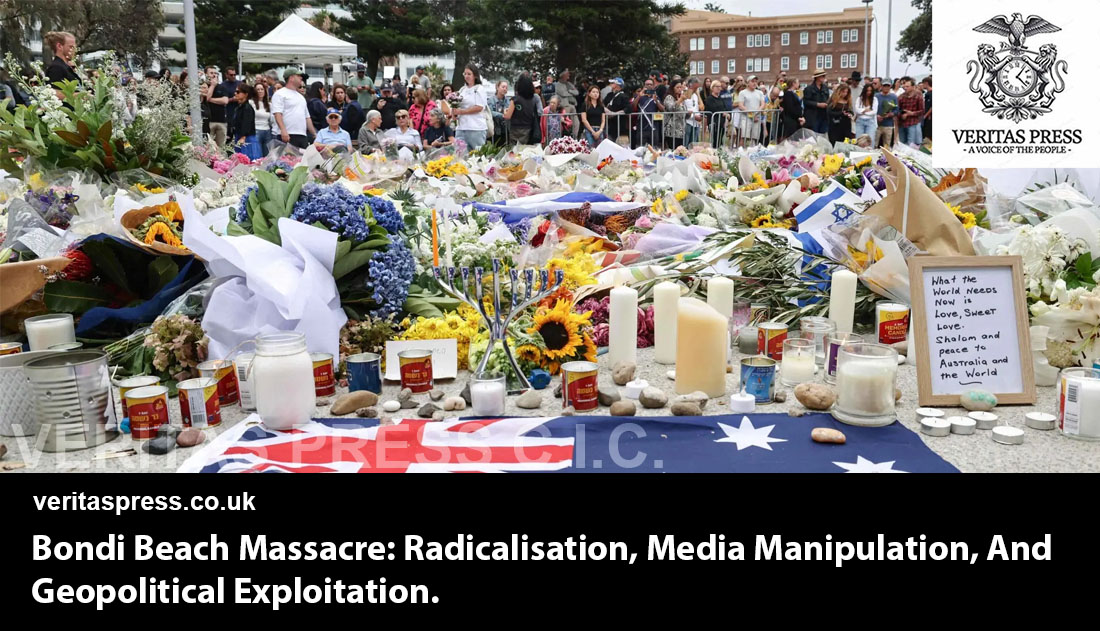
Floral tributes continue to grow outside Sydney’s Bondi Pavilion as Australia grapples with one of its deadliest mass shootings in modern history. Sixteen people, including a 10-year-old girl and a Holocaust survivor, were killed, and dozens more were wounded, when a father-and-son duo opened fire on a crowd gathered for a Hanukkah celebration at Bondi Beach on December 14, 2025.
The attack, which lasted roughly ten minutes, left the city in shock and raised urgent questions about intelligence oversight, gun licensing, the rise of extremist ideologies, and the politicisation of tragedy on a global scale.
Confirmed Identities And Travel History:
Australian authorities have confirmed that the elder gunman, Sajid Akram, was originally from Hyderabad, India, while his son, Naveed Akram, was born and raised in Australia. Sajid, 50, was shot dead by police at the scene, while Naveed, 24, remains in critical condition after being wounded during the confrontation.
Indian authorities have clarified that Sajid had limited contact with family in Hyderabad, had no criminal record before migrating to Australia in 1998, and visited India six times for family reasons. Telangana police stated that the factors behind the radicalisation of the two men “appear to have no connection with India or any local influence,” highlighting the transnational nature of their ideological radicalisation.
Investigations have revealed that the father and son spent nearly the entire month of November in the southern Philippines, arriving on November 1 in Davao and leaving on November 28. While the purpose of their trip remains unclear, Philippine authorities are investigating, noting that Islamic State-linked networks have historically operated in southern Mindanao, even if weakened after the 2017 Marawi siege.
Australian Federal Police (AFP) Commissioner Krissy Barrett stated that “early indications point to a terrorist attack inspired by Islamic State, allegedly committed by a father and son,” and emphasised that “these are the alleged actions of those who have aligned themselves with a terrorist organisation, not a religion.” Police also discovered improvised explosive devices and homemade ISIS flags in a vehicle registered to Naveed Akram.
Intelligence Oversight And Radicalisation:
Prime Minister Anthony Albanese confirmed that Naveed Akram had come to the attention of Australian intelligence in 2019 but was not considered an imminent threat at the time, after interviews with him, his family, and associates. The fact that he remained unsupervised despite earlier scrutiny raises questions about intelligence assessment protocols, monitoring of returning travellers, and predictive risk models in counterterrorism operations.
The Bondi Beach massacre starkly illustrates how transnational extremist networks such as the self-styled Islamic State continue to radicalise individuals across borders, exploiting online propaganda, identity crises, and global grievances. Groups like IS have long weaponised the persecution of Muslims, from the ongoing genocide in Gaza to past Western wars in Afghanistan and Iraq, to recruit followers and justify violence. Simultaneously, in non-Muslim societies, factors such as marginalisation, racism, social alienation, and surveillance can further push susceptible individuals toward extremist pathways.
Experts note that radicalisation often occurs through a combination of global ideological influence, local grievances, and online echo chambers. In this case, analysts suggest that transnational extremist networks and the circulation of IS propaganda online may have played a significant role, compounded by social isolation and personal marginalisation in Australia.
Memorials And Community Impact:
Bondi Beach, a major tourist destination 8.2 km from Sydney’s city centre, has become a site of mourning. Survivors and witnesses recount chaos and terror as people fled, hid, and sought shelter. Among the heroes of the day was Ahmed al Ahmed, a 43-year-old Muslim father of two, who charged one of the gunmen and seized his rifle before being shot. Al Ahmed remains hospitalised and has been widely lauded as a hero, with a GoFundMe campaign raising over A$1.9 million.
The victims’ diversity, from a rabbi and father of five to a 10-year-old child, underscores the indiscriminate nature of the attack. Israeli Ambassador Amir Maimon visited the site, urging the Australian government to protect Jewish communities and highlighting a series of antisemitic incidents over the past 16 months.
Gun Licensing And Regulatory Failures:
The attack has renewed debate over Australia’s gun laws. Sajid Akram was a licensed gun owner with six registered firearms, having obtained his licence in 2023, not 2015 as initially reported. Home Affairs Minister Tony Burke and former Prime Minister John Howard have called for a review, although Howard warned that gun law reform should not distract from the urgent need to tackle antisemitism and communal security.
Media Manipulation, Geopolitical Spin, And False-Flag Concerns:
Yet alongside the well-documented drivers of radicalisation, the aftermath of the Bondi attack has revealed a parallel and troubling phenomenon: the rapid politicisation and misrepresentation of facts by state-aligned actors and sections of the Western mainstream media.
Despite clear confirmations by Australian and Indian authorities that Sajid Akram was originally from Hyderabad, India, and that his son Naveed Akram was born and raised in Australia, claims have circulated in India, Israel, the United States, and Western media suggesting the attackers were of Pakistani origin. To date, no investigative agency has produced evidence linking the suspects to Pakistan, nor is there any indication that Pakistan played a role in their radicalisation or movements. Telangana police explicitly stated that the factors behind the attackers’ radicalisation “appear to have no connection with India or any local influence.”
Nevertheless, selective leaks, speculative commentary, and social-media amplification have contributed to a manufactured narrative that externalises blame, diverting attention from domestic intelligence failures, gaps in counterterrorism monitoring, and online radicalisation pathways within Western societies. Analysts warn that this narrative bears clear hallmarks of a false-flag strategy, designed not only to whip up anti-Muslim sentiment but also to push antisemitism, reinforcing prejudices and creating an atmosphere of communal fear. Despite the allegation of a coordinated false-flag operation, the speed and coordination of the Pakistan-linked and antisemitic narrative give rise to serious concerns about agenda-driven information warfare.
History shows that terrorist atrocities are often instrumentalised by state and media actors to advance unrelated geopolitical agendas, deflect domestic scrutiny, or manipulate public opinion. In the Bondi case, prematurely invoking Pakistan or linking the attack to Australia’s recognition of Palestine obscures the documented facts: the attackers’ identities, their movements between Australia and the Philippines, the presence of IS-linked symbolism, and failures in intelligence risk assessment and firearms regulation. Misattribution not only undermines justice but also endangers innocent communities, deepens regional tensions, and diverts attention from the actual mechanisms of radicalisation.
Crucially, such manipulation threatens to delegitimise legitimate political struggles, including the Palestinian liberation movement, by conflating them with terrorism. Israeli officials’ attempts to link the Bondi attack to Australia’s recognition of Palestine exemplify how tragedy is weaponised to silence criticism, reshape international narratives, and feed antisemitic prejudices.
Radicalisation And Global Context:
The Bondi attack exemplifies the transnational nature of modern extremism. Radical groups exploit conflicts in Muslim-majority regions, historical grievances, and Western foreign policy failures to inspire violence abroad. Simultaneously, social alienation, islamophobia, racism, and marginalisation in non-Muslim societies create fertile ground for extremist recruitment.
Experts argue that tackling these challenges requires:
- Robust counterterrorism coordination across borders
- Credible deradicalisation programmes
- Stronger firearms controls and monitoring of licensed owners
- Addressing structural injustices, unresolved conflicts, and global grievances exploited by extremist ideologies
Equally important is resisting fear-mongering and disinformation campaigns designed to inflame both anti-Muslim and antisemitic hatred, which only serve to empower extremists and far-right movements alike.
If hate, misinformation, and geopolitical opportunism are allowed to fracture societies, the real victors will be organisations like the Islamic State and far-right actors in the West who thrive on polarisation, scapegoating, and perpetual conflict.
Conclusion: Resisting Manipulation, Standing For Justice.
The Bondi Beach tragedy is more than a story of violent extremism; it is also a cautionary tale about how narratives can be manipulated to serve political agendas. Attempts to misrepresent the attackers’ origins, stoke anti-Muslim sentiment, and simultaneously push antisemitism bear the hallmarks of a false-flag strategy, aiming to inflame fear, polarise communities, and distract from the real lessons of this horror.
Australia, and the world, must resist the allure of simplified narratives and scapegoating. True security cannot be achieved by demonising entire communities or weaponising tragedy for geopolitical advantage. Instead, governments, media, and civil society must work together to:
- Confront extremism irrespective of religion, wherever it arises
- Ensure accurate and responsible reporting
- Strengthen social cohesion
- Address the underlying grievances that radicalisation exploits
Only by prioritising justice over hysteria, evidence over speculation, and unity over division can societies honour the victims of Bondi Beach and prevent future atrocities.
As Australia mourns the victims and examines the failures exposed by this tragedy, one question remains: how can societies confront the real drivers of extremism, prevent the manipulation of narratives for political gain, and ensure that justice and truth are not sacrificed to fear and prejudice?