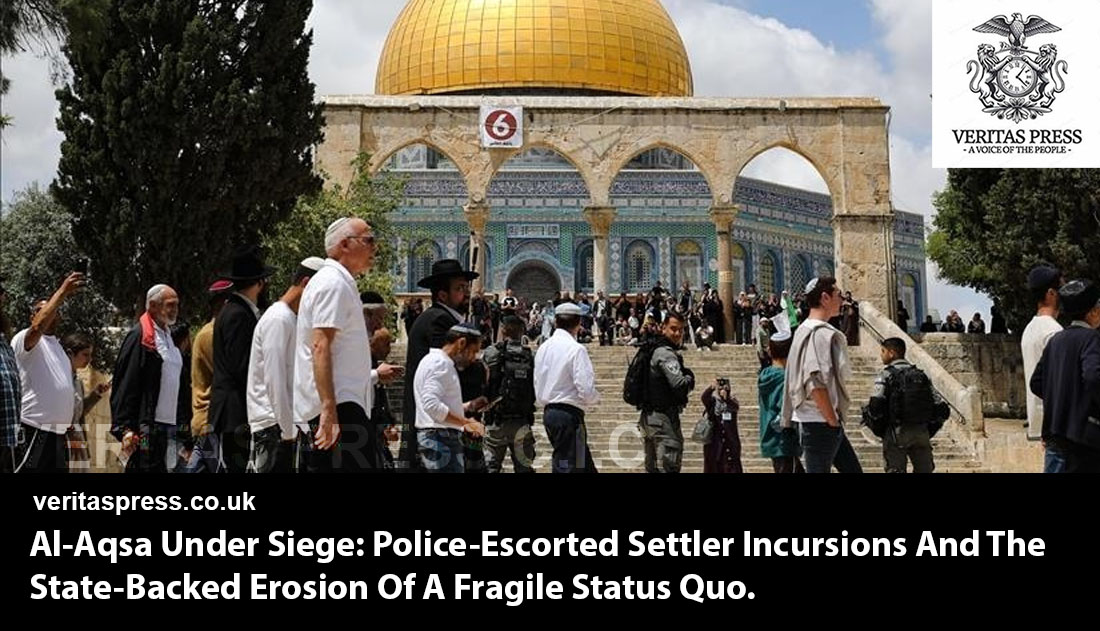

Title: Al-Aqsa Under Siege: Police-Escorted Settler Incursions And The State-Backed Erosion Of A Fragile Status Quo.
Press Release: Veritas Press C.I.C.
Author: Kamran Faqir
Article Date Published: 11 Dec 2025 at 13:05 GMT
Category: Middle-East | Palestine-Gaza-West Bank -OPT | Al-Aqsa Under Siege
Source(s): Veritas Press C.I.C. | Multi News Agencies
Website: www.veritaspress.co.uk

Business Ads

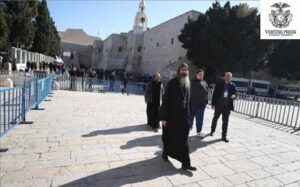
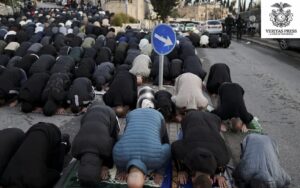
JERUSALEM: 11 December 2025. For the second week of December, as in dozens of weeks this year, groups of Israeli settlers entered the courtyards of the Al-Aqsa Mosque/Temple Mount compound under the protection of heavily armed police units. According to the Jerusalem Governorate, 182 settlers carried out “provocative tours” and performed Talmudic rituals near the Dome of the Rock, while 778 foreign tourists were ushered in through Israeli-controlled gates.
Palestinian institutions documented 4,266 settler entries in November, alongside nearly 15,000 tourists, a measurable escalation in a pattern many governments and rights bodies now describe as systematic.
This investigation examines what these incursions look like on the ground, how they are being enabled by state agencies, and why Palestinians and regional governments say a decades-old status quo is being deliberately dismantled in real time.
The Ground Reality: Escorted Incursions, Silenced Warnings.
Local reporting and Waqf officials describe a consistent pattern: settler groups, often mobilised by far-right religious-nationalist factions, enter the site in coordinated waves through police-controlled gates, especially the Moroccan Gate.
Video and eyewitness accounts show settlers chanting, chanting nationalist slogans, carrying Torah scrolls, waving flags, and performing ritual prostrations, acts Palestinians and Islamic authorities consider targeted provocations.
A senior Waqf official told WAFA:
“The site is subjected to daily violations by groups operating with full state backing. These are not religious visits; this is the methodical encroachment of a new reality.”
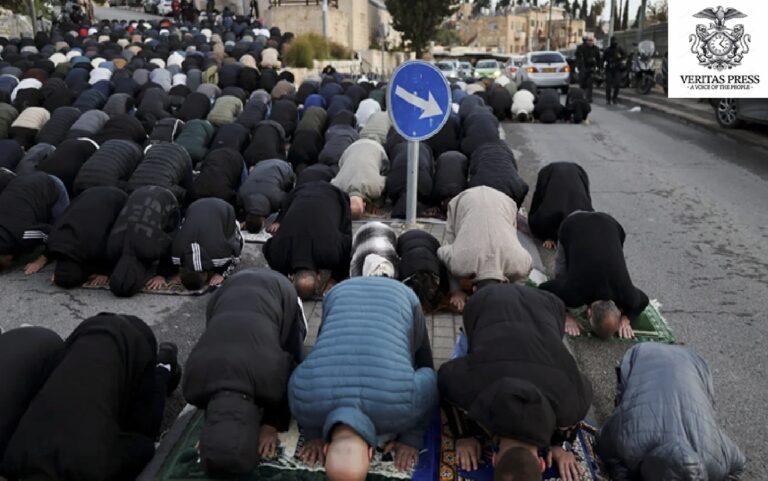
For Palestinians in and around the Old City, these incursions have become part of daily life, a physically enforced shift in space, access, and security, altering prayer patterns and heightening tensions.
Police Protection Or State Facilitation? The Impunity System:
Human Rights Watch and B’Tselem have documented dozens of episodes in which Israeli police shield settlers as they harass worshippers, disrupt prayers, damage property, or attempt forbidden rituals.
In many cases, police simultaneously block Palestinian entry or push Waqf guards aside to clear pathways for settler groups.
B’Tselem’s 2025 analysis states:
“Police do not act as neutral regulators. They routinely intervene on behalf of settlers and against Palestinians, creating a two-tier enforcement regime.”
HRW notes allegations by senior Israeli journalists that far-right ministers have informally instructed police not to interfere with settler actions, implying political direction rather than operational discretion.
Political Signals From Above: When Ministers Shift The Red Lines.
Far-right leaders have played a key role in amplifying settler presence.
National Security Minister Itamar Ben-Gvir has visited Al-Aqsa multiple times since taking office, often arriving with tactical units and publicly endorsing Jewish prayer on the site.
During a January incursion, broadcast by Israeli channels, Ben-Gvir declared:
“Jewish prayer on the Temple Mount is no longer a question. It is a reality.”
These signals matter: settler groups closely follow ministerial rhetoric, and each high-profile visit triggers spikes in ritual attempts and nationalist mobilisation.
A Jerusalem resident told The Guardian:
“The extremists do not want a two-state solution. They want the land without the people.”
Regional And International Alarm: Legal And Diplomatic Stakes.
Jordan, custodian of Muslim holy sites, has issued near-weekly condemnations. UNESCO warns of “irreversible heritage damage,” and OHCHR has repeatedly cited settler activity as a key contributor to rights violations and forced displacement across the occupied territories.
On 10 December, Israel approved hundreds of new settlement units in the West Bank, a decision Palestinians say aligns seamlessly with intensifying incursions at Al-Aqsa.
A diplomat from an Arab state said privately:
“Every move at Al-Aqsa has a corresponding move on the ground. The project is one: change control, change demography, change sovereignty.”
Voices From The Ground: Witnesses, Officials, Civil Society.
Islamic Waqf:
“A structured and escalating plan to take over religious landmarks.”
Jerusalem Governorate:
The December figures “prove an unprecedented expansion in settler activity under state protection.”
Local residents:
“Police protect them, not us. We pray under surveillance; they pray under armed escort.”
HRW / B’Tselem:
“The dual enforcement system constitutes discriminatory policing in violation of international humanitarian law.”
Israeli journalists (Haaretz, Channel 13):
Ben-Gvir’s policy shift is “normalising behaviour previously blocked by police for decades.”
Ritual As Territorial Claim: The Strategy Behind The Spectacle.
Legal experts note a clear strategic use of religious ritual:
normalise presence → normalise prayer → normalise sovereignty.
Ritual acts performed under armed escort, blowing the shofar, prostration, flag marches, become performances of ownership, gradually redefining space.
A senior analyst at Israel’s INSS notes:
“Once practice changes, law follows. The struggle at Al-Aqsa is over practice.”
The Legal Frame: Occupation, Annexation And Accountability Vacuums.
East Jerusalem is internationally recognised as occupied territory, and Israel’s 1980 annexation remains unrecognised.
Under occupation law, Israel must protect civilians and refrain from altering religious and cultural systems.
UN investigators have found that settler actions, enabled by state forces, may constitute elements of forcible transfer, yet accountability mechanisms remain weak.
OHCHR concluded in its 2025 report:
“State agents contribute to conditions enabling repeated violations, with almost no accountability.”
Investigative Red Flags: Missing Records, Missing Accountability.
Critical gaps warrant deeper journalistic investigation:
- Internal police directives on settler escorts remain sealed.
- The chain of command for large-scale deployments inside the compound is obscured.
- Prosecution rates for settler violence remain near zero.
- Settlement approvals and settler religious activism appear closely linked.
Mapping these connections is essential to understanding whether incursions are spontaneous or elements of coordinated state policy.
What Palestinians And Regional Actors Demand:
Regional governing bodies call for:
- Restoring the pre-2000 status quo
- Ending settler incursions
- Reopening all Waqf-administered gates
- Independent investigations of police conduct
- Halting settlement expansion linked to Al-Aqsa tensions
Rights groups demand conditionality on arms transfers and diplomatic engagement until Israel enforces equal protection and halts settler violations.
Conclusion: The Stakes Are Not Symbolic, They Are Existential.
Across Gaza, the West Bank, and Jerusalem, the patterns documented in this investigation reveal not isolated misconduct but a political architecture built on systemic dehumanisation, an architecture reinforced by the rhetoric of the very officials charged with maintaining international norms. Humanitarian agencies, rights organisations, and local witnesses all detail the same mechanisms: starvation as a weapon, movement restrictions that turn cities into cages, and military doctrines that collapse the distinction between civilian and combatant.
These outcomes do not occur in a vacuum. They are continuously legitimised by the words of Israeli politicians who openly describe Palestinians in exterminatory terms. Finance Minister Bezalel Smotrich’s declaration that “there are no Palestinians, only people who must be subdued,”National Security Minister Itamar Ben-Gvir’s repeated assertions that Palestinians are “terror supporters who must be expelled,” and senior lawmakers’ references to Gazans as “human animals” form the ideological scaffolding for policies now unfolding on the ground. Israeli media commentators often amplify this rhetoric, with several high-profile television analysts characterising mass displacement as a “necessary cleansing of the area” and describing starving families crowding aid trucks as “Hamas sympathisers exploiting humanitarian optics.”
International law experts interviewed for this investigation stress that such language is not mere provocation, but part of the evidentiary record of intent. “When ministers justify collective punishment using racialised language, they are not just expressing opinion, they are documenting mens rea,”one genocide scholar noted. This rhetoric also shapes the operational reality: the bombing of civilian infrastructure, the killing of children seeking food, and the bureaucratic sabotage of life-saving aid.
Local medical workers offer testimonies that expose how this dehumanisation translates into mass suffering. A nurse in Khan Younis told reporters, “When they call us ‘animals,’ this is what it looks like, children dying because someone decided they don’t need food.” Doctors from northern Gaza describe infants starving while Israeli officials mock international warnings. Ben-Gvir’s widely circulated claim that reports of famine are “fake news invented by Hamas and human rights groups” stands in stark contrast to photographic evidence, UN assessments, and the testimony of families burying children whose bodies weigh barely a few kilograms.
The logic of erasure extends far beyond Gaza. It now defines the rapidly escalating situation in Jerusalem, where the Al-Aqsa Mosque compound, a site whose sanctity and volatility are well-documented, is being transformed into a stage for ultra-nationalist provocation. Al-Aqsa is not only a sacred site; it is a geopolitical pressure point that has triggered regional conflict multiple times. Today’s numbers, thousands of settlers per month, steadily expanding ritual intrusions, indicate not random provocations but structural shifts in sovereignty on the ground. If left unchecked, the “new facts” being manufactured at Al-Aqsa may become irreversible, with profound consequences for law, heritage, and human life across the region.
Extremist Israeli activists openly celebrate these incursions as “steps toward full Jewish control,” while far-right commentators on Israeli television describe Muslim worshippers as a “demographic nuisance” obstructing the “restoration of Jewish sovereignty.” Government ministers, some of whom have participated in or endorsed these raids, frame them as “assertions of authority,” further inflaming tensions. Jerusalem researchers interviewed warn that these acts form part of a coordinated effort to spatially and legally fragment Palestinian presence in the city.
Diplomats across Europe and the Global South increasingly describe Western responses as a “managed hypocrisy” that protects strategic alliances at the expense of human life. Despite extensive documentation, satellite imagery, forensic investigations, leaked Israeli military testimonies, and field reporting, the governments with the greatest leverage continue to shield Israeli officials from accountability. As one European official admitted on the record, “We have all the evidence we need. What we lack is the political will to treat Palestinians as fully human.”
Meanwhile, Palestinian voices, those who endure the airstrikes, the hunger, the raids at prayer, continue to document the reality that state officials and sympathetic media seek to obscure. Their testimonies dismantle the narrative frameworks built to sanitise military violence and expose the racist logic underpinning policy decisions. These accounts now form an evidentiary archive that future tribunals cannot plausibly ignore.
Ultimately, what this investigation reveals is not a failure of the system but its ruthless efficiency: a global architecture that selectively applies international law, excuses incitement when voiced by allied governments, and treats Palestinian suffering as a geopolitical inconvenience rather than a humanitarian emergency. The steady escalation at Al-Aqsa, the starvation in Gaza, and the racialised political rhetoric driving both are not disconnected events. They are components of a single, expanding crisis.
The question that now confronts the international community is stark: How many more documented warnings, in ministers’ own words, in journalists’ footage, in doctors’ testimony, in satellite images of mass graves, will the world ignore before accountability becomes unavoidable? The answer will determine not only the fate of Gaza’s surviving children and Jerusalem’s sacred precincts, but whether international law retains any credibility in the century ahead.
Multiple regional analysts, diplomats, and religious authorities warn that the escalation at Al-Aqsa is not merely a domestic policing issue but part of what they describe as an emerging strategy by Israel’s far-right political and religious actors to provoke a wider sectarian confrontation. Senior officials in Jordan, Turkey, and Indonesia argue that the repeated settler incursions, combined with inflammatory statements by ministers like Itamar Ben-Gvir, who has called Muslim worshippers “invaders” and has publicly championed Jewish prayer inside the compound, appear designed to trigger a religious backlash that could shift the conflict from a political struggle over occupation into a region-wide holy war. Several Middle Eastern intelligence assessments shared with journalists describe these actions as “calculated provocations intended to draw Muslim states into an emotional rather than diplomatic response,” potentially providing Israel a pretext to escalate militarily while rallying domestic nationalist support. Leading scholars of religion and conflict echo these warnings, noting that fringe settler groups openly advocate for “the cleansing of the Mount” and the construction of a Third Temple, a demand they promote through coordinated media campaigns and on-the-ground provocations. As one Jordanian official put it in an on-record interview: “This is not security policy, this is an attempt by extremists in the Israeli government to set the entire Muslim world on fire.”