



Title: “A System Willing To Let Them Die”: Hunger Strikes, Medical Neglect, And Political Punishment In UK Prisons.
Press Release: Veritas Press C.I.C.
Author: Kamran Faqir
Article Date Published: 19 Dec 2025 at 13:25 GMT
Category: UK | Politics | “A System Willing To Let Them Die”: Hunger Strikes, Medical Neglect, And Political Punishment In UK Prisons.
Source(s): Veritas Press C.I.C. | Multi News Agencies
Website: www.veritaspress.co.uk

Business Ads


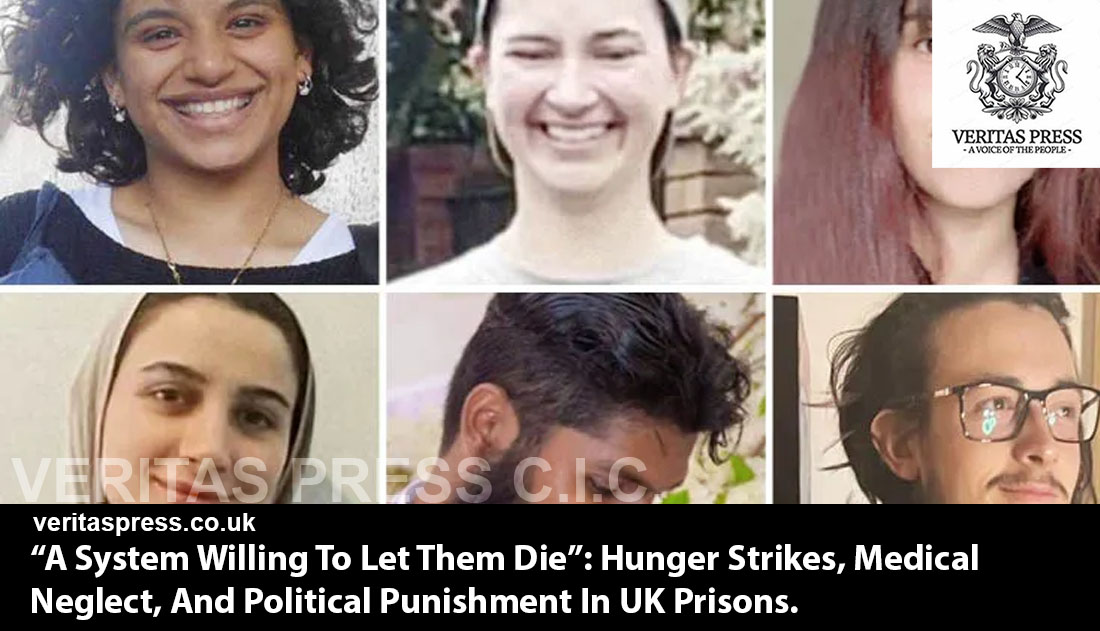
The unfolding medical emergency involving eight Palestine Action activists on hunger strike is no longer simply a question of prison healthcare. It has become a test case for how far the British state is willing to go in criminalising dissent, weaponising remand, and tolerating the risk of death to suppress politically inconvenient movements.

More than 800 medical professionals have now issued an unprecedented warning to the UK government that the prisoners, young, unconvicted, and dispersed across five prisons, are at imminent risk of organ failure and death. Their letter to Justice Secretary David Lammy is not cautious or speculative. It is explicit:
“Without resolution, there is a real and increasingly likely potential that young British citizens will die in prison, having never even been convicted of an offence.”
That warning places the government in direct conflict not only with medical ethics, but with its own legal obligations under Article 2 of the European Convention on Human Rights, which requires the state to actively protect life in custody when a foreseeable risk is clearly established.
Medical Consensus: This Is No Longer A Hunger Strike, It Is A Terminal Phase.

At a London press conference attended by MPs, lawyers, journalists, and family members, Dr James Smith, an NHS emergency physician and lecturer at University College London, rejected the government’s insistence that existing prison protocols are sufficient.
“We are not talking about routine hunger strike management anymore,” Smith said. “After six to seven weeks, the body enters a catastrophic phase. The heart muscle wastes, kidney filtration collapses, and neurological damage sets in. Death can occur suddenly.”
Smith, backed by hundreds of colleagues across emergency medicine, general practice, psychiatry and academic medicine, described substandard monitoring, inconsistent blood testing, and a lack of specialist oversight inside prison conditions he said would be unacceptable in any NHS hospital.
More than 200 members of the British Medical Association have separately raised alarms that prison healthcare staff are being placed in an impossible ethical position, forced to navigate security constraints while patients deteriorate into medical emergencies.
One consultant physician involved in drafting the doctors’ letter, speaking anonymously due to professional risk, was unequivocal:
“If this were happening outside prison walls, these patients would already be in high-dependency units. The refusal to hospitalise them is not a medical judgment, it’s a political one.”
Remand As Punishment: Detention Without Conviction, Without End.
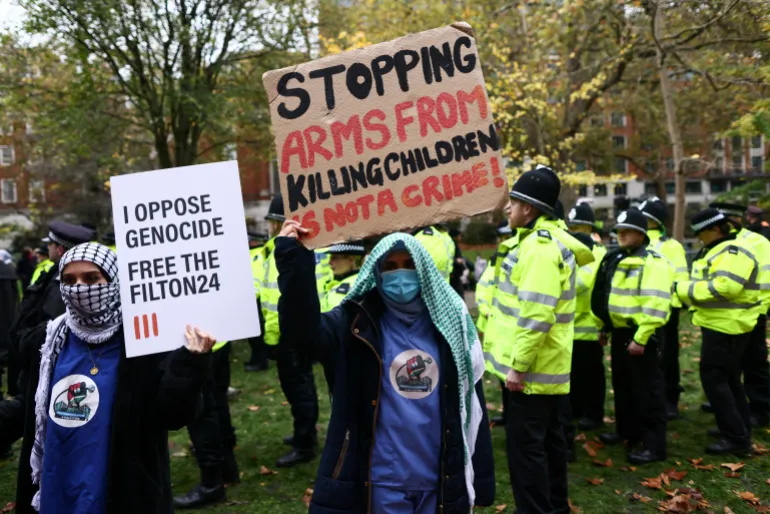
All eight hunger strikers are being held on remand, some facing trial dates more than two years away. Legal analysts argue that this transforms pre-trial detention into de facto punishment, particularly when combined with restrictive regimes, dispersal across prisons, and the routine denial of bail.
Daniel Lemberger Cooper, the solicitor representing the group, has repeatedly stressed that requests to meet Lammy are not about influencing criminal proceedings, but about preventing deaths.
“We are trying to stop our clients dying in custody,” he said. “The refusal to even meet is extraordinary, and deeply alarming.”
Human rights organisations, including Liberty and Amnesty International UK, have warned that prolonged detention of unconvicted activists under terrorism-adjacent legislation risks normalising exceptional measures against political protest.
A legal briefing circulated by rights advocates notes that the charges relate primarily to alleged property damage and trespass, yet the defendants are being treated within a security framework designed for violent extremism, a mismatch critics say reveals the political nature of the case.
The Proscription Question: Criminalising Solidarity.
The hunger strikes cannot be separated from the July 2024 proscription of Palestine Action, which placed the group in the same legal category as armed organisations such as ISIL.
Palestine Action argues the ban was designed to shield British arms firms from public scrutiny, particularly Elbit Systems, Israel’s largest weapons manufacturer and a major supplier to the Israeli military during its assault on Gaza.
Investigative journalists have documented how Elbit equipment has been used in drone strikes, surveillance systems, and targeting technologies repeatedly criticised by the UN and international human rights groups. Yet while arms exports continue with government approval, activists targeting Elbit facilities in the UK now face terrorism-related consequences.
As one defence analyst told an independent outlet:
“The state has effectively inverted the moral framework those protesting potential war crimes are treated as extremists, while those profiting from them receive government protection.”
Families Describe Dehumanisation And Psychological Pressure:
Relatives of the hunger strikers describe a pattern of verbal abuse, isolation, and psychological intimidation inside prison walls.
Rahma Hoxha, sister of Teuta Hoxha, says guards have labelled her sister a “terrorist” despite her being untried.
“She feels like she’s being punished for her politics,” Rahma said. “It’s as if they want her to disappear quietly.”
Families also report that hospital transfers frequently cut off all communication, forcing some detainees to discharge themselves against medical advice simply to reassure loved ones, an act doctors say dramatically increases the risk of sudden death.
Shahmina Alam, sister of hunger striker Kamran Ahmed, described watching her brother’s condition deteriorate in real time:
“He’s losing half a kilo a day. His heart rate is slowing. We are living phone call to phone call.”
Government Response: Procedure Over Life.
The government’s response has been strikingly narrow. Lord Timpson, the prisons minister, has repeatedly insisted that hunger strikes are common and that procedures are “well-established.”
Campaigners argue this framing deliberately obscures scale, intent, and consequence.
“This is not a solitary prisoner refusing food,” said a spokesperson for Medical Justice, a charity monitoring healthcare in detention. “This is a coordinated protest involving young people willing to risk death because every other avenue has been closed.”
The refusal by David Lammy to meet lawyers, despite pressure from 51 MPs and peers, including members of his own party, has intensified criticism that political considerations are overriding humanitarian duty.
Former Labour leader Jeremy Corbyn warned:
“If a death occurs, the responsibility will not be abstract. It will lie with those who had the power to intervene and chose not to.”
Political Deniability As Strategy:
Lammy’s repeated insistence that “rules and procedures” are being followed has drawn sharp criticism from legal observers, who describe the stance as strategic non-engagement designed to preserve political deniability.
A senior prison law barrister told reporters:
“Ministers are choosing not to know enough to be responsible. That is not neutrality, it’s risk management.”
Human rights group INQUEST has warned that reliance on procedural language in the face of explicit medical warnings may expose the government to serious legal liability should deaths occur.
A Dangerous Precedent:
Journalists covering the case have increasingly drawn parallels with historic hunger strikes, including the 1981 Irish Republican hunger strikes, where state intransigence culminated in preventable deaths.
A senior political correspondent wrote this week:
“The government appears to believe that acknowledging the hunger strikers would legitimise their cause. History suggests the opposite, that silence hardens resolve and escalates tragedy.”
Former Guantánamo detainee Mansoor Adayfi, now on hunger strike in solidarity, framed the situation starkly:
“Hunger strikes are not about spectacle. They are what happens when a system refuses to listen. I know this because I lived it.”
A Line The State Is About To Cross:
Medical experts agree that the coming days represent the most lethal phase of prolonged starvation. Every refusal to intervene increases the risk of sudden, irreversible death.
What is unfolding inside Britain’s prisons, doctors warn, is not merely a healthcare failure but a political experiment: testing whether the state can contain dissent through attrition, even if that means young, unconvicted people die behind bars.
As one emergency physician put it bluntly:
“If these prisoners die, it won’t be because hunger strikes are dangerous. It will be because the government chose procedure over life.”
The question now confronting the UK is no longer whether rules are being followed, but whether those rules have become instruments of lethal silence.
Conclusion: When Procedure Masks Power, And Power Serves Others.
What is unfolding inside Britain’s prisons is not a tragic oversight, nor an unavoidable consequence of hunger strikes. It is the foreseeable outcome of political decisions taken in full knowledge of their consequences.
The British government has been warned, repeatedly, explicitly, and in writing warned by hundreds of medical professionals that eight young, unconvicted prisoners are entering the most lethal phase of prolonged starvation. Doctors have described the mechanisms of organ failure in clinical detail. Families have documented collapse, confusion, and terror. Lawyers have sought meetings not to influence trials, but to prevent deaths. MPs across party lines have intervened. Journalists have traced the deterioration in real time.
At this stage, ignorance is no longer credible.
Yet what the government has chosen is not merely procedural distance, but something more revealing: political subservience dressed as neutrality. The invocation of “rules and processes” functions not simply as bureaucratic insulation, but as a mechanism for protecting strategic interests, particularly Britain’s alignment with foreign military partners and arms manufacturers implicated in Israel’s assault on Gaza.
The hunger strikers are not random detainees. They are being punished for targeting Elbit Systems, Israel’s largest weapons manufacturer, a company deeply embedded in the UK defence economy and closely linked to Israel’s military operations, operations that have been widely accused by UN bodies, legal experts, and humanitarian organisations of constituting war crimes and crimes against humanity.
In this context, the refusal to intervene is not politically neutral. It reflects a hierarchy of value in which diplomatic alliances, arms contracts, and geopolitical loyalty outweigh the lives of young citizens who challenge them.
The use of remand as a punitive tool, the stretching of terrorism legislation to encompass non-violent direct action, and the suppression of protest through attrition together point to a state apparatus increasingly willing to sacrifice civil and human rights to maintain alignment with foreign power.
As one legal analyst observed:
“This is not just about domestic repression. It’s about protecting international relationships by making an example of those who expose their moral cost.”
History leaves little room for ambiguity. Hunger strikes become fatal not because governments lack alternatives, but because they refuse to concede legitimacy to dissent that threatens entrenched power structures. Silence, in such cases, is not a restraint; it is escalation by omission.
Should any of these prisoners die, responsibility will not lie with abstract systems or faceless institutions. It will rest with named officials who possessed both the authority to intervene and incontrovertible evidence that intervention was urgently required, and who chose instead to defer to procedure, politics, and foreign alignment.
The question confronting Britain now is not whether it can maintain order, but whose interests that order serves.
If the state is willing to allow unconvicted citizens to die in custody to preserve arms relationships and geopolitical standing, then what is being tested inside Britain’s prisons is not the resilience of hunger strikers, but the moral sovereignty of the British state itself.
And once that sovereignty is ceded, the damage will not end at the prison gates.