






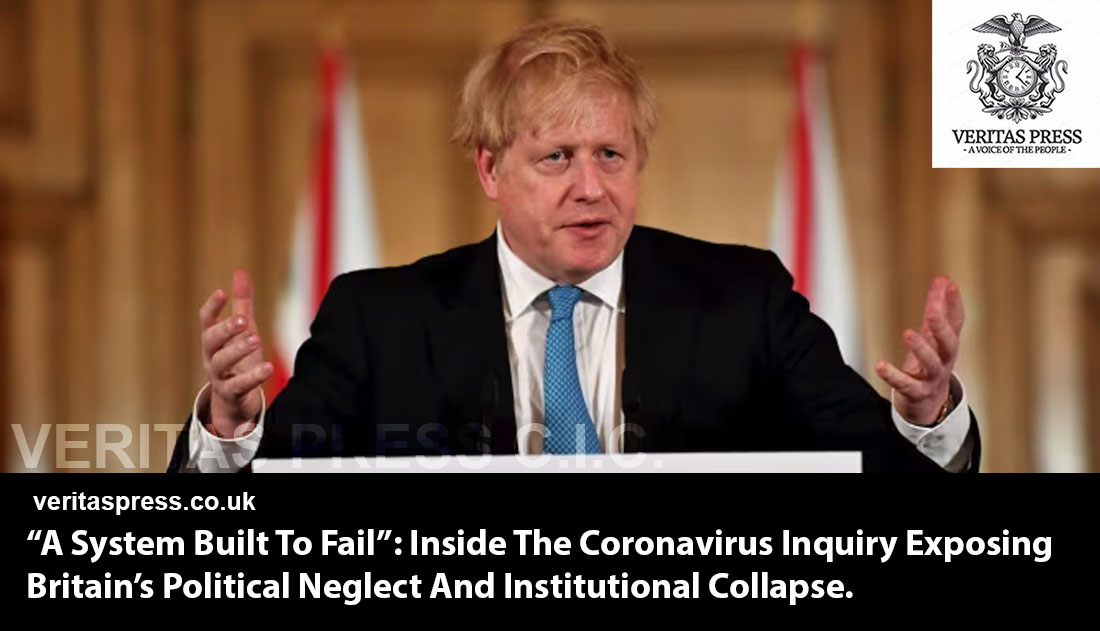

Title: “A System Built To Fail”: Inside The Coronavirus Inquiry Exposing Britain’s Political Neglect And Institutional Collapse.
Press Release: Veritas Press C.I.C.
Author: Kamran Faqir
Article Date Published: 20 Nov 2025 at 19:38 GMT
Category: UK | Politics | Inside The Coronavirus Inquiry Exposing Britain’s Political Neglect
Source(s): Veritas Press C.I.C. | Multi News Agencies
Website: www.veritaspress.co.uk

Business Ads

An Investigative Feature on Political Neglect, Structural Decay, and the Public Paying the Price
When the enquiry commission convened its final hearing last month, its chair, retired High Court judge Dame Eleanor Whitcombe, delivered a stark warning rarely heard in such formal settings: “What we are looking at is not a one-off failure, but a systemic pattern produced by political decisions, organisational decay, and deliberate underinvestment.”
Across weeks of testimony, the commission heard from frontline workers, union representatives, analysts, and ordinary residents. Each witness described not merely an isolated lapse but a cumulative collapse, one that had been years in the making, and which successive governments, Labour and Conservative alike, helped engineer.
I. Years of Political Neglect and the Manufactured Crisis
The commission’s interim report traces today’s crisis to a decade of austerity-driven restructuring that hollowed out essential services.
According to public administration analyst Dr. Marcia Ellwood, whose expert testimony shaped much of the enquiry’s analytical framework:
“You can draw a straight line from deliberate political underfunding to the breakdown we’re seeing now. This is not bureaucratic misfortune, it’s political architecture.”
While Conservatives imposed the heaviest cuts, the enquiry pointed out that Labour-run councils often implemented them without resistance. One senior civil servant told commissioners, under protected anonymity, that:
“Councils were placed in an impossible position. But it’s also true that many Labour authorities complied quietly in order to preserve their relationship with Whitehall.”
That quiet compliance, activists argue, is part of the problem. UNISON organisers testified that even when councillors claimed to oppose austerity, they frequently adopted the same outsourcing models promoted by Tory ministers.
As Nasreen Malik, a community activist from Birmingham, told the panel:
“We’re living with the consequences of both parties pretending they have no choice. But they always had a choice; they just refused to confront Westminster.”
II. Institutional Failure at Every Level
The commission highlighted several structural failures:
1. Outsourcing Without Oversight
Evidence from investigative journalists at The Sentinel revealed that private contractors repeatedly breached performance standards while still securing contract renewals. A leaked internal audit, entered into evidence by the commission, showed that one contractor failed to meet its service obligations 47 times in a single quarter, but the council imposed no penalties.
2. Management Suppressing Whistleblowers
Multiple employees testified that attempts to report wrongdoing were ignored or punished. A frontline worker told commissioners:
“Supervisors would say, ‘Don’t put this in writing.’ If we raised concerns publicly, we were accused of being ‘political’ or ‘against the council.’”
3. A Culture of Political Evasion
When questioned, senior executives repeatedly deflected responsibility. One commissioner privately described their testimony as “an exercise in reputational self-preservation masquerading as accountability.”
A media analysis submitted by PressWatch UK noted that council leaders often invoked “government pressure” while simultaneously defending the very systems that were failing residents.
III. The Human Cost: Public Anger and Unfiltered Testimony
Residents’ testimonies were often emotional, sometimes furious, and formed the heart of the hearings.
A mother from Handsworth described weeks without access to basic services:
“People talk about inefficiency like it’s abstract. It’s not. It means my kids are getting sick, it means elderly neighbours can’t cope. We’re treated like we don’t matter.”
One elderly resident bluntly told commissioners:
“We pay taxes, we follow the rules, and we’re told to be patient while the system collapses around us.”
Journalists covering the hearings noted a striking theme: a collapse of public trust not just in one institution, but in the entire political structure that allowed the crisis to happen.
IV. Labour vs. Tory: A Manufactured Divide
While national political narratives cast the crisis as the inevitable result of Conservative austerity, activists and experts emphasised that Labour authorities were not merely victims of Tory policy.
Public policy researcher Dr. Amrit Dutta testified:
“The Conservative project imposed structural harm, but Labour councils operationalised it. The crisis emerges from a bipartisan refusal to challenge centralised fiscal control.”
One union representative encapsulated the dual culpability:
“The Tories built the cage. Labour Councils locked the door.”
The commission also cited internal correspondence showing that local leaders lobbied privately for more flexibility but never mounted a public challenge to government-imposed constraints, a decision that, journalists argued, prioritised party unity over public welfare.
V. “Chronic Underfunding Is a Political Choice”: Organisations Weigh In
Several organisations submitted written evidence:
• The Institute for Public Policy Research (IPPR)
Warned that institutional collapse would become “structural and permanent” without a “radical reversal” of centralised austerity models.
• The Joseph Rowntree Foundation
Told commissioners that impoverished communities were being “systematically exposed to heightened risk” because of delayed service provision.
• Transparency International UK
Pointed to opaque procurement practices that “create fertile ground for corruption and political favouritism.”
• Local Democracy Reporters (LDRS)
Provided case studies showing that public complaints rose by 40–60% while response rates plummeted.
VI. Where Accountability Ends, and Excuses Begin
A recurring pattern emerged:
- Officials blamed funding constraints.
- Councillors blamed Westminster.
- Ministers blamed “legacy issues.”
- Contractors blamed “unexpected pressures.”
At no point did any institution fully acknowledge its role.
One commissioner summarised the state of affairs in a leaked closed-session note published by The Herald:
“The political class has normalised decline, preferring managed deterioration to radical reform.”
Conclusion: A Crisis Foretold, and Still Avoided
The Coronavirus Inquiry’s findings do not simply catalogue past mistakes, they expose the architecture of a political system that failed long before the virus arrived on British shores. What Baroness Hallett has laid out is not merely a timeline of misjudgments, but a portrait of a state hollowed out by years of austerity, managerial drift, and a political culture that placed messaging above reality, optics above preparation, and loyalty above competence.
The Conservative governments of 2010–2024 emerge as the most direct architects of this disaster: a decade spent stripping local authorities of resilience capacity; sidelining pandemic preparedness; starving the NHS of surge capability; and elevating political advisers whose main qualification was ideological zeal rather than crisis management competence. The inquiry’s hearings revealed, in painful detail, a Downing Street where misogyny, factionalism, and a fetish for contrarianism overrode the warnings of scientists and frontline officials. Decisions that cost tens of thousands of lives were shaped not only by failure, but by a worldview that regarded caution as weakness and expertise as inconvenience.
But Labour does not escape scrutiny. The inquiry makes clear that, even today, under a Labour government, the conditions that allowed early 2020 to unfold remain largely unchanged: fragmented governance, an overstretched health service, and a Whitehall machinery still allergic to transparency. Starmer’s promises of reform sound measured, but bereaved families and public health experts have noted that the political appetite for confronting the structural rot, from centralised emergency powers to the privatised infrastructure of public health delivery, remains limited. The question is not simply whether Labour will learn the lessons, but whether it is willing to challenge a system it now presides over.
Institutionally, the inquiry exposes a British state that cannot decide, cannot coordinate, and cannot communicate. SAGE was reduced to a political football. Devolved governments operated on separate tracks without a coherent national strategy. Ministers issued slogans instead of instructions. Disabled communities were left in the dark, literally, without accessible communications for months. The very machinery designed to protect the public became another casualty of political short-termism.
In its preliminary findings, the commission warned that unless there is structural reform, the failures will not only continue but deepen. The report states:
“This is a systemic breakdown, not an isolated malfunction. Responsibility lies across successive governments, public bodies, and corporate partners. The public is bearing the full weight of institutional failure.”
For many observers, the crisis represents the end of Britain’s long experiment with austerity-driven public management, but the political establishment, Labour and Tory alike, remains unwilling to admit it. As Dame Whitcombe concluded:
“We cannot fix a system if those with power refuse to recognise how they broke it.”
This is why the inquiry matters: it forces a reckoning not with the virus, but with the political settlement that shaped the UK’s vulnerability. The “lost month” of February 2020 was not an accident. It was the logical endpoint of a governance culture built on deregulation, cost-cutting, and a belief that crises could be managed through improvisation and spin. It was a failure rooted in ideology as much as incompetence.
Whether anything changes now will depend not on the eloquence of the inquiry’s recommendations but on the political will to confront a decade-long pattern of institutional decay. The danger, as several experts and bereaved families warned in the hearings, is that Britain will memorialise Covid-19 without reforming the state that failed to protect its people. If left unaddressed, the next crisis will not wait politely for Westminster to catch up, and once again, the public will pay the price for failures that were never inevitable, only politically engineered.

















Hi http://veritaspress.co.uk,
I specialize in creating clean, responsive website designs that help businesses make a strong first impression online. If you can share your website link, I’ll take a quick look and suggest how it can be improved for better engagement and results.
Can I share a few design suggestions for your site? Please share you’r Website Link and Whatsapp Number.
Thank You,
Deepa
Hi http://veritaspress.co.uk,
We create modern, user-friendly websites that help brands stand out and attract more customers. Our focus is on design, performance, and user experience — so your visitors stay longer and take action.
Can I share a few design suggestions for your site? Please share you’r Website Link and Whatsapp Number.
Thank You,
anaya
Hello http://veritaspress.co.uk,
I wanted to reach out to see if you’re open to exploring ways to grow your website traffic and boost online performance.
We offer customized SEO services that deliver measurable improvements.
Once you share your target keywords and target market, I’ll send a full proposal.
Best Regards,
Sonam
Hi http://veritaspress.co.uk,
I had a quick look at your website and noticed that it’s not getting the Google visibility it deserves.
In most cases, traffic is lost due to:
1.Keywords not aligned with search intent
2.Technical SEO issues
3.Pages not being indexed or structured properly
I work with businesses to fix these problems and improve organic reach.
Would you be open to a SEO check or a short 10-minute call to discuss this?
Warm regards,
Sonam
Hello veritaspress.co.uk,
Is your website not getting the traffic or leads it deserves?
Would you like to receive more details?
Well wishes,
Terry Fowler| Digital Marketing Manager
Note: – If you’re not Interested in our Services, send us “No”