Kamran Faqir is a volunteer investigative journalist and writer committed to exposing hidden truths and amplifying underreported stories. Driven by social justice, he brings sharp insight and fearless truth-telling to independent journalism. NUJ registered.
Original Article Date Published:
Article Date Modified:
Listen to this article
Help support our mission—donate today and be the change. Every contribution goes directly toward driving real impact for the cause we believe in.
Around 1,200 prominent Israeli public figures, including Nobel Prize laureates, retired judges, former military chiefs, and senior legal officials, have issued a powerful public rebuke of a controversial bill before the Israeli parliament that would reinstate the death penalty specifically for Palestinian prisoners accused of killing Israelis. The statement, published on 17 February 2026, described the proposal as a “moral stain” that contradicts Israel’s identity as a Jewish and democratic state, raising alarm across legal, civil society, and international sectors.
Critics argue that the bill is not an isolated legal measure; it is part of a broader strategy by the Israeli government to legalise annexation and systematically eliminate Palestinian claims to identity, sovereignty, land, and civilisation. By embedding extreme punitive measures within the legal system, the state is attempting to institutionalise the erasure of Palestinian existence under the guise of criminal justice.
Elite Opposition United Across Society:
The statement against the death penalty was signed by leaders across Israeli society:
Nobel laureates in Chemistry: Ada Yonath, Aharon Ciechanover, Avram Hershko, and Dan Shechtman
Former Supreme Court justices: Meni Mazuz, Yoram Danziger, Anat Baron, and George Kara
Senior ex-security officials: Shin Bet chiefs Ami Ayalon and Carmi Gillon, former Mossad chief Tamir Pardo
Ex-IDF chiefs of staff: Dan Halutz and Moshe Ya’alon, and former Prime Minister Ehud Olmert
Academia and judiciary: dozens of judges, prosecutors, university presidents, and senior academics
The collective statement warns that reinstating executions would undermine human rights, due process, and Israel’s own democratic and moral values. Experts also highlighted that the supposed deterrence effect of the death penalty is unsupported by research, and that irreversible executions carry acute risks of judicial error, especially in military courts overseeing Palestinians.
What The Bill Would Do:
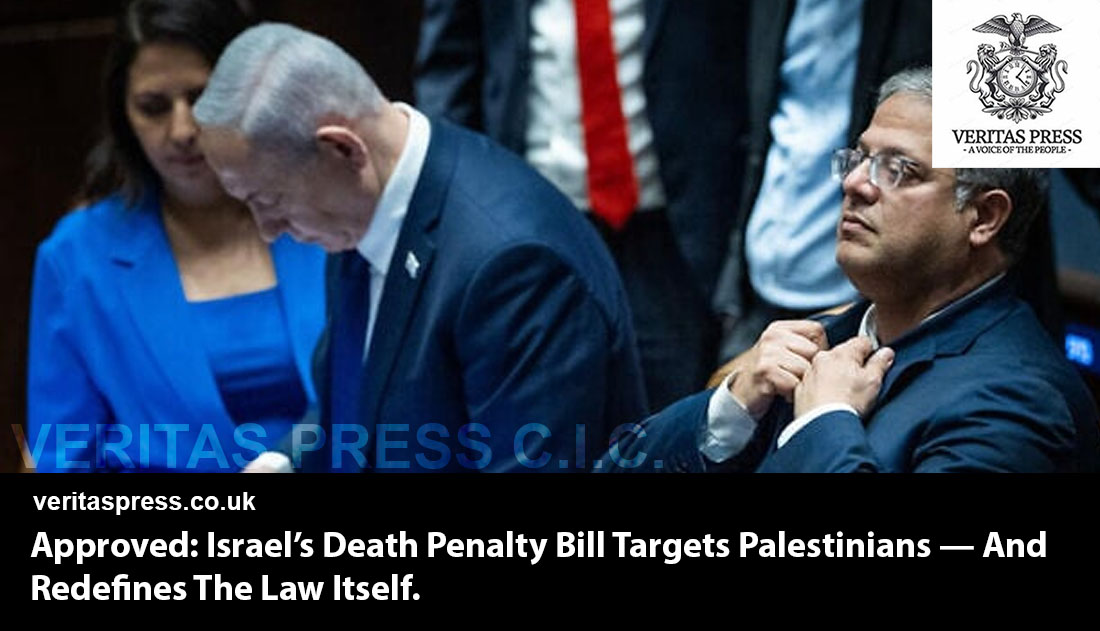
The legislation, advanced by National Security Minister Itamar Ben‑Gvir’s far-right Otzma Yehudit party, would impose the death penalty exclusively on Palestinians (and others under military jurisdiction) convicted of murder or “terrorism-related killings,” while Israeli citizens committing comparable acts would remain exempt.
Key features include:
Mandatory execution within 90 days, minimising appeals,
Expanded jurisdiction for military courts across the West Bank,
Removal of procedural safeguards, including discretion for mitigation or judicial review.
The bill passed its first reading in November 2025, with 39 votes in favour and 16 against. It now awaits second and third readings, with no dates scheduled, leaving Palestinians under the shadow of potential execution while the legislative process drags on.
Prison Service Preparing For Execution Regime:
Hebrew media report that the Israel Prison Service (IPS) is actively preparing for possible executions, planning a facility informally called the “Israeli Green Corridor” or “Green Mile.” Preparations reportedly include:
Constructing a dedicated execution complex,
Training personnel in execution protocols,
Studying capital punishment procedures abroad,
Planning executions by hanging or other methods once final sentences are issued.
These preparations, occurring before the law’s final passage, suggest a premeditated normalisation of state-sanctioned killings, signalling that this legislation is part of a broader political agenda rather than a purely judicial measure.
Domestic And International Backlash: Legal And Human Rights Objections.
Israeli legal experts and human rights advocates warn that the bill:
Discriminates explicitly on nationality and ethnicity,
Undermines due process by restricting appeals,
Constitutes arbitrary punishment prohibited under international law.
Veteran security officials also warn that capital punishment does not deter attacks. Selectively executing Palestinians could escalate radicalisation and retaliatory violence, destabilising Israel’s own security.
UN Experts And International NGOS:
UN human rights experts have urged Israel to withdraw the bill, emphasising that mandatory executions violate the right to life and fair trial guarantees, disproportionately targeting Palestinians. Amnesty International and other NGOs warn that reinstating the death penalty would entrench discrimination, isolate Israel from the international community, and reverse decades of global progress against capital punishment.
Palestinian Authorities And Human Rights Organisations:
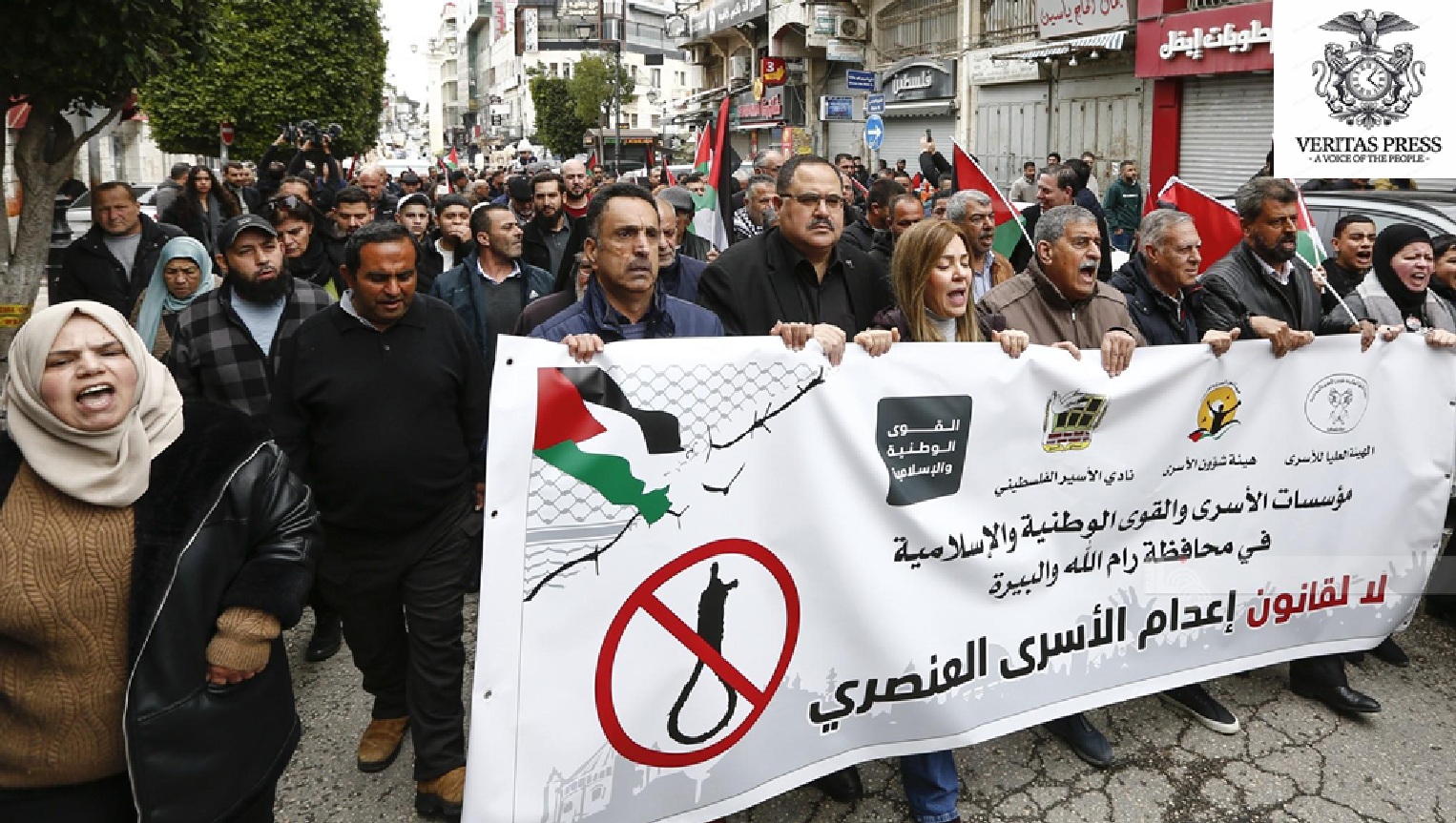
The Palestinian Ministry of Foreign Affairs has labelled the legislation a war crime, arguing that executing detainees under military jurisdiction represents “a new manifestation of growing extremism and criminality.” Palestinian rights groups have called for UN intervention, framing the law as part of systemic abuses, mass detention, and erasure of Palestinian legal protections.
Political And Ethical Faultlines Within Israel:
The bill has revealed deep divisions in Israeli society:
Far-right supporters frame it as a deterrent and tool of justice after the 7 October 2023 assault,
Critics see it as a dangerous regression that undermines democracy, law, and Israel’s international credibility.
Analysts emphasise that militarised justice and selective executions are being used as legal instruments of annexation and control, embedding ethnic and political domination into Israel’s legal system.
Broader Human Rights Context:
The death penalty proposal arises amid documented systemic abuses against Palestinian detainees, including deaths in custody, medical neglect, and restricted procedural rights. Critics argue that the bill would formalise extrajudicial violence under the guise of law, signalling a broader strategy to erase Palestinian identity, sovereignty, and claims to land.
This move is part of a continuum of policies that include military occupation, settler expansion, and legal reforms that systematically deprive Palestinians of political, social, and cultural rights, reinforcing a regime where Palestinians are treated as a subjugated population.
Investigative Analysis: Death Penalty As Annexation Tool.
Ethnic and Political Instrumentalisation: By targeting Palestinians exclusively, the law transforms justice into a tool for political domination, effectively criminalising existence.
Legalisation of Annexation: Combined with military courts and occupation policies, the bill reinforces Israel’s ability to impose sovereignty unilaterally over Palestinian land and people, undermining international law and Palestinian claims.
Erosion of Democracy and Human Rights: Mandatory executions, compressed appeals, and procedural shortcuts mark a departure from democratic legal norms, turning Israel’s justice system into an instrument of selective oppression.
Normalisation of State Violence: IPS preparations for executions indicate that lethal punishment is being institutionalised and ritualised, aligning the state apparatus with extreme punitive policies.
Symbolic Erasure of Palestinian Civilisation: The law sends a clear message: Palestinian identity, history, and claims to justice are subordinate to Israeli state priorities, integrating punitive measures into a broader strategy of cultural and political elimination.
Conclusion: A Flashpoint Of Law, Ethics, And Occupation.
The proposed death penalty bill is more than a legal measure; it is part of a deliberate strategy to consolidate annexation and suppress Palestinian existence. It signals a fundamental reshaping of Israeli governance, where the state’s monopoly on violence, the legal system, and military occupation converge to erode Palestinian sovereignty, identity, and civil protections.
With elite opposition mounting, international scrutiny intensifying, and prison systems already preparing for executions, this legislation represents a historic test of Israel’s democratic principles, human rights obligations, and the future of Palestinian life and rights.
Kamran Faqir is a volunteer investigative journalist and writer committed to exposing hidden truths and amplifying underreported stories. Driven by social justice, he brings sharp insight and fearless truth-telling to independent journalism. NUJ registered.
SEATTLE, TEHRAN — The U.S. Department of Homeland Security (DHS) will allow Iran’s national football team to enter the country 48 hours before their critical World Cup match against Egypt on Friday, a modest concession in a tournament where Team Melli’s travel conditions have sparked claims of oppression and competitive disadvantage.