Kamran Faqir is a volunteer investigative journalist and writer committed to exposing hidden truths and amplifying underreported stories. Driven by social justice, he brings sharp insight and fearless truth-telling to independent journalism. NUJ registered.
Original Article Date Published:
Article Date Modified:
Listen to this article
Help Support our mission—donate today and be the change. Every contribution goes directly toward driving real impact for the cause we believe in.
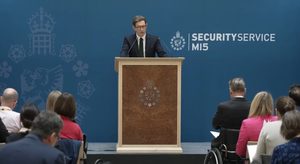
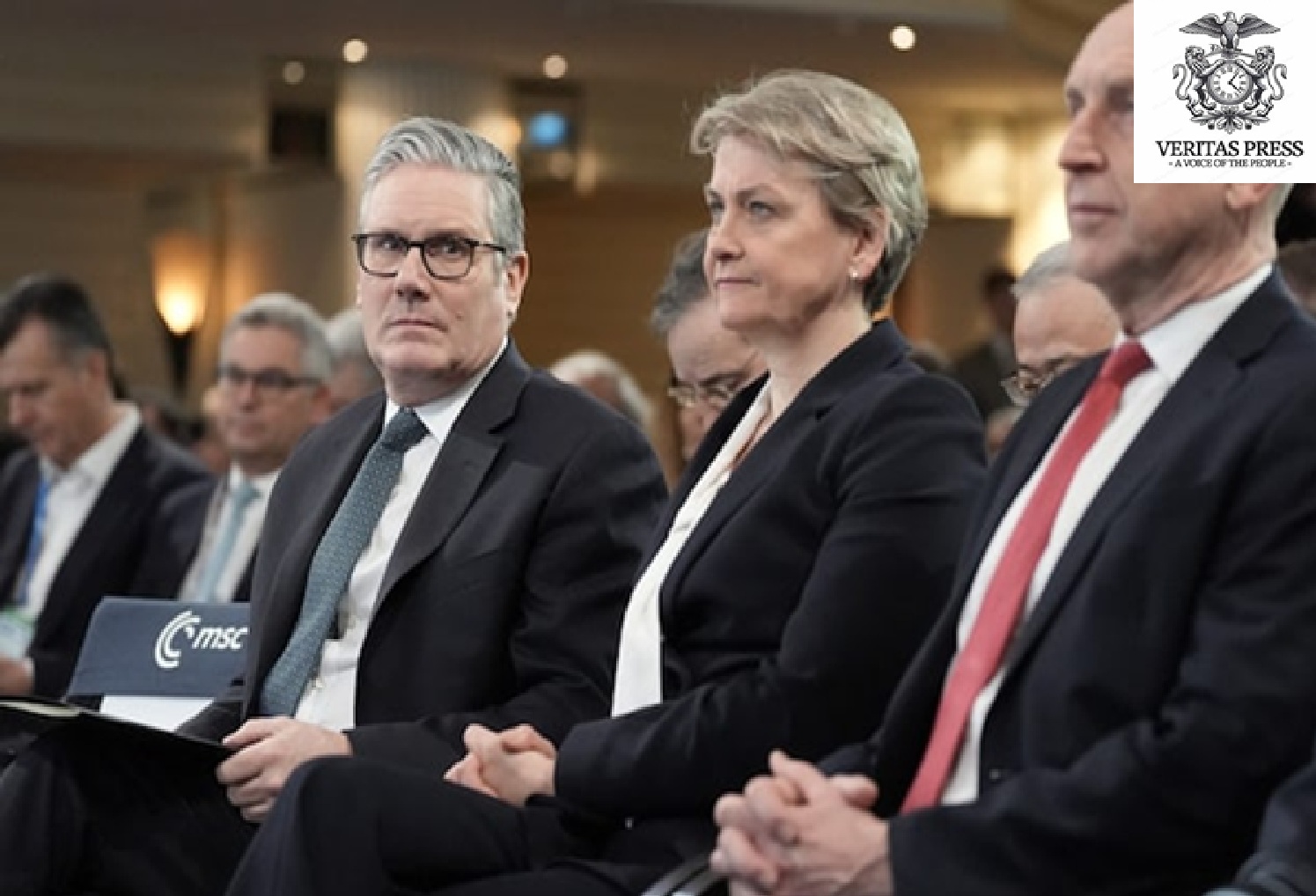
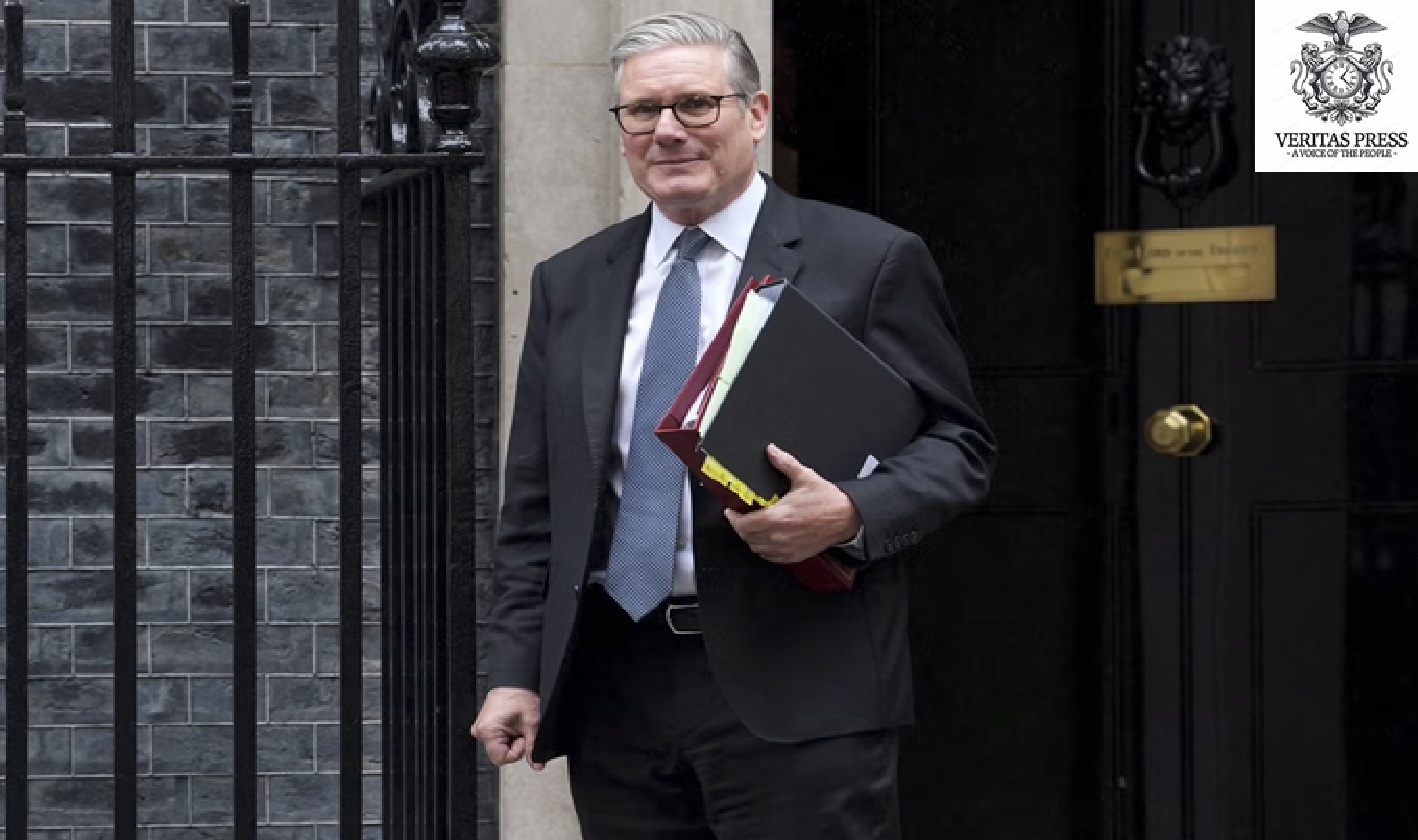
In a landmark address at the Munich Security Conference on February 14, 2025, British Prime Minister Keir Starmer delivered what many observers are calling the most significant statement of UK foreign policy since Brexit. Speaking to an audience of global leaders and security officials, Starmer declared that “the solidity of peace, the very ground we stand on, is softening under our feet”, a stark warning that Europe must awaken to the growing threat from Russia and fundamentally reshape its defence architecture.
The Prime Minister’s intervention came at a pivotal moment. With the United States signalling a strategic shift toward the Indo-Pacific and demanding greater burden-sharing from European allies, and with Russia reconstituting its military capabilities despite heavy losses in Ukraine, Starmer argued that Europe can no longer afford to rely on the security umbrella that has protected it for eight decades. His solution: a “more European NATO,” deeper integration with the European Union, and a generational shift in defence industrial cooperation.
This article examines Starmer’s vision, the strategic context in which it was delivered, the reaction from allies and domestic critics, and the developments that have followed in the months since his landmark speech, while also considering critical perspectives that frame these developments within a broader transformation of the global order.
The Strategic Context: A Continent On Alert.
When Starmer took the podium at the Munich Security Conference’s main hall, the backdrop to his remarks was unmistakably ominous. NATO Secretary General Mark Rutte had warned just days earlier that Russia could be ready to use military force against the alliance by the end of the decade. German intelligence services had reached similar conclusions, suggesting Moscow is “at least keeping open the option of war against NATO by 2029 at the latest.”
The Baltic states, long the most vocal about the Russian threat, were preparing for the possibility of an attack within three years. A December 2025 analysis by the Belfer Centre at Harvard Kennedy School found that among the various official warnings about Russia’s readiness for conflict with NATO, the years most frequently mentioned were 2027 and 2028.
Yet the threat is not merely military. As Starmer noted in his speech, Russia is waging a hybrid war across Europe: “Using disinformation to sow division, using cyber-attacks and sabotage to disrupt our lives.” Security experts point to overwhelming evidence of Russian operations, including repeated incursions into NATO airspace, GPS jamming in the Baltics, and sabotage attacks against critical infrastructure traced back to Russian intelligence services.
Adding to the urgency was the changing posture of the United States. President Donald Trump’s administration had made clear that European allies must take primary responsibility for their own defence. US Secretary of State Marco Rubio, speaking at the same conference, articulated the new American position: “We want allies who can defend themselves, so that no adversary will ever be tempted to test our collective strength.”
This twin pressure, a revanchist Russia and a demanding United States, created the conditions for Starmer’s intervention. As he put it: “We must move forward together to create a more European NATO.”
The Vision: A “More European NATO”.
Starmer’s central argument was that Europe possesses the resources to defend itself but squanders them through fragmentation. “Europe is a sleeping giant,” he told the conference. “Our economies dwarf Russia more than ten times over. We have huge defence capabilities, yet too often this adds up to less than the sum of its parts.”
To illustrate the problem, Starmer pointed to the inefficiencies in European defence procurement: Europe operates over 20 types of frigates and 10 types of fighter jets, and more than 10 types of main battle tanks, while the United States manages with one. “It’s wildly inefficient,” he said, “and it harms our collective security.”
The solution, in Starmer’s vision, is not to replace NATO but to rebalance it. “We must focus on diversifying and decreasing some dependencies,” he argued, calling for a shift “from over-dependence to interdependence.” This would involve deeper cooperation on defence industrial production, joint procurement, and integrated capabilities, all within a NATO framework that remains firmly anchored to the United States.
“We do not seek to replace the United States,” a senior British official later clarified. “But we must answer the call for more burden-sharing. That is what a more European NATO means.”
Economic Integration: Moving Closer To The Single Market.
Perhaps the most striking element of Starmer’s address, and the one that drew the sharpest political reaction, was his explicit call for closer economic alignment with the European Union.
“We are not the Britain of the Brexit years anymore,” Starmer declared, a line that drew applause from the Munich audience but condemnation from Conservative and Reform UK politicians at home. The Prime Minister argued that deeper economic integration is essential for European security: “The prize here is greater security, stronger growth for the United Kingdom and the EU, which will fuel increased defence spending.”
Starmer acknowledged that this would involve “trade-offs” but insisted that “the status quo is not fit for purpose.” He pointed to areas where the UK is already aligned with the single market, such as food and energy pricing, and suggested that similar alignment could be extended to other sectors “where that would work for both sides.”
This represents a significant evolution in the UK’s post-Brexit posture. Since leaving the EU in 2020, successive British governments have resisted any suggestion of regulatory alignment or single market participation. Starmer’s willingness to countenance closer ties reflects a strategic calculation: in an era of great power competition, security considerations must trump ideological purity.
European Commission President Ursula von der Leyen welcomed the overture, sharing a stage with Starmer and declaring: “Europe and the UK should come closer together, on security, on economy or on defending our democracies.”
The “Rejoin Question”: What This Reset Really Means.
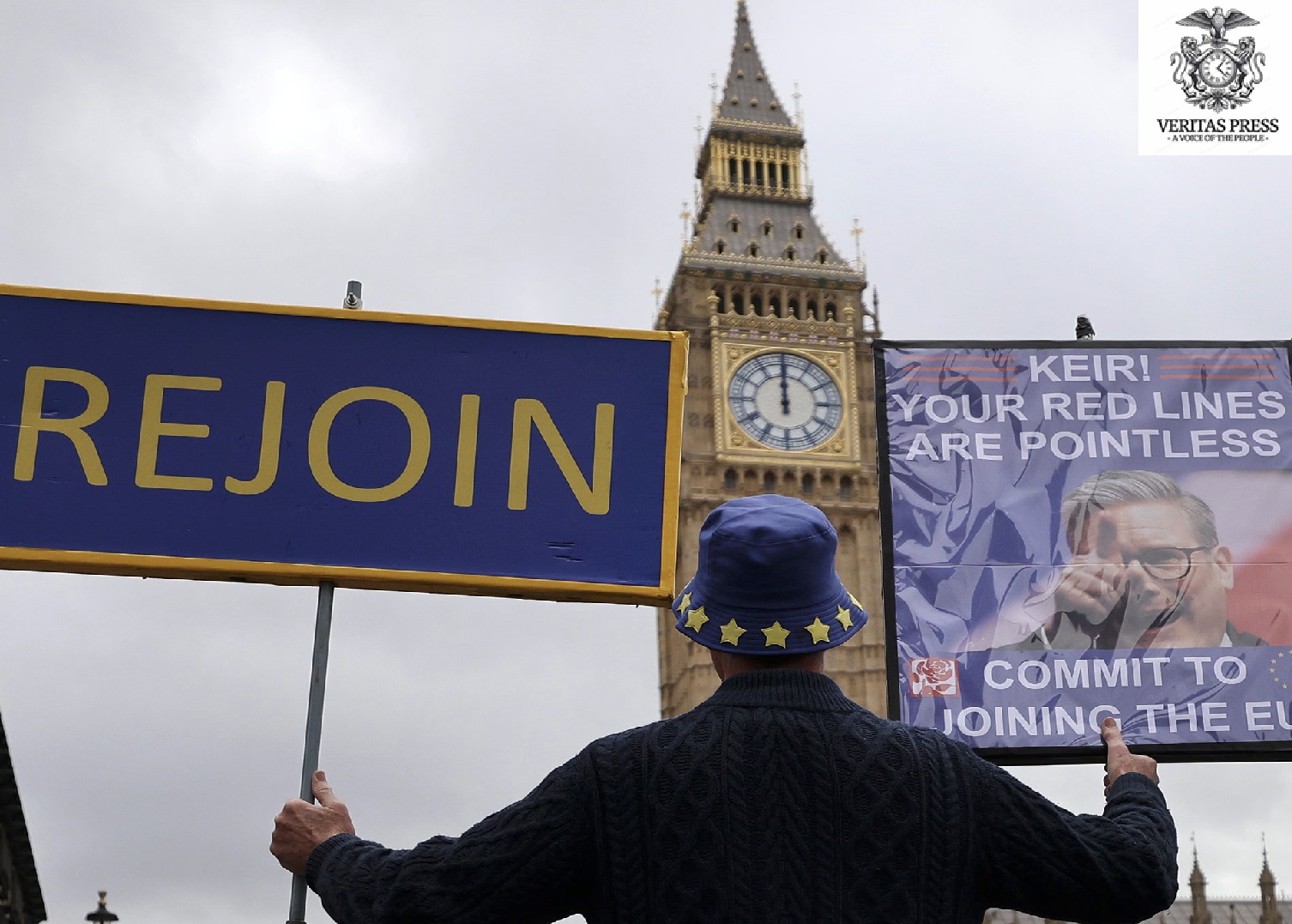
The moves by Starmer and his government represent a significant and deliberate warming of relations with the European Union, but they do not currently amount to a move to rejoin the bloc. The strategy is best described as a “reset” or a move towards “interdependence,” focusing on practical cooperation rather than reversing the constitutional fact of Brexit.
A “Pragmatic Reset” Driven By Security:
The primary driver for Starmer’s push is the urgent security situation in Europe. He argues that to build a “more European NATO” and face the threat from Russia, the UK must deepen its ties with its European neighbours.
Defence cooperation is the spearhead of this approach. Starmer has explicitly called for a “generational shift in defence industrial cooperation,” which includes reviving talks on joining the EU’s €150 billion SAFE rearmament fund, despite talks collapsing last year over the entry fee. To bypass the political hurdles of EU-only schemes, Starmer is also examining a new “European Defence Mechanism”, an intergovernmental institution open to all European democracies (both in and out of the EU) to finance joint military procurement.
Economic Integration: Going Further, But With Limits.
While defence is the trigger, the economic logic is impossible to ignore. Chancellor Rachel Reeves has been explicit that “the biggest prize is clearly with the EU,” arguing that closer integration is in the UK’s “national interest” for growth and security.
The government is proposing to look at the EU single market “in other sectors” where alignment would work for both sides, with the goal of reducing trade friction without rejoining the overarching structures. This reset has already yielded tangible results, such as the agreement for the UK to rejoin the Erasmus+ student exchange programme starting in 2027, and ongoing negotiations on a youth mobility scheme.
What Remains “Off The Table”:
Despite the warming rhetoric, the government is meticulously staying within its manifesto commitments. Rejoining the EU is not being considered. Starmer and Reeves have repeatedly and clearly stated that the UK will not rejoin the single market, the customs union, or return to freedom of movement.
While figures like London Mayor Sadiq Khan have called rejoining the EU the “ultimate goal,” the Chancellor herself recently urged colleagues to stop floating such ideas, insisting the UK “cannot go back in time.” The official position is about a new partnership, not reversing the 2016 referendum.
The Carrier Strike Group Deployment: Demonstrating Commitment.
Alongside his rhetorical appeal for European unity, Starmer announced a concrete military commitment: the deployment of the UK Carrier Strike Group to the North Atlantic and the High North in 2025.
Led by the flagship HMS Prince of Wales, the strike group would operate alongside US, Canadian, and other NATO allies in what Starmer described as “a powerful show of our commitment to Euro-Atlantic security.” The deployment, codenamed CSG25, would take the force as far east as Japan and Australia, but its Mediterranean and Atlantic phases were explicitly designed to demonstrate NATO’s integrated deterrent capability.
The strategic significance of this deployment was twofold. First, it showcased the UK’s ability to project power in partnership with allies; the strike group included vessels from Canada, Norway, and Spain, and exercised alongside the Italian Navy’s ITS Cavour carrier group in Exercise Med Strike. Second, it sent a message to Russia about NATO’s capacity to defend its northern flank, including the strategically critical GIUK Gap, the Greenland-Iceland-UK gap through which Russian submarines must pass to reach the Atlantic.
By November 2025, the strike group had completed its mission, with Commodore James Blackmore, Commander UK Carrier Strike Group, declaring it “home stronger for NATO than it departed.”
Nuclear Cooperation: The Franco-British Dimension.
Starmer also highlighted enhanced nuclear cooperation with France, describing it as a crucial component of European deterrence. “For decades, the UK has been the only nuclear power in Europe to commit its deterrent to protect all NATO members,” he noted. “But now any adversary must know that in a crisis, they could be confronted by our combined strength.”
Britain and France are Europe’s only nuclear-armed states, and their cooperation on nuclear matters has deep roots. The Lancaster House Treaties of 2010 established a framework for joint nuclear certification facilities and a combined joint expeditionary force. Starmer’s reference suggested a desire to deepen this cooperation further, though specifics remain classified.
The nuclear dimension is particularly significant given concerns about the US commitment to European deterrence. While the United States maintains nuclear weapons in several European countries under NATO sharing arrangements, any diminution of US engagement would place greater emphasis on the independent British and French deterrents.
The Threat Assessment: Russia’s Reconstitution.
Underpinning Starmer’s entire address was a grim assessment of Russian intentions and capabilities. While acknowledging that Russia had made “a huge strategic blunder in Ukraine” with casualties “well over a million,” Starmer warned that Moscow was rapidly reconstituting its forces.
“Even as the war goes on, Russia is re-arming, reconstituting their armed forces, and an industrial base,” he said. Crucially, he argued that a peace deal in Ukraine would not reduce the threat but accelerate it: “In the event of a peace deal in Ukraine, which we are all working hard to achieve, Russia’s rearmament would only accelerate. The wider danger to Europe would not end there. It would increase.”
This assessment aligns with intelligence warnings from multiple NATO members. Russian President Vladimir Putin, in a December 2025 statement, denied planning an attack on Europe but added ominously: “If Europe suddenly wants to go to war with us and starts, we are ready right now.”
Russian Deputy Foreign Minister Sergei Ryabkov, speaking at the Valdai Discussion Club in December 2025, accused the West of pushing strategic stability to the “edge of an abyss” and warned of “uncontrollable escalation.” He rejected claims that Moscow intends to attack NATO but cited Western “remilitarization programs” as evidence of hostile intent.
The dissonance between Russian denials and Western intelligence assessments remains a central feature of the current security environment.
NATO’s Spending Targets: From 2% To 5%.
Starmer’s speech came against the backdrop of a historic shift in NATO defence spending commitments. At the June 2025 NATO summit in The Hague, member states agreed to a new investment plan requiring members to allocate 3.5% of GDP to core defence and 1.5% to defence and security-related expenditure by 2035, a total of 5%.
This represented a dramatic increase from the previous 2% target, which itself had taken over a decade for most members to achieve. According to analysis by the International Institute for Strategic Studies, reaching the 3.5% core defence figure would require a compound annual growth rate of around 10% in nominal terms – significantly higher than the 0.9% real growth between 2008 and 2021.
The new targets were designed to address two pressures simultaneously: the long-term threat from Russia and US demands for greater burden-sharing. President Trump hailed the agreement as “a big win,” while NATO Secretary General Mark Rutte led a “charm offensive” to ensure summit success.
However, implementation challenges abound. Spain secured a last-minute exemption after Prime Minister Pedro Sánchez warned that the pledge was “unreasonable” and could harm the economy and social welfare. Slovakia’s Prime Minister Robert Fico publicly stated that his country had other priorities and would not increase defence spending in 2026. Public protests against defence spending increases have occurred in Italy, Belgium, the Netherlands, and Spain.
The UK has committed to the new target and plans to increase the defence budget to 2.6% of GDP by 2027, achieved partly through cuts to international aid and welfare reforms.
The SAFE Negotiations: A Setback For UK-EU Defence Cooperation.
Despite the warm rhetoric in Munich, practical cooperation between the UK and EU on defence procurement has encountered obstacles. In November 2025, talks on British participation in the EU’s €150 billion Security Action for Europe (SAFE) defence fund broke down over financial terms.
The SAFE program, announced in March 2025, is designed to provide long-duration loans to EU member states for urgent defence procurement, with the European Commission borrowing up to €150 billion to finance the effort. The UK had sought participation that would allow British defence companies to access these loans, potentially securing a share of the contracts.
However, negotiations foundered on the price of participation. British EU Relations Minister Nick Thomas-Symonds stated that while negotiations were “carried out in good faith,” the UK would “only sign agreements that are in the national interest and provide value for money.” The European Commission suggested talks could resume later, noting that the UK “accepted it should pay a fee, but insisted it would not sign up to an agreement at any price.”
The breakdown was a blow to Starmer’s reset agenda. Nevertheless, British defence companies can still participate in SAFE projects on “third country terms,” up to a maximum of 35% of contract value, though the UK had sought a higher threshold.
German Foreign Minister Johann Wadephul, speaking at a joint news conference with Turkish Foreign Minister Hakan Fidan, argued that SAFE should include key NATO partners like Türkiye and the UK, a position that may gain traction as the program develops.
Bilateral Partnerships: An Alternative Path.
While multilateral cooperation through SAFE has stalled, the UK has made progress through bilateral partnerships. Starmer highlighted several examples in his Munich speech:
A deal with Norway to build a fleet of warships for hunting Russian submarines and protecting undersea infrastructure
Collaboration with Germany, Italy, and France on next-generation long-range missiles
Enhanced nuclear cooperation with France
Joint Expeditionary Force (JEF) operations to protect NATO’s northern flank
Integration of British commandos in the Arctic
These bilateral arrangements reflect a pragmatic approach: where multilateral EU cooperation proves difficult, the UK will build capability through flexible partnerships with like-minded allies.
Domestic Politics: The Brexit Legacy And Farage Factor.
Starmer’s Munich speech was not merely a foreign policy address; it was also a political intervention aimed at domestic audiences. His declaration that “we are not the Britain of the Brexit years anymore” was carefully calibrated to signal a new approach while avoiding direct confrontation with Leave voters.
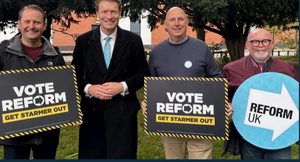
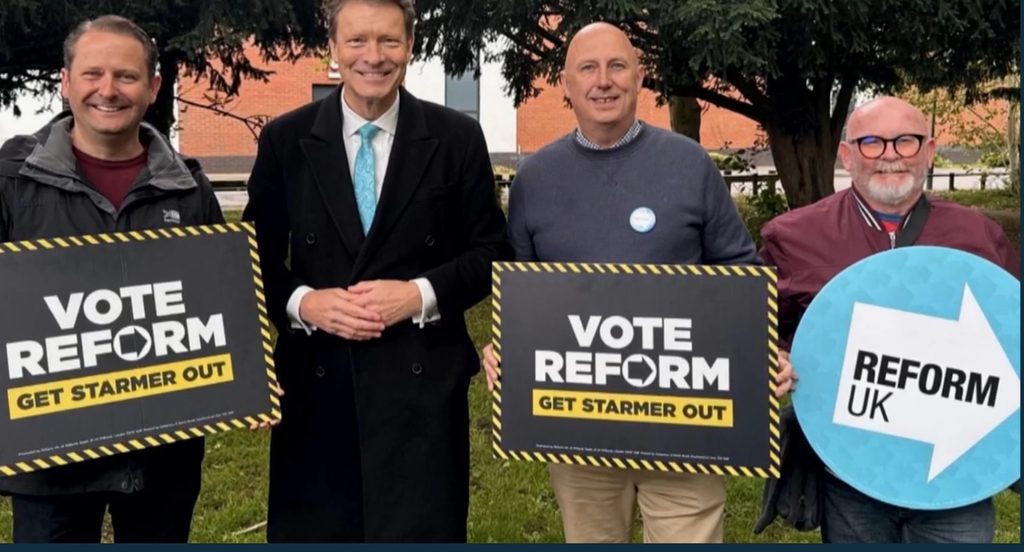
But it was his attack on domestic political rivals that drew the sharpest reactions. Starmer claimed that both Reform UK and the Green Party are “soft on Russia and weak on NATO,” arguing that their approach would lead to “division and capitulation” with the result that “the lamps would go out across Europe once again”, a reference to Sir Edward Grey’s famous remark on the eve of the First World War.
Reform UK leader Nigel Farage has long been a controversial figure in UK-Russia relations. In 2014, he described the EU’s expansion eastward as “provocative” and suggested the West bore some responsibility for Putin’s actions in Ukraine. He has consistently denied being sympathetic to Russia.
The Conservative Party’s shadow foreign secretary, Priti Patel, accused Starmer of “rolling the pitch for greater EU integration and less control for the UK”, a line of attack designed to mobilise Brexit-supporting voters. Reform UK’s Suella Braverman went further, claiming the government is “hellbent on eroding Brexit” and turning the UK into an EU “rule taker.”
This repositioning carries significant political risk, which is why the government is moving cautiously. Interestingly, some analysts suggest that the recent departure of key aides from Downing Street may have removed a major block to pursuing closer ties with the EU, potentially giving Starmer more freedom to pursue this agenda.
Starmer’s willingness to engage in such partisan rhetoric on the international stage reflects the intertwining of foreign and domestic politics in the current era. As he put it: “If we don’t build consent for the decisions we must take to keep us safe, the peddlers of easy answers are ready on the extremes.”
The Strategic Dilemma: Walking The Tightrope.
In the weeks following Starmer’s Munich speech, the strategic environment has grown no less complex. Anne McElvoy, writing in The i Paper, described Starmer’s position as “walking a tightrope” between maintaining the transatlantic alliance and building European autonomy.
The immediate challenge is Ukraine. With US policy shifting toward a transactional approach, including proposals for preferential access to Ukrainian minerals in exchange for defence support, European leaders must navigate between standing with Kyiv and maintaining Washington’s engagement.
Starmer’s offer of British peacekeepers as a stabilisation force in any post-war settlement represents an early bargaining chip, an asset that can be offered to Trump in return for a serious role in negotiations. It achieves two things: it slows the precipitous pace of potential US-Russia deals, and it introduces the question of post-agreement guarantees.
But the risks are real. One Cabinet member helping Starmer prepare for engagement with Washington described the challenge as “following seven bluebottles buzzing around in a jar and trying to remember which one you want to keep watching.” Diplomatic channels are often the last to be informed about Trump’s next move.
Public Opinion: The Challenge Of Societal Readiness.
A recurring theme in strategic discussions is whether European publics are ready for the sacrifices that genuine deterrence requires. Richard Barrons, former head of the UK’s Joint Forces Command, warned at a December 2025 RUSI conference that at the current pace, it would take the UK about ten years to be ready for a war, while intelligence suggests Russia could be ready in three to five.
Barrons argued that the UK must rethink the resilience of its infrastructure, build up armed forces, reserves and civil defence, and invest in health, industry and the economy to allow a quick pivot to a war footing. “We frankly don’t need much more analysis to tell us what it is we need to do,” he said. “The problem is that we need to actually do it.”
General Fabien Mandon, France’s armed forces chief, sparked outcry in late 2025 when he warned that France must “accept losing its children” to “protect who we are”, a statement that revealed the gap between strategic necessity and public readiness.
Public attitudes vary significantly across Europe. In Eastern member states like Poland and the Baltic nations, the threat is viscerally felt, and preparations, including public shelters and reintroduced conscription, are well advanced. Sweden and Finland updated citizen guidance on surviving war in 2024, distributing booklets with instructions for communications outages, power cuts and extreme weather.
But in Western Europe, including the UK, trust in institutions is lower and the concept of “total defence”, where every citizen, every business and every public body contributes to national resilience, is less developed. Sam Greene of King’s College London noted that while surveys show Europeans are concerned about security, “governments are still not quite confident enough to have that conversation with their publics.”
A New World Order? The Authoritarian Turn And US-Israeli Imperial Rule:
While Starmer’s vision of a “more European NATO” is presented as a necessary response to external threats, a growing chorus of critics argues that these developments cannot be understood in isolation. Rather, they form part of a broader transformation of the global order – one characterised by the triumph of brute force over international law, the emergence of a US-Israeli axis of power, and the consolidation of authoritarian governance on a global scale.
The Official US Vision: A World Of Sovereign Competitors.
The Trump administration’s National Security Strategy, released in December 2025, marks a decisive departure from the post-1945 vision of an American-led rules-based international order. According to analysis by The National, the document explicitly de-emphasises the idea of a US-led order in favour of “a world of sovereign competitors, where American strength, military, economic, technological and energy, remains the ultimate guarantor of US interests”.
This new worldview produces a sharp hierarchy. The Western Hemisphere is treated as a sphere of near-exclusive US influence, echoing a revived Monroe Doctrine and illustrated most clearly by Washington’s recent actions in Venezuela. In January 2026, US special operations forces conducted a high-risk extraction in Caracas to capture Nicolás Maduro, an operation the global community viewed as a blatant violation of national sovereignty.
Within this re-ordered global map, the Middle East holds particular importance. The NSS identifies among its “core vital national interests”: “Preventing any adversarial power from dominating the Middle East, its oil and gas resources, and the maritime chokepoints through which they pass”.
Israel As “Model Ally”:
Central to this emerging order is the US-Israeli relationship. The 2026 National Defence Strategy, signed by “War Secretary” Pete Hegseth (the Department of Defence having been renamed in September 2025), offers unusually strong praise for Israel, repeatedly defining it as a “model ally”, mentioned no fewer than ten times.
The document states: “In the Middle East, Israel has proven that it is willing and able to defend itself after the barbaric attacks of October 7. In short, it is a model ally. Yet instead of empowering Israel, the previous administration tied its hands”. Later, it adds: “Israel has long demonstrated that it is willing and able to defend itself with critical but limited support from the United States. Israel is a model ally, and we now have an opportunity to further empower it to defend itself and advance our shared interests.”
The strategy envisions a region where “local partners can and should do more,” with Israel taking primary responsibility for confronting Iran and its proxies, supported by deepening cooperation with Gulf partners under the expanded Abraham Accords framework. Major operations highlighted as key elements of deterrence include “Operation Midnight Hammer,” the June 2025 strike that destroyed Iranian nuclear facilities at Fordo, Natanz and Isfahan.
The “Peace Council”: Replacing The UN.
Perhaps the most dramatic institutional innovation is Trump’s proposed “Peace Council”, an alternative to the UN Security Council that would reportedly grant the United States sole veto power. According to the Morning Star, Trump has had around 60 countries worldwide write to establish this body, which “empowers itself to act in all matters that previously fell exclusively to the UN Security Council”.
The Peace Council aims to replace the UN Security Council with its primary responsibility for international security and the maintenance of world peace. The sole veto right would belong to the US and “the eternal President Donald Trump”, effectively overriding the veto rights of permanent members Russia and China.
Critics describe this as a “mafioso offer”, one that, if accepted, would disempower other nations and give US imperialism carte blanche. The internal structure reinforces this concern: Trump would be installed as President of the Council for life, while the Council would be staffed with figures such as Tony Blair and Jared Kushner, “who in the past strongly advocated for Israel’s genocide against the Palestinians”.
As one analysis puts it: “The Peace Council becomes a US war council and US colonial council. An institution that legitimises US wars and threats of violence. Anyone not appointed as a member – such as Cuba, Venezuela, and Iran-risks immediately falling into the sights of the new self-appointed guardians of world order”.
The Greenland Gambit: Colonialism Renewed.
The administration’s approach to Greenland illustrates the broader pattern. President Trump’s renewed interest in purchasing the island, this time accompanied by threats of economic sanctions against Denmark and hints of “military necessity” for Arctic defence, has pushed NATO to a breaking point.
The reaction from Europe has been defensive and unified. NATO officials have reportedly discussed contingency plans for “host nation control” of American bases on European soil, such as the Pituffik Space Base (formerly Thule), should the US attempt to coerce Denmark into a territorial sale. This rhetoric has shifted the perception of the US from a security guarantor to a potential security threat within its own alliance.
The Nation describes this as “the rantings of a nuclear-armed lunatic,” noting that Trump’s threats of conquest, later partially walked back, represent “the most serious rupture of the Western Alliance since the Suez crisis in 1956”. Canadian Prime Minister Mark Carney told the Davos audience that this constitutes a “rupture” of the international order on an epochal scale.
Critics see a deeper pattern: the renewal of Western colonialism. The Morning Star argues: “It seems no coincidence that Denmark was not invited to the Peace Council, to allow the planned US annexation of Greenland to proceed as smoothly as possible”. The dispute between Trump and European leaders is characterised as “a dispute over how best to legitimise the renewal of Western hegemony”.
The Erosion Of International Law:
Underpinning these developments is a systematic assault on international legal frameworks. In his first year back, President Trump signed an executive order to withdraw from over 60 international treaties and organisations, including the World Health Organisation, the UNFCCC (abandoning Paris Agreement goals), and UNESCO and UNHRC.
The administration’s approach to the Gaza conflict has further isolated the US and Israel. The International Court of Justice issued binding orders regarding the prevention of genocide, which the Netanyahu administration largely dismissed as politically motivated. By continuing to provide unrestricted military aid and diplomatic cover at the UN Security Council, the Trump administration has effectively placed itself outside the consensus of international law.
This has created a moral and legal rift with traditional allies. Countries like South Africa, Turkey, and Brazil have severed or downgraded ties. The refusal to abide by ICJ rulings has weakened the perceived authority of the UN, leading many nations to seek alternative frameworks for justice and security.
The Critique From Munich:
At the same Munich Security Conference where Starmer delivered his address, Representative Alexandria Ocasio-Cortez offered a starkly different diagnosis. Speaking on a panel, she warned that the Trump administration seeks to “withdraw the United States from the entire world so that we can turn into an age of authoritarianism, of authoritarians, that can carve out the world where Donald Trump can command the Western Hemisphere and Latin America”.
Ocasio-Cortez argued that Trump sees the entire Western Hemisphere as “his personal sandbox” and would not care if strong-arm leaders such as Russia’s Vladimir Putin started to “sabre-rattle around Europe” and militarily “bully” America’s allies there. His goal, she said, is for “authoritarians to have their own geographic domains”.
She further argued that the US must revisit its commitments to international alliances as “a hard stop against authoritarian consolidation of power, particularly in the installation of regional puppet governments”.
“Reverse Convergence”: The West Adopts Authoritarian Tools.
Some analysts see a deeper dynamic at work: not simply US withdrawal from the liberal order, but the West’s adoption of authoritarian governance techniques. The concept of “reverse convergence” suggests that liberal democracies are increasingly adopting illiberal governance methods, expanded surveillance, executive discretion, securitised policy frames, and controlled pluralism, while authoritarian regimes adopt capitalist tools without liberalising.
This is not ideological convergence through persuasion, but functional convergence driven by systemic pressure. As one analysis puts it: “The tools of governance increasingly function through infrastructures of data extraction, algorithmic control, and dependency rather than through persuasion or consent”.
The result is a world in which “power is the only currency that retains its value”. The transition from a rules-based order to a doctrine of pure coercion has opened a dangerous fissure in global security. While this “America First” posture may offer Washington the illusion of short-term gain, it risks deeper, more permanent isolation.
Israel’s Position: Between Opportunity And Peril.
For Israel, this transformed landscape presents both opportunities and acute risks. The ideological foundation of the “special relationship” is shrinking as Washington swaps democratic solidarity for narrow, transactional calculations. As the US retreats from its role as a global guarantor, Israel finds itself increasingly exposed.
The erosion of international law in Washington’s calculus may offer a temporary veneer of tactical freedom, but it simultaneously weakens the frameworks that prevent non-conventional arms races and regional anarchy. The weakening of international law could complicate Israel’s efforts to preserve the IDF’s freedom of action, while Trump’s scepticism toward arms-control regimes may accelerate nonconventional arms races.
Regional players, sensing the withdrawal of the American umbrella, are exploring alternative pillars of support, casting doubt on the future of initiatives like a “Middle Eastern NATO.” The hard truth, according to Israeli analysts, is that long-standing assumptions about American guarantees are no longer operative.
Yet Israel also sees opportunity. Kobi Michael, writing in Aurora Israel, notes that Trump’s relationship with Netanyahu and his support for Israel represent a “valuable and vital strategic asset.” However, Israel must understand the limits of this support when Israeli actions do not align with Trump’s expectations or conflict with his vision for restructuring the Middle East.
Trump considers his regional architecture essential for promoting US security and economic interests, and a necessary tool for competing against Russia and China. The challenge for Israel is to navigate between these competing pressures, securing US backing for action against Iran while potentially making concessions in Gaza to accommodate Trump’s broader vision.
Europe’s Response: Fortress Or Vassal?
Where does this leave Europe? The continent finds itself caught between its historical dependence on the US security umbrella and the reality of an American administration that views allies as transactional partners at best, obstacles at worst.
The response has been fragmented. Some European leaders, exhausted by trade wars and the unpredictability of Washington, have begun quiet negotiations for a “Continental Peace” with Russia, a proposed treaty that would aim to end the war in Ukraine through a “frozen conflict” model, potentially bypassing US interests entirely.
Others advocate for strategic autonomy. Canadian Prime Minister Mark Carney’s diagnosis at Davos, that “the strong can do what they can, and the weak suffer what they must”, invokes the Melian Dialogue, a canonical statement of power politics rationality. The significance is not the originality of the reference; it is that Davos discourse now treats such realism as publicly speakable.
If Europe chooses to prioritise its own energy security and economic stability over the Transatlantic alliance, the US would find itself strategically isolated on the world stage, relegated to a “Western Hemisphere power” rather than a global hegemon. Yet such a move carries its own risks, potentially leaving Europe exposed without either US protection or a coherent narrative security architecture.
The Emerging Multipolar Reality:
The combined actions of the Trump and Netanyahu administrations have fundamentally challenged the post-Cold War world order. By prioritising immediate national interests and unilateral force over established international law and multilateral cooperation, the US and Israel have triggered a defensive reaction from the rest of the world.
Whether this isolation is temporary or permanent remains to be seen. However, as of 2026, the world is moving toward a multipolar reality where the US dollar is one of many currencies, the “rules-based order” is being replaced by a fragmented series of regional alliances, and the old maps become increasingly blurry.
For Starmer’s vision of a “more European NATO,” this transformed landscape presents profound challenges. European defence integration may be necessary, but it is also unavoidably implicated in a broader global realignment, one that critics characterise as the consolidation of authoritarian governance, the renewal of colonial power relations, and the emergence of a US-Israeli imperial axis.
The Way Forward: From Words To Action.
The question is whether Starmer’s Munich vision can be translated into concrete action. The challenges are formidable:
Defence spending: Meeting NATO’s 5% target by 2035 will require sustained political will and difficult fiscal choices. Countries like Germany have reformed debt rules to enable increases, but others face public resistance and economic constraints.
Industrial integration: Fragmented European defence procurement remains a structural weakness. As Starmer noted, “fragmented industrial planning and procurement have led to gaps in some areas, and massive duplication in others.” Overcoming this will require member states to subordinate national industrial interests to collective capability.
UK-EU relations: The breakdown of SAFE talks demonstrates the difficulty of rebuilding trust after Brexit. While the political will for a reset exists on both sides, the practical mechanisms remain elusive. However, progress on Erasmus+ and youth mobility suggests that incremental gains are possible.
US engagement: The fundamental uncertainty remains the long-term US commitment to European security. While the Trump administration has demanded greater burden-sharing, it has not articulated a clear vision for the future US role. European leaders must plan for scenarios ranging from continued strong engagement to significant force reductions or worse, active US hostility toward European interests.
Societal readiness: Perhaps the greatest challenge is preparing the public for a world in which peace can no longer be taken for granted. This requires political leadership willing to level with citizens about hard choices, exactly what Starmer called for in his Munich speech.
The “Rejoin” question: For the foreseeable future, the UK’s relationship with the EU will be one of pragmatic cooperation rather than constitutional reunification. The government’s red lines on the single market, customs union, and freedom of movement remain firmly in place. But as Starmer’s Munich speech demonstrated, the scope for cooperation within those boundaries is wider than the Brexit years suggested.
The authoritarian challenge: Beyond these practical challenges lies a deeper question: what kind of order is Europe building, and in partnership with whom? If critics are correct that the emerging global order is characterised by US-Israeli imperial rule, the erosion of international law, and the consolidation of authoritarian governance, then European defence integration may not be a solution but a symptom of an adaptation to a darker world rather than a resistance to it.
Conclusion: The Sleeping Giant Stirs, Into What?
Starmer’s Munich address will be remembered as a defining moment in post-Brexit British foreign policy. By explicitly linking UK security to European security, and by arguing for closer economic integration with the EU, he broke with the isolationist temptations of the Brexit era and positioned Britain at the centre of European efforts to build a more capable defence posture.
Whether the vision can be realised depends on factors beyond any single leader’s control: the trajectory of the war in Ukraine, the direction of US foreign policy, the willingness of European publics to accept sacrifice, and the ability of NATO members to overcome long-standing inefficiencies in defence procurement.
But Starmer’s central insight, that Europe must take greater responsibility for its own defence, and that Britain must be at the heart of that effort, reflects a strategic reality that transcends any particular government. As he put it: “There is no British security without Europe, and no European security without Britain. That is the lesson of history, and it is today’s reality too.”
Yet history’s lessons are rarely simple. The world into which Europe is awakening is not the liberal order that NATO was created to defend. It is a world of “sovereign competitors,” of revived colonial ambitions, of institutions replaced by brute force. It is a world in which the United States openly embraces unilateral power, Israel is celebrated as a “model ally” for its willingness to fight its own wars, and the distinction between ally and adversary grows increasingly blurred.
The sleeping giant is stirring. Whether it rises to defend liberal democracy or merely to secure its place in a new authoritarian order will determine the future of European security and the meaning of European values, for generations to come. And while the Britain that emerges from this moment will not be rejoining the European Union, it will be unmistakably, and unapologetically, European for better or worse, in a Europe that is itself being remade by forces beyond its control.
Kamran Faqir is a volunteer investigative journalist and writer committed to exposing hidden truths and amplifying underreported stories. Driven by social justice, he brings sharp insight and fearless truth-telling to independent journalism. NUJ registered.
SEATTLE, TEHRAN — The U.S. Department of Homeland Security (DHS) will allow Iran’s national football team to enter the country 48 hours before their critical World Cup match against Egypt on Friday, a modest concession in a tournament where Team Melli’s travel conditions have sparked claims of oppression and competitive disadvantage.