



Title: F-15s, Warships, And The USS Abraham Lincoln: How The US-Israel Axis Is Manufacturing Crisis In The Gulf.
Press Release: Veritas Press C.I.C.
Author: Kamran Faqir
Article Date Published: 26 Jan 2026 at 13:30 GMT
Category: Americas-Asia | Politics-US-Israel-Iran | F-15s, Warships, And The USS Abraham Lincoln: How The US-Israel Axis Is Manufacturing Crisis In The Gulf
Source(s): Veritas Press C.I.C. | Multi News Agencies
Website: www.veritaspress.co.uk

Business Ads

Military escalation, intelligence signalling, and the legal architecture of imperial power converge as Washington re-militarises the Middle East.
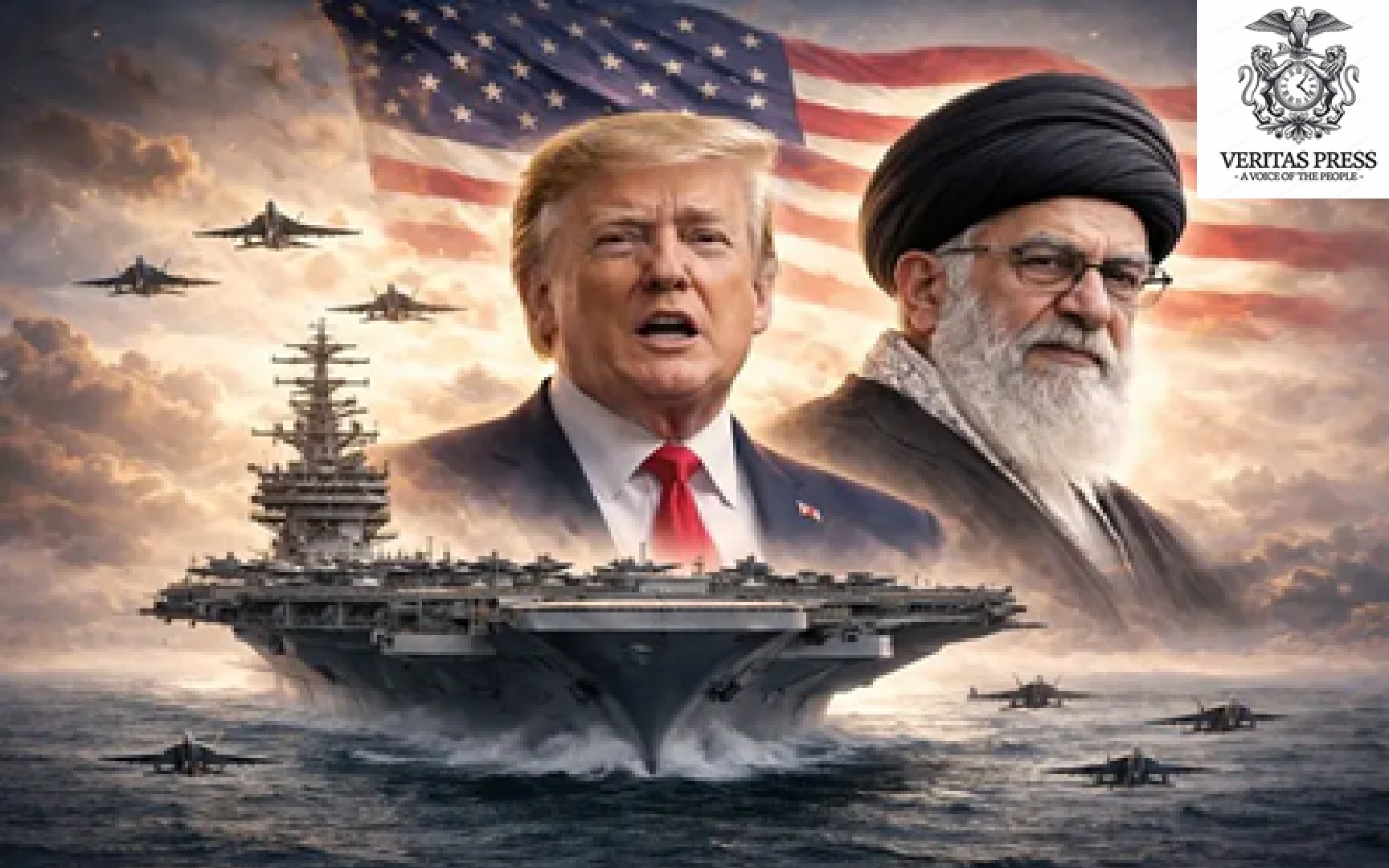
As tensions between the United States and Iran surge once again, Washington has accelerated one of its most significant military deployments to the Middle East in years, a show of force that extends far beyond deterrence. At the centre of the buildup is the nuclear-powered aircraft carrier USS Abraham Lincoln (CVN-72), flanked by guided-missile destroyers, cruisers, stealth aircraft, and long-range strike capabilities capable of reaching deep into Iranian territory.
Officially, these movements are defensive, framed as precautionary steps amid Tehran’s domestic unrest. In practice, however, the deployment reflects structural escalation engineered over decades, leveraging military power, sanctions, intelligence signalling, and regional alliances to maintain US and Israeli strategic dominance in the Gulf.
Escalation By Design: Imperial Power, Managed Chaos, And The Legal Architecture Of War.
As US aircraft carriers move toward the Persian Gulf and advanced fighter squadrons are redeployed across the Middle East, Washington insists its actions are defensive. Iran, however, has issued categorical warnings: any attack, regardless of scale, will be treated as a full-scale war.
What is unfolding is not deterrence but structural escalation, a predictable outcome of an imperial system built on fragmentation, coercion, and perpetual crisis.
This moment has been deliberately shaped through the convergence of:
- Israeli strategic pressure, which repeatedly urges US military engagement.
- US military hegemony is demonstrated through overwhelming deployments exceeding what is necessary for deterrence.
- and the Abraham Accords, which reconfigured the Middle East into a zone of managed instability while embedding the region in a broader confrontation with Russia and China.
As analysts from the Council on Foreign Relations, Reuters, and AP have observed, this is not a failure of diplomacy. It is the political economy of the empire functioning as intended.
Military Force As Policy Instrument:
According to US defence officials cited in multiple media outlets, the deployment of the Abraham Lincoln carrier strike group includes guided-missile destroyers, electronic warfare aircraft, and long-range strike capabilities designed for sustained offensive operations.
Military analysts note that such deployments exceed what is required for deterrence, aligning instead with first-strike and escalation-dominance doctrines developed post-Iraq and Afghanistan. Under Article 2(4) of the UN Charter, the threat of force absent an imminent armed attack constitutes a violation of international law, a principle repeatedly affirmed by UN legal experts.
US officials continue to frame these movements as defensive, but the scale, composition, and positioning of forces contradict that narrative.
US And Israeli Intelligence: Public Support For Destabilisation.
Beyond military deployments, US and Israeli intelligence agencies have openly signalled support for internal unrest in Iran. Senior US officials linked to national security institutions have publicly endorsed protest movements, while Israeli intelligence officials, including former Mossad and military analysts, have framed domestic instability as strategic leverage.
These public statements, widely reported by Reuters and Israeli media, include:
- encouragement of “pressure from within,”
- framing protests as leverage against Iran’s regional power,
- and acknowledgement that unrest aligns with broader US-Israeli containment objectives.
Human rights experts caution that such signalling does not protect protesters; rather, it provides Tehran with justification for mass arrests, lethal repression, and internet shutdowns. As the ICJ affirmed in Nicaragua v. United States, coercive interference in domestic political processes violates international law.
Israel’s Strategic Pressure And Escalation Entrapment:
Israeli leaders have consistently identified Iran as an existential threat, even as US intelligence assessments indicate Tehran is not pursuing a nuclear weapon. Former US officials told media outlets that sustained Israeli pressure has repeatedly pushed Washington toward military escalation, a phenomenon known as escalation entrapment.
Historical precedent exists: US interventions in Lebanon, Iraq, and Syria were similarly shaped by alliance dynamics overriding legal and strategic restraint. Preventive war, military action taken against speculative threats, has no legal basis under customary international law, yet remains embedded in Israeli strategy and increasingly reflected in US deployments.
Regime Change As Political And Economic Strategy:
While US officials publicly deny seeking regime change in Iran, policy outcomes suggest otherwise. UN Special Rapporteur reports on unilateral coercive measures document that sanctions have:
- restricted access to medicine and essential goods,
- degraded civilian infrastructure,
- contributed to economic collapse, affecting the most vulnerable.
Simultaneously, public support for protests and escalating military threats creates conditions that strengthen state repression, legitimising Tehran’s lethal crackdowns. This mirrors the US approach in Iraq and Libya, where sanctions and military pressure destroyed state capacity, opening pathways for external control over reconstruction, energy assets, and governance through proxies.
Regime change here is economic and political engineering, not humanitarian intervention.
The Abraham Accords: Regional Fragmentation As Policy.
The Abraham Accords, hailed as peace agreements, have functioned as security and economic normalisation compactsdesigned to bypass Palestinian statehood and undermine Arab collective diplomacy. Analysts and former diplomats note that the accords:
- fragmented regional solidarity,
- institutionalised intelligence sharing with Israel,
- aligned Gulf states with US-Israeli containment strategies against Iran.
Legal scholars highlight that this reconfiguration neutralised collective opposition to Israeli violations of international law, including settlement expansion, annexation, and apartheid policies documented by Human Rights Watch, Amnesty International, and Israeli rights organisations. Fragmentation, in this context, is not an accident but a governing principle.
Iran: Structural Threat To Imperial Control:
Iran’s significance lies in sovereignty, not ideology. It controls the Strait of Hormuz, holds the world’s second-largest gas reserves, and resists integration into Western financial and security systems.
A sovereign Iran disrupts:
- dollar-denominated energy markets,
- sanctions enforcement,
- US-Israeli regional military supremacy.
Pressure on Iran has intensified alongside its strategic ties with Russia and China, highlighting the global stakes.
Russia, China, And The Limits Of Unipolar Power:
Analysts from Eurasian policy institutes note that Iran serves as a strategic buffer for Russia, securing access to the Caspian and Eurasian transport corridors, while also underpinning China’s Belt and Road Initiative and energy diversification strategies.
Both countries have publicly warned that the US escalation violates international law and risks global instability. Any attack on Iran would thus be a challenge to the emerging multipolar order, far beyond a regional confrontation.
Energy, Arms, And The Economics Of Permanent Crisis:
Data from the Stockholm International Peace Research Institute (SIPRI) show arms sales to the Middle East surge amid sustained tensions. Energy analysts argue that instability around the Strait of Hormuz benefits arms manufacturers, insurance markets, and energy traders, while justifying permanent US naval dominance. Crisis is profitable. Peace is not.
Selective Human Rights And Legal Exceptionalism:
Western governments routinely invoke human rights in Iran, but:
- continue to arm Israel amid allegations of war crimes and genocide in Gaza,
- block accountability mechanisms at the UN,
- and ignore repression in allied Gulf states hosting US bases.
This selective application of law erodes the international legal order, turning norms into instruments of imperial strategy.
A System Built For Instability:
US militarisation, Israeli escalation pressure, sanctions warfare, intelligence signalling, and regional fragmentation form a coherent system: control through managed chaos. Unity threatens hegemony. Sovereignty disrupts markets. Peace undermines leverage.
The Middle East is not unstable because diplomacy failed.
It is unstable because instability is profitable, calculable, and politically useful.
The Legal Consequences Of Miscalculation:
Under international law, any US or Israeli strike absent an armed attack would constitute:
- a violation of the UN Charter,
- an act of aggression under customary international law,
- and a precedent-setting collapse of the post-1945 legal order.
Iran has pledged a military response. Russia and China have signalled global stakes.
If war erupts, it will not be accidental. It will be the foreseeable outcome of a system designed to maintain imperial dominance at the expense of civilian life, from Tehran to Gaza, from Beirut to the Gulf.
Conclusion: Managed Chaos, Market Control, Nuclear Sovereignty, And The Human Cost Of Empire.
What is unfolding in the Persian Gulf is not a spontaneous crisis. It is the deliberate, predictable outcome of a decades-long imperial strategy, in which regime change, military, economic, and political levers are calibrated to extract resources, enforce market dominance, and reshape governance under the guise of deterrence or humanitarian concern.
The deployment of the USS Abraham Lincoln and its strike group, the forward positioning of F-15E and F-35C squadrons, and the public support of unrest by US and Israeli intelligence agencies are not defensive manoeuvres; they are instruments of structural coercion. By creating conditions of perpetual crisis, Washington and Tel Aviv ensure that regional sovereignty, collective diplomacy, and independent economic strategies are subordinated to the imperatives of empire.
Economic levers amplify military coercion. US sanctions, tariffs, and restrictions on energy exports are strategically aligned with military escalation to constrain Iran’s economic independence, disrupt non-Western trade networks, and open markets to US and allied corporations. Control over the Strait of Hormuz, the manipulation of tariffs, and sustained naval dominance secure market strongholds in oil, gas, shipping, and energy insurance, sectors that thrive on instability (SIPRI, 2025; IEA, 2026).
Central to these pressures is Iran’s nuclear energy program, which is explicitly intended for domestic civilian power generation and energy independence. According to the International Atomic Energy Agency (IAEA, 2026), Iran’s nuclear facilities, including the Bushehr and Natanz plants, are designed to provide reliable electricity to a population facing rolling blackouts, industrial shortages, and energy insecurity. Yet, US and Israeli narratives deliberately frame Iran’s civilian nuclear program as an existential threat, justifying sanctions, military posturing, and preemptive threat doctrines. In reality, denying Iran its sovereign energy options consolidates Western control over global energy markets, making Tehran dependent on fossil fuel trade flows and international systems dominated by Washington allies.
Israel’s strategic pressure, reinforced through the Abraham Accords, institutionalises regional fragmentation. By bypassing multilateral Arab diplomacy, these accords neutralise collective opposition to Western and Israeli economic and military agendas. Gulf states are aligned with US-Israeli containment strategies, facilitating energy market manipulation, intelligence sharing, and unilateral military signalling, ensuring that Iran cannot fully leverage its domestic nuclear or hydrocarbon resources (Brookings Institution, 2025).
Iran’s strategic importance lies not in ideology, but in its sovereign control of energy chokepoints and resources. Its partnerships with Russia and China reflect structural resistance to Western unipolar economic and military domination, not ideological alignment. For Russia, Iran buffers southern NATO expansions and secures Caspian access; for China, it anchors Belt and Road energy corridors and diversifies energy imports beyond Western-controlled markets (Carnegie Endowment, 2025). Any US or Israeli strike would therefore not remain regional but challenge the emerging multipolar energy and economic order.
From a legal perspective, these actions are stark: any US or Israeli strike absent an imminent armed attack violates Article 2(4) of the UN Charter and constitutes an act of aggression under customary international law. The scale, composition, and positioning of military forces, coupled with economic coercion targeting Iran’s domestic energy sector, indicate structural escalation by design, not defensive necessity.
The human cost remains profound. Civilians face mass arrests, executions, and repression under the regime, which justifies brutality as a defence against foreign interference. Across the region, ordinary people bear the burden of militarised markets, energy insecurity, and perpetual crisis. Instability benefits arms manufacturers, fossil fuel traders, and global finance intermediaries, but devastates daily life for millions.
This is the political economy of permanent instability. Sovereignty threatens markets. Peace undermines leverage. Stability challenges imperial control. Iran’s pursuit of domestic nuclear energy, its resource autonomy, and its multipolar partnerships are precisely what trigger sustained pressure and military signalling, illustrating that regional volatility is not a failure of diplomacy but a tool of imperial dominance and market control.
Any meaningful path toward energy sovereignty, regional autonomy, or independent governance is treated as a strategic threat. In this system, the victims are always civilians, the protesters, the workers, the families, whose lives are subordinated to the imperatives of empire, market dominance, and geopolitical leverage.
GENEVA — A United Nations fact-finding mission has concluded there are “reasonable grounds to believe” that U.S. forces committed war crimes during two airstrikes in Iran in February, strikes that
Iran’s GDP is projected to contract by 5.4 to 6.1% in 2026, its worst performance since 1988. Oil exports have collapsed from 2.12 million barrels per day before the war
The Trump administration is preparing a $2.8 billion weapons package for Israel containing 40,000 2,000-pound bombs, according to US officials cited by The Washington Post, Reuters and the Associated Press.

Film alleges mass civilian deaths are routinely built into military decisions amid Israel’s genocidal war on Gaza
The Israeli rights group says violence, displacement, economic strangulation, and settlement expansion form part of a single project (The Elimination Project), transforming the occupied West Bank. Drawing on 2,000 testimonies

Houthi forces have captured the historic Red Sea port of Mocha and are advancing on Dhubab, positioning themselves to control the 20-kilometre-wide Bab el-Mandeb Strait with artillery alone, a strategic
London’s historic sanctions against Israeli settlements mark a watershed moment in UK foreign policy, but Israeli diplomats privately concede the diplomatic framework Britain seeks to save no longer exists.
With 95% of Gaza’s population now wholly dependent on aid and more than 90% stripped of purchasing power, Palestinian officials allege that Israel is waging a calculated campaign of “silent