Kamran Faqir is a volunteer investigative journalist and writer committed to exposing hidden truths and amplifying underreported stories. Driven by social justice, he brings sharp insight and fearless truth-telling to independent journalism. NUJ registered.
Title: How UK News And Politics Are In The Grip Of An ‘Islamist’ Conspiracy Theory.
Press Release: Veritas Press C.I.C.
Author: Kamran Faqir
Article Date Published: 17 Jan 2026 at 11:20 GMT
Category: UK | Politics-Islamophobia | How UK News And Politics Are In The Grip Of An ‘Islamist’ Conspiracy Theory
Source(s): Veritas Press C.I.C. | Multi News Agencies
From Birmingham to Westminster, from football stadiums to national newspapers, one word has taken on extraordinary political weight: Islamist.
It is routinely presented as a neutral descriptor, a technical term separating religion from politics. But in practice, it functions less as analysis and more as accusation. Once deployed, it renders Muslim political agency inherently suspect, irrational or dangerous. The term does not merely describe; it condemns.
British news and political culture are now firmly in the grip of what can only be described as an Islamism conspiracy theory: the idea that Muslims, imagined as a monolith, are bent on undermining the state and “western civilisation” itself. Across domestic reporting, foreign policy commentary and parliamentary speech, Islamist has become a catch-all charge, one used to discipline dissent, collapse complexity and prevent scrutiny of power.
This is not accidental misuse. It is a governing logic.
From Birmingham’s “Trojan Horse” To A Football Match Row:
In Britain, this logic has long underpinned moral panics about Muslim communities. The 2014 Birmingham “Trojan Horse” affair remains emblematic. An anonymous letter, later widely criticised by journalists, academics and former investigators as unreliable and likely a hoax, was seized upon to justify sweeping state intervention policies in Muslim-majority schools.
Teachers were suspended, careers destroyed, governing bodies dismantled and an entire city placed under collective suspicion. The allegation was never simply about educational standards or governance. It was framed as an Islamist plot, a phrase vague enough to mean almost anything, yet potent enough to suspend due process.
As one Birmingham teacher later told reporters: “Once the word ‘Islamist’ was used, it didn’t matter what we said. We weren’t parents or educators anymore; we were a threat.”
That same assumption now underpins contemporary policy and reporting. The recent political blow-up over the banning of Maccabi Tel Aviv supporters from a Europa League match in Birmingham has become a proxy battle in a much deeper cultural war.
What should have been a routine, if flawed, policing decision, based on contested intelligence around public disorder, was rapidly transformed into a national scandal. Senior politicians, particularly from the Conservative right and factions closely aligned with “Friends of Israel” lobbying groups, did not defend police independence. Instead, they weaponised the decision as evidence that British institutions were capitulating to supposed Islamist influence.
Policing Failure Reframed As Cultural Threat:
West Midlands Police faced serious and legitimate criticism, but not primarily for the reasons pushed in headlines and parliamentary rhetoric. A critical watchdog report found that the force overstated threats posed by Maccabi fans, under-evaluated risks to them, and relied on deeply flawed intelligence, including at least one entirely fictitious football match included in briefing materials.
Within days of the report’s publication, Chief Constable Craig Guildford retired under intense political pressure.
Yet much of the political and media reaction did not centre on institutional failure, accountability or the dangers of politicising policing. Instead, the debate was infused with coded insinuations about Birmingham’s Muslim population, with commentators and MPs questioning whether police decisions had been shaped by mosques, Muslim “community leaders” or shadowy Islamist pressure.
A senior West Midlands officer privately acknowledged to journalists that the force had become “the arena for a political narrative that had very little to do with operational reality.”
This environment allowed right-wing media figures and politicians to frame a demonstrable policing failure as capitulation to extremists, despite no evidence that Muslim communities had engineered, demanded or even supported the ban.
Insinuation Over Inquiry:
In the Telegraph, GB News and allied outlets, the narrative quickly slipped into full-blown cultural warfare. Birmingham was portrayed, yet again, as an Islamist city. Commentators questioned whether police were “taking orders from mosques.” MPs demanded inquiries not into intelligence processes, but into alleged ideological capture.
This followed a familiar pattern: when reporting leads with insinuation rather than evidence, it does not interrogate power, it recycles prejudice.
Shadow justice secretary Robert Jenrick has been among the most explicit political voices advancing this worldview. He has repeatedly warned that Britain faces “the fight of our generation” against “Islamism”, accusing police forces of capitulating to Islamist pressure and suggesting that expressions of Muslim religiosity or protest should themselves be treated as security concerns.
Such rhetoric collapses routine policing decisions, civic protest and Muslim public life into a single civilisational threat. Once framed this way, extraordinary measures, from banning protests to curtailing religious expression, can be justified not as political choices, but as defensive necessities based on fascism and discriminatory policies designed to target minorities and create communal divide and hatred.
This is how Islamism moves from media trope to governing ideology.
Failures Of Fact And The Power Of A Label:
The most damning illustration of this dynamic is when the label is applied even where it is demonstrably false.
In early January, a major national newspaper ran a headline claiming that an “Islamist killer” had won a human rights case because prison conditions left him “depressed”. The implication was unmistakable: once again, human rights law was shielding a religious extremist.
It later emerged that the murders were not motivated by religion at all. The paper issued a correction quietly acknowledging that describing the perpetrator as an “Islamist killer” was inaccurate.
But the damage was already done.
The headline, the part most readers see and remember, had circulated widely. Politicians and medias repeated the claim. The false association between Islam, violence and human rights had already been absorbed into public discourse.
This is how misinformation hardens into ideology. The misleading elements are always front-loaded. Corrections, when they come, are buried. The word Islamist has already done its work.
Policy Consequences Beyond Headlines:
The reach of the Islamist frame extends far beyond British domestic politics. It now shapes foreign policy, diplomacy and academic freedom.
The United Arab Emirates has cited concerns about “Islamist radicalisation” linked to tensions over Britain’s refusal to proscribe the Muslim Brotherhood as justification for cutting study funding for UAE citizens at UK universities, a move discussed in diplomatic and regional media circles.
The message is clear: British campuses are no longer seen primarily as spaces of intellectual exchange, but as security risks.
This demonstrates how anxieties over “Islamism” are not merely amplified by British media and politicians, they are exported, leveraged by foreign states to influence educational flows, diplomatic relationships and global perceptions of the UK.
Double Standards By Design:
The term Islamist is not applied symmetrically. Leaders who openly draw on religious zealotry elsewhere are rarely framed as civilisational threats.
Turkish president Recep Tayyip Erdoğan is routinely described as an Islamist leader, even when pursuing conventional nationalist politics. By contrast, Israeli leaders dependent on messianic settler movements, or US politicians powered by Christian evangelical networks framing wars and borders as divinely ordained, are treated as practising normal, if controversial, politics.
This is not a failure of language. It is a strategy.
Why This Matters:
Islamist has become a tool of delegitimisation, allowing journalists and politicians to justify surveillance, repression, racial profiling and exclusion while claiming neutrality.
Muslims are permitted to exist culturally and privately. But the moment they organise, protest, dissent or articulate political demands, a label is waiting.
From Birmingham councils to Westminster, from football stadiums to national newspapers, the term has become what it was always designed to be: not a description, but a weapon.
Until this is confronted, openly, rigorously and honestly, Muslim political agency will continue to be treated not as a democratic right, but as a threat to be contained. And in that process, Britain’s own democratic institutions are quietly hollowed out, one insinuation at a time.
Kamran Faqir is a volunteer investigative journalist and writer committed to exposing hidden truths and amplifying underreported stories. Driven by social justice, he brings sharp insight and fearless truth-telling to independent journalism. NUJ registered.
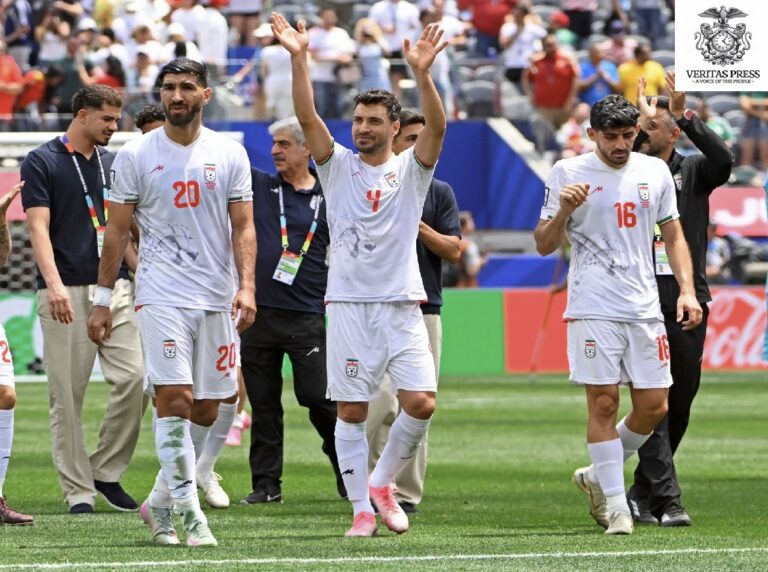
SEATTLE, TEHRAN — The U.S. Department of Homeland Security (DHS) will allow Iran’s national football team to enter the country 48 hours before their critical World Cup match against Egypt on Friday, a modest concession in a tournament where Team Melli’s travel conditions have sparked claims of oppression and competitive disadvantage.