Kamran Faqir is a volunteer investigative journalist and writer committed to exposing hidden truths and amplifying underreported stories. Driven by social justice, he brings sharp insight and fearless truth-telling to independent journalism. NUJ registered.
Title: Palestinians Shot, Homes Demolished As Israeli Raids And Settler Attacks Intensify Across The West Bank.
Press Release: Veritas Press C.I.C.
Author: Kamran Faqir
Article Date Published: 15 Jan 2026 at 18:20 GMT
Category: Middle East | Palestine-Gaza-West Bank-OPT | Palestinians Shot, Homes Demolished as Israeli Raids and Settler Attacks Intensify Across the West Bank
Source(s): Veritas Press C.I.C. | Multi News Agencies
Israeli occupation forces escalated their assault across the occupied West Bank on Thursday, shooting and injuring Palestinians, demolishing homes, and detaining scores of residents in what Palestinian rights groups and international observers describe as a systematic campaign of collective punishment and territorial consolidation carried out in parallel with Israel’s ongoing war on Gaza.
From Hebron and Masafer Yatta in the south to Jenin, Nablus, and Tubas in the north, raids swept through cities, refugee camps, and rural communities, while armed Israeli settlers continued near-daily attacks on Palestinian land and livelihoods, often under the direct protection or silent complicity of Israeli soldiers.
Human rights organisations warn that the scale, coordination, and geographic spread of these operations point not to isolated security incidents, but to a deliberate policy aimed at deepening control, accelerating displacement, and entrenching de-facto annexation of the territory.
Live Fire, Medical Obstruction, And Night Raids:
In the town of Dura, southwest of Hebron (al-Khalil), Israeli forces surrounded the home of Khaled Hassan al-Fasfous before opening fire with live ammunition, wounding him, according to the Palestinian news agency WAFA. Soldiers blocked ambulance crews from reaching the injured man before detaining him, a practice repeatedly documented by Palestinian medical organisations.
A relative of the family told local journalists:
“They shot him and left him bleeding. The ambulance was metres away, but the soldiers refused to let it pass. This is not an arrest, it is punishment.”
In a related incident, Israeli forces also shot and wounded the brother of Mahmoud al-Fasfous, a former prisoner long targeted by Israeli raids. The al-Fasfous family has endured years of repeated night incursions, interrogations, and assaults, what neighbours describe as a policy of intimidation designed to break families socially and psychologically.
Clashes erupted in Tuqu’, southeast of Bethlehem; Idhna, west of Hebron; and across several neighbourhoods of Qalqilya, where Israeli forces fired live rounds and stun grenades. A Palestinian man was shot in the foot during a raid on Qalqilya’s al-Naqqar neighbourhood, as soldiers maintained a heavy deployment across the city and raided the homes of former prisoners.
According to Quds News Network (QNN), dozens were arrested during these operations, including children and recently released detainees.
Masafer Yatta: Displacement By Design.
In Masafer Yatta, south of Hebron, an area Israel has designated a “firing zone” while allowing settler expansion, Israeli forces stormed Khirbet al-Majaz twice within hours. Soldiers raided the home of Mahmoud Musa Abu Aram, forcibly expelled his family, and converted the house into a military post.
Huda Abu Aram, a family member, said:
“They told us to leave for our own safety, then took our home. We slept outside in the cold while soldiers used our rooms. If this is not forced displacement, what is?”
Israeli forces also stormed al-Fawwar refugee camp, firing stun grenades and raiding homes. Similar operations were reported in Khirbet al-Majaz, al-Fakhit, and surrounding hamlets, reinforcing what activists describe as a long-running campaign to empty Masafer Yatta of its Palestinian population.
The International Committee of the Red Cross (ICRC) has clarified that displacement caused by sustained pressure, fear, and harassment constitutes forcible transfer under international humanitarian law, even when residents are not physically deported.
Raids Sweep The Northern West Bank:
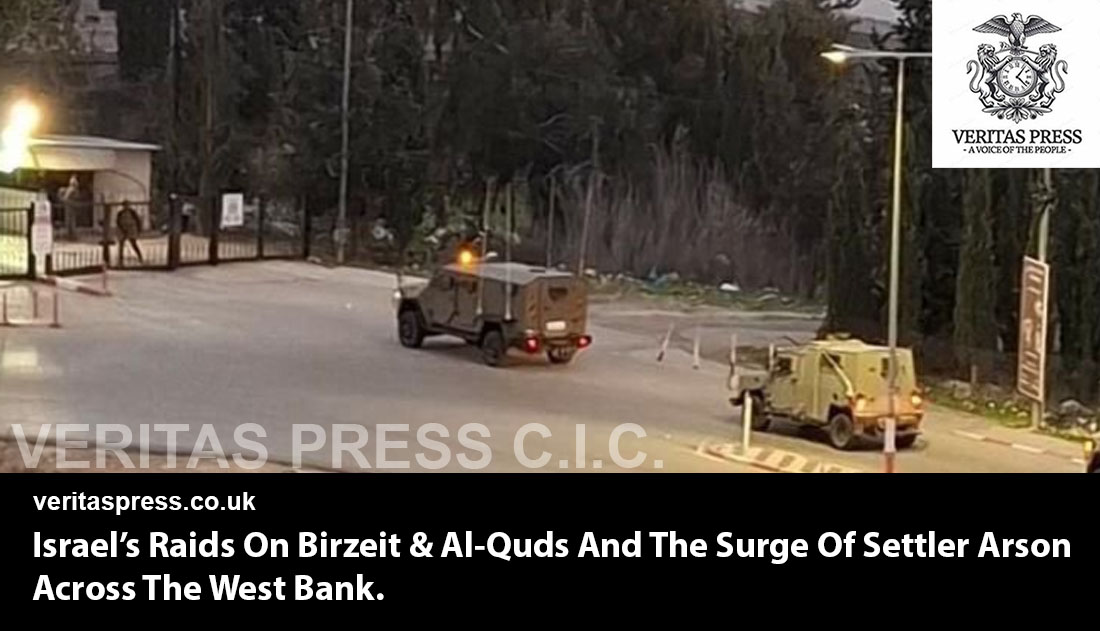
Raids extended to the northern West Bank, with Israeli forces storming Tell village southwest of Nablus, the al-Masaken al-Sha’biya neighbourhood east of the city, Wadi al-Far’a south of Tubas, and Mithlon south of Jenin.
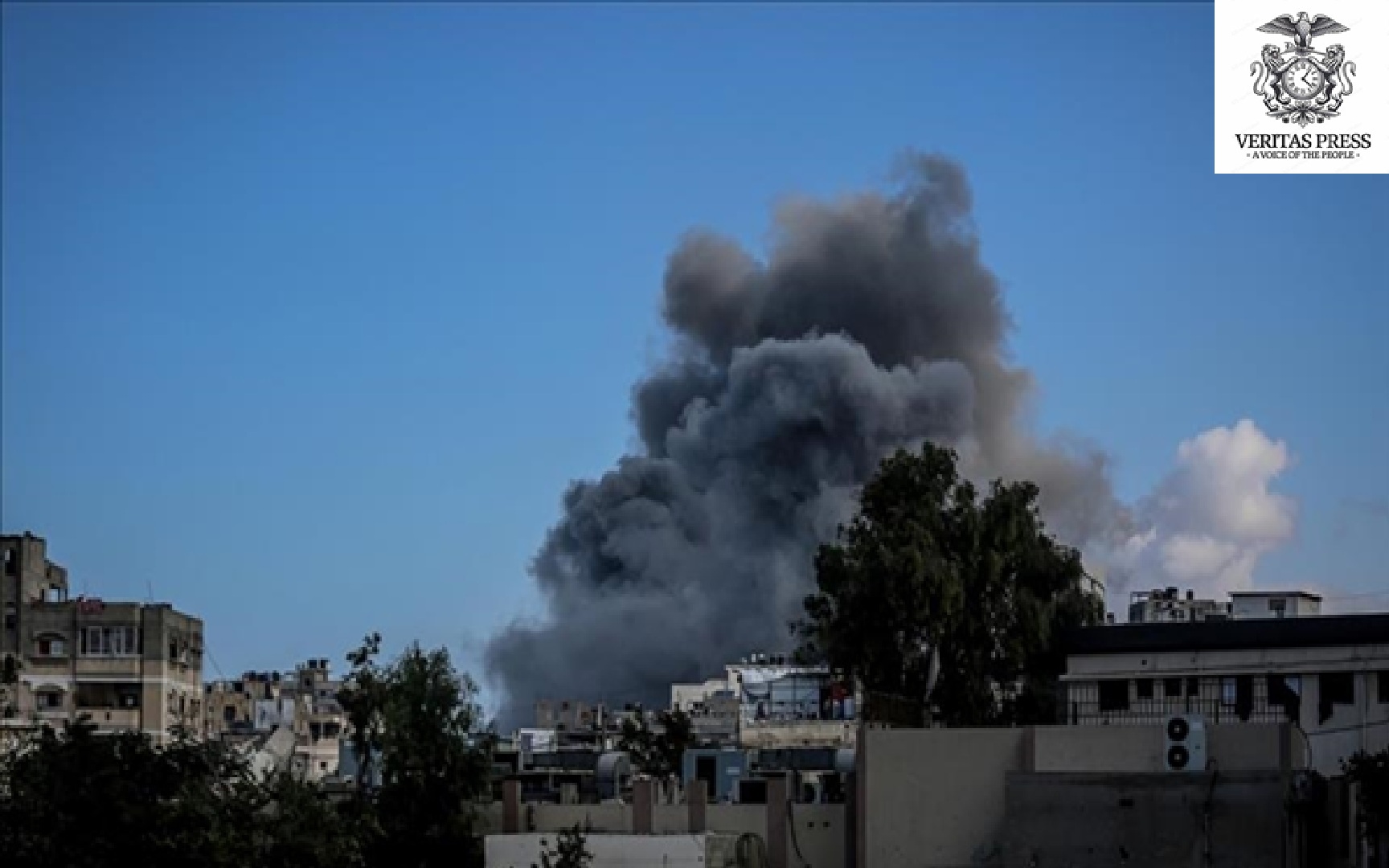
Israeli troops also raided the old and new Askar refugee camps and the Rafidia neighbourhood in Nablus, where QNN reported an explosion amid the incursion.
In Arraba, southwest of Jenin, eight young men were arrested in a single raid. Further arrests were reported in Al-Mughayyir, northeast of Ramallah; Kafr Aqab and the al-Kasarat neighbourhood north of occupied Jerusalem; and Anabta, east of Tulkarm. Among those detained were minors, including Iyad Alaa Faqha and Muhammad Yusuf Akka.
Mass Arrests As Collective Punishment:
In Hebron, Israeli forces launched a large-scale arrest campaign in Sa’ir and al-Shuyukh, raiding dozens of homes, including that of slain Palestinian Muhammad Kawazba. Recently released prisoner Muhammad Fahim Shalalda was among those detained, alongside several youths.
The Palestinian Prisoners’ Society reported that more than 80 Palestinians were detained or interrogated during overnight raids across the West Bank, including women, children, and former prisoners.
The group said the campaign represents an “unprecedented escalation,” adding:
“Field interrogations, mass arrests, and repeated targeting of the same families point to a policy of collective punishment rather than law enforcement.”
Punitive Home Demolition In Hebron:
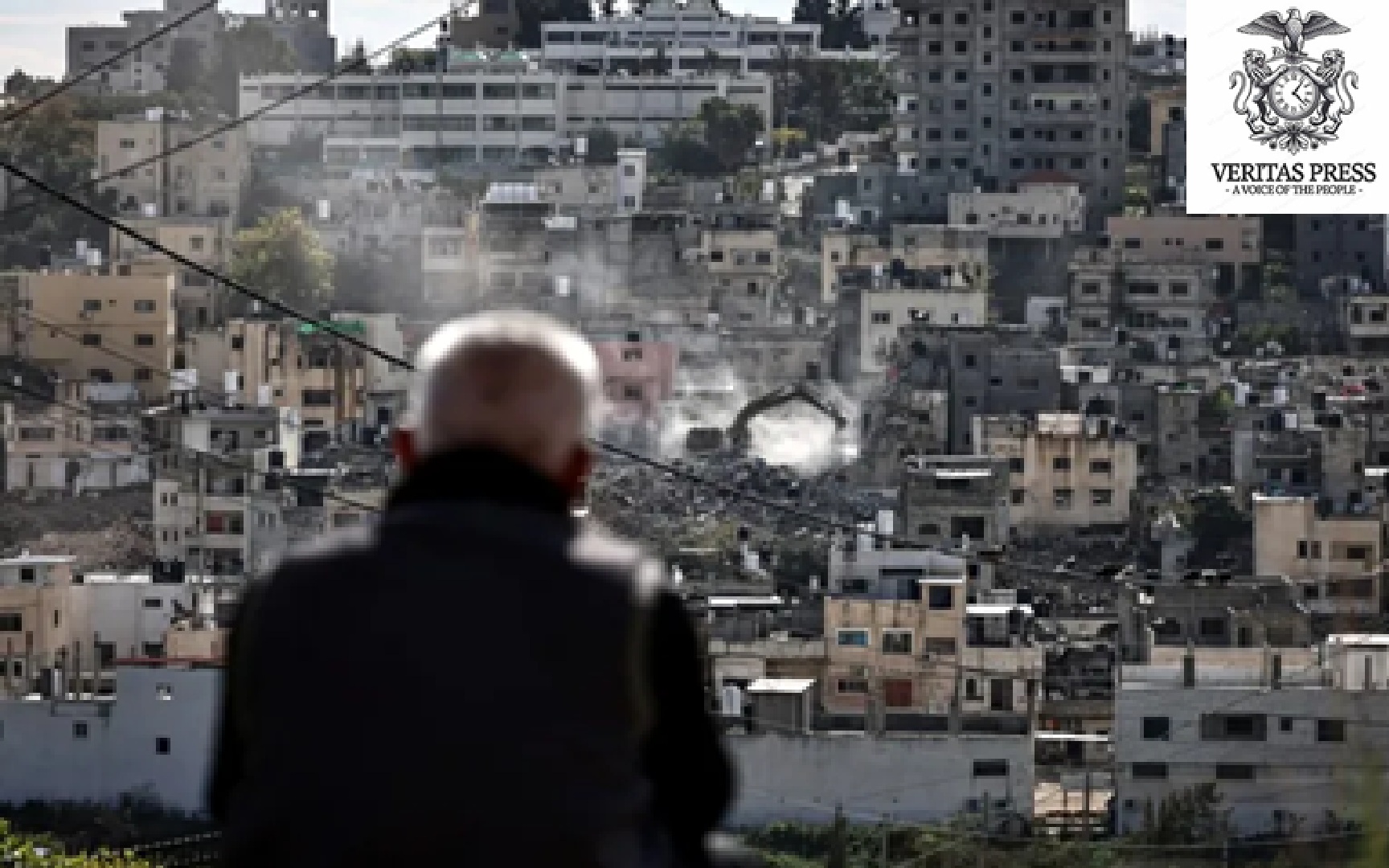
Israeli forces also demolished the home of the family of Imran al-Atrash in Hebron’s Khallat Nafisa area. Soldiers sealed off the neighbourhood, forcibly expelled the family and nearby residents, and deployed bulldozers under heavy military protection.
Al-Atrash was killed by Israeli forces in November alongside Walid Muhammad Khalil Sabarna, after Israel accused them of carrying out a car-ramming and stabbing attack near the Gush Etzion settlement bloc. The army later posted photos of the demolition on Telegram, celebrating the destruction and branding al-Atrash a “terrorist.”
Human rights organisations stress that punitive home demolitions violate Article 33 of the Fourth Geneva Convention, which explicitly prohibits collective punishment. The UN, ICRC, and Human Rights Watch have repeatedly affirmed that demolishing the family homes of accused individuals constitutes a war crime.
Settler Violence: Attacks With Impunity.
Alongside military raids, illegal Israeli settlers escalated attacks on Palestinian communities.
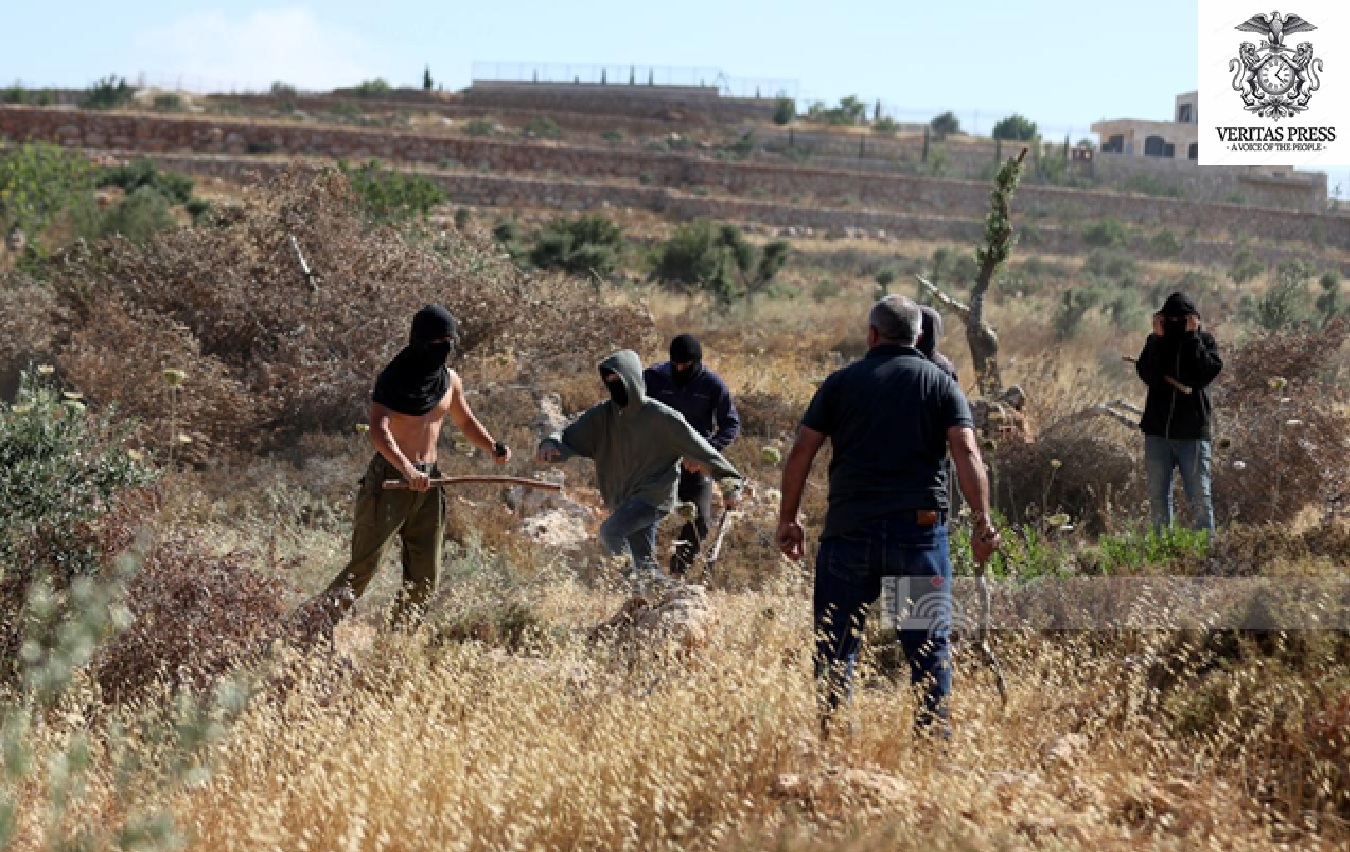
In Al-Mughayyir, settlers cut down olive trees in the Marj Si’a plain, targeting a vital agricultural area. In Qalandiya, Israeli forces bulldozed olive groves north of Jerusalem.
In Masafer Yatta, armed settlers from the Susiya outpost attacked Palestinian shepherds in Wadi al-Rakheem, injuring Mohammed Hussein Shannar, an elderly man. In another incident, settlers stormed al-Fakhit School, driving herds of camels into the schoolyard and surrounding homes.
Osama Makhameh, a local activist, said:
“They attack our children’s schools, our animals, our fields, this is about making life impossible so people leave.”
The UN Office for the Coordination of Humanitarian Affairs (OCHA) reports that Israeli forces are present in a majority of settler attacks and rarely intervene. Former UN Special Rapporteur Michael Lynk stated:
“When an occupying power systematically fails to stop settler violence, it becomes complicit in those crimes.”
A Pattern Confirmed By International Law:
Under international law, Israel’s actions in the West Bank violate multiple legal frameworks:
The Fourth Geneva Convention prohibits collective punishment, forcible transfer, and destruction of property not justified by military necessity.
Article 49(6) bans the transfer of the occupier’s civilian population into occupied territory, rendering all Israeli settlements illegal.
UN Security Council Resolution 2334 (2016) reaffirmed that settlements have “no legal validity.”
The International Court of Justice (ICJ) ruled in 2004 that Israel’s occupation practices violate Palestinian self-determination, and recent advisory proceedings have increasingly framed the occupation as unlawful and permanent.
The International Criminal Court (ICC) is investigating war crimes and crimes against humanity in the West Bank, including settlement expansion, forcible transfer, and persecution.
Amnesty International and Human Rights Watch have concluded that Israel’s policies amount to apartheid, prohibited under international criminal law.
Rising Death Toll, No Accountability:
According to OCHA, 240 Palestinians were killed in the West Bank throughout 2025, including 55 children. Israeli forces were responsible for at least 225 deaths, while settlers killed at least nine. During the same period, Palestinians killed 17 Israelis.
Despite this, Israeli military investigations rarely lead to indictments. The UN Commission of Inquiry has warned that impunity is “structural and institutionalised.”
Legal scholar Valentina Azarova noted:
“This is not a failure of law; it is a failure to enforce law, enabling permanent occupation through violence and dispossession.”
A Territory Under Siege:
For Palestinians across the West Bank, the raids, demolitions, and settler attacks are not isolated events but a daily reality, one shaped by military force, legal discrimination, and political impunity.
As one Masafer Yatta resident told journalists:
“They don’t come all at once. They come again and again, until nothing is left.”
The evidence, from eyewitness testimony to UN data and international legal findings, suggests that the West Bank is being reshaped through a slow, systematic process of repression and displacement, raising urgent questions not only about Israel’s actions, but about the international community’s continued failure to stop them.
Conclusion: Ethnic Cleansing By Design, Enabled By Impunity.
What is unfolding across the occupied West Bank cannot be credibly described as a collection of isolated security operations. The cumulative evidence of raids, live fire, home demolitions, mass arrests, settler pogroms, land seizures, and forced displacement points to a coherent system of domination aimed at the removal, fragmentation, and erasure of the Palestinian people from their land.
Across Hebron, Masafer Yatta, Qalqilya, Jenin, and Nablus, Palestinians are being subjected to conditions that international law recognises as ethnic cleansing: the deliberate creation of a coercive environment designed to push a protected population off its territory without formal deportation. Families are expelled from homes, villages are rendered unlivable, livelihoods are destroyed, and communities are broken apart, often incrementally, so that no single act appears decisive, yet the outcome is unmistakable.
As UN Special Rapporteurs have warned, forcible transfer does not require buses or mass round-ups. It occurs when people are left with no viable choice but to leave. In Masafer Yatta, in the Jordan Valley, and across rural Area C, that threshold has long been crossed.
The violence is not merely physical. It is also cultural and civilisational. Olive groves, some centuries old, are uprooted. Schools are invaded by armed settlers. Shepherding lands are seized. Cemeteries, water sources, and sacred spaces are desecrated. These acts constitute the systematic erasure of Palestinian presence, memory, and continuity, severing the intergenerational ties that bind people to land, history, and identity.
Legal scholars and human rights organisations increasingly situate these practices within the framework of genocide, not solely through mass killing, but through the deliberate infliction of conditions of life calculated to bring about the destruction of a people, in whole or in part, language drawn directly from the Genocide Convention. When displacement, starvation, denial of healthcare, arbitrary detention, and lethal force converge as policy rather than exception, intent can be inferred from pattern.
As Amnesty International has noted, genocide is not only an event, but it is a process. In the West Bank, that process manifests through fragmentation, confinement, and attrition, while in Gaza, it is rendered through open annihilation. Together, they form a single regime of control aimed at resolving the “Palestinian question” by demographic elimination.
The role of settlers is central to this project. Armed, ideologically driven, and operating with near-total immunity, settler groups function as instruments of ethnic cleansing, extending state power through violence while allowing the Israeli government to maintain plausible deniability. When soldiers escort settlers, protect outposts, and suppress Palestinian resistance, the distinction between state and mob violence collapses entirely.
International law is unequivocal. Ethnic cleansing, apartheid, forcible transfer, and genocide are prohibited without exception. The Fourth Geneva Convention, the Rome Statute, the Apartheid Convention, and the Genocide Convention were written precisely to prevent the kinds of abuses now being documented daily in the West Bank. The International Criminal Court is seized of jurisdiction. The International Court of Justice has warned of irreversible harm to Palestinian self-determination.
What remains absent is enforcement.
Western governments that continue to arm, fund, and diplomatically shield Israel while acknowledging “concerns” are not bystanders. They are participants in a system of impunity that allows ethnic cleansing to proceed under the language of security and legality.
For Palestinians, this is not an abstract legal debate. It is the lived experience of a people being slowly erased, physically, culturally, and politically, from their homeland.
Unless accountability is imposed, the West Bank will continue to serve as a laboratory for permanent occupation, where genocide is not always loud, but methodical; not always instantaneous, but cumulative; and not always denied, but rationalised.
History will not judge this moment by the number of statements issued or resolutions passed, but by whether the world chose to stop a process of destruction while there was still time.
Kamran Faqir is a volunteer investigative journalist and writer committed to exposing hidden truths and amplifying underreported stories. Driven by social justice, he brings sharp insight and fearless truth-telling to independent journalism. NUJ registered.
SEATTLE, TEHRAN — The U.S. Department of Homeland Security (DHS) will allow Iran’s national football team to enter the country 48 hours before their critical World Cup match against Egypt on Friday, a modest concession in a tournament where Team Melli’s travel conditions have sparked claims of oppression and competitive disadvantage.