




Title: Trump’s $100 Billion Venezuela Oil Push Exposes A Corporate-Military Resource Grab Led By US–Israeli Energy Interests.
Press Release: Veritas Press C.I.C.
Author: Kamran Faqir
Article Date Published: 09 Jan 2026 at 14:30 GMT
Category: Americas | Politics | Trump’s $100 Billion Venezuela Oil Push Exposes a Corporate–Military Resource Grab Led by US–Israeli Energy Interests.
Source(s): Veritas Press C.I.C. | Multi News Agencies
Website: www.veritaspress.co.uk

Business Ads

VENEZUELA/USA – US President Donald Trump’s claim that the world’s largest oil companies will invest $100 billion to rebuild Venezuela’s oil sector is being presented as an economic revival plan. In reality, it represents one of the clearest modern examples of corporate-driven regime change and resource capture, carried out through military force, sanctions warfare, and the open subordination of a sovereign country’s energy wealth to foreign control.
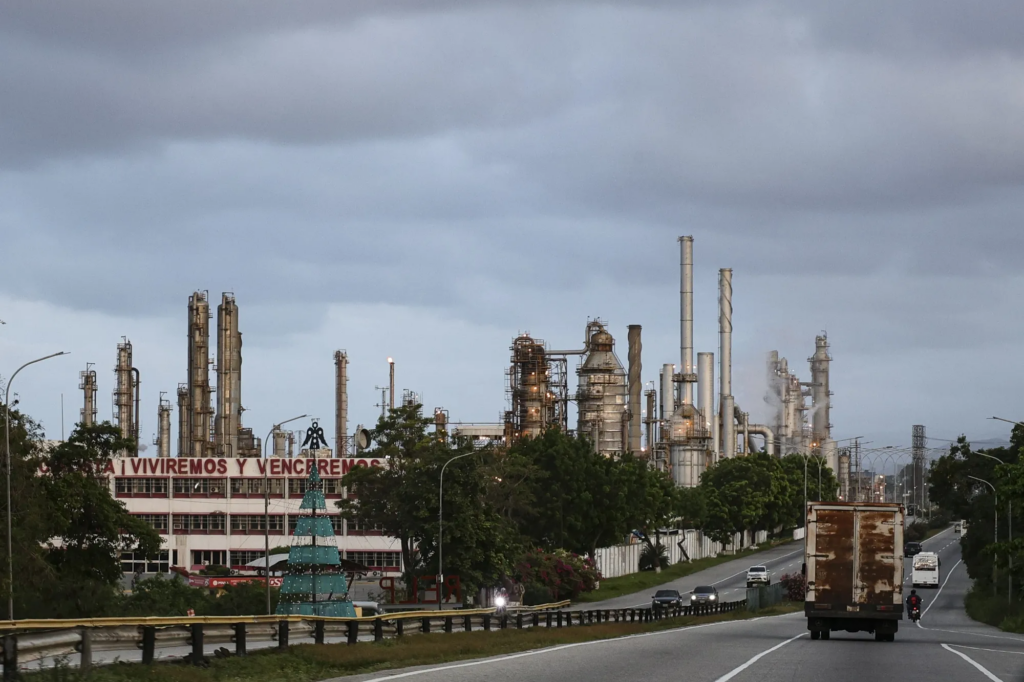
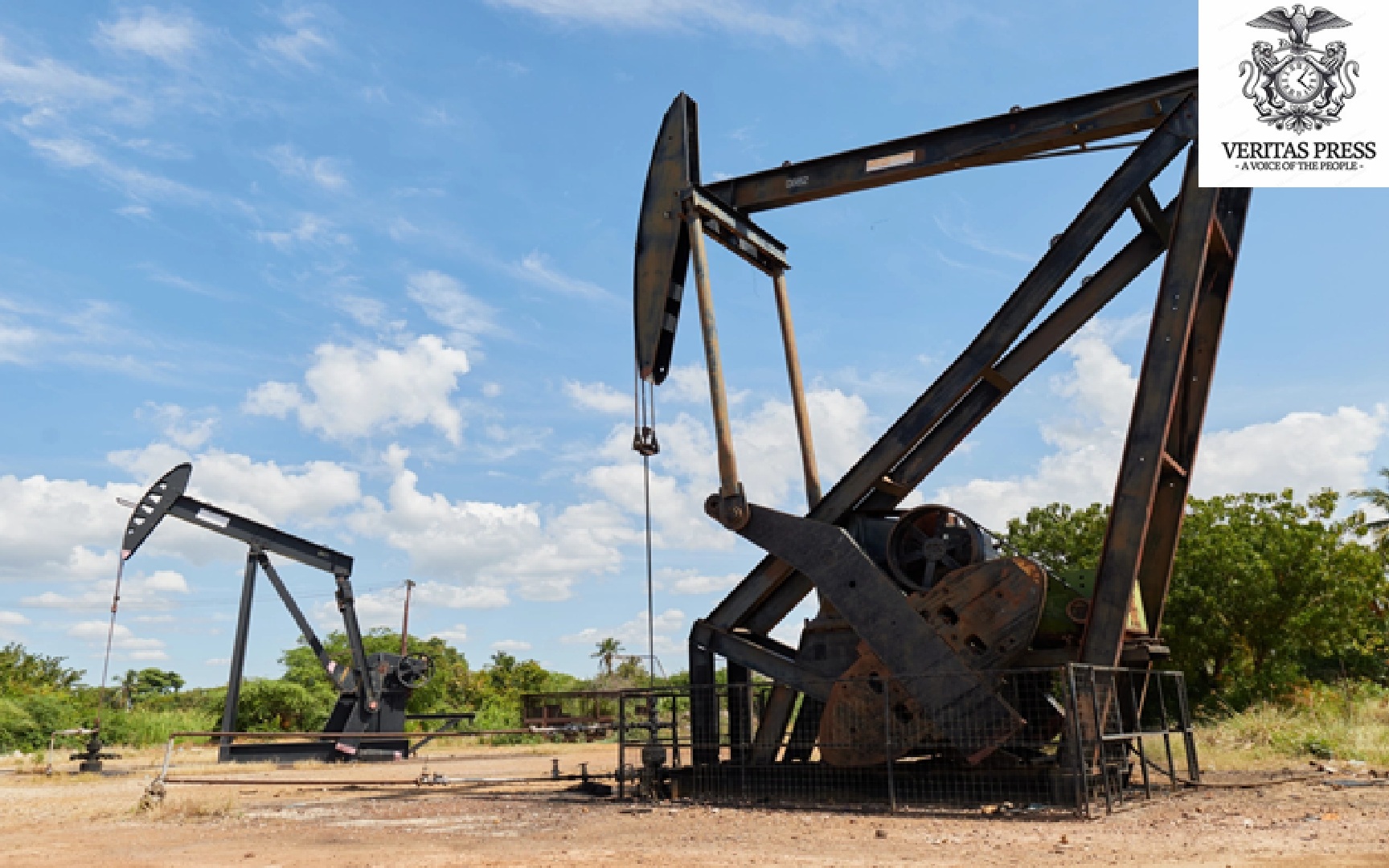
The El Palito refinery in Puerto Cabello, Venezuela.Photographer: Jesus Vargas/Getty Images
Behind the rhetoric of “rebuilding infrastructure” lies a familiar imperial playbook: military intervention followed by corporate penetration, with US and allied, particularly Israeli-linked, energy, security, and infrastructure firms positioned to profit from the dismantling of national control over strategic resources.
From Sanctions To Seizure: How Venezuela Became A Corporate Target.
Venezuela has been under sweeping US sanctions since 2019, measures that deliberately choked off oil exports, blocked access to finance, and accelerated infrastructure collapse. These sanctions were not a policy failure—they were a preparatory stage.
Years of enforced underinvestment hollowed out Venezuela’s oil industry, reducing production to about 1 percent of global output by 2024, despite the country holding roughly 20 percent of the world’s proven oil reserves. This collapse created the very “crisis” now being cited to justify foreign intervention.
On January 3, US forces escalated that strategy from economic warfare to direct military action, seizing President Nicolás Maduro in an operation Trump openly framed around oil. Unlike past interventions cloaked in humanitarian language, Trump dispensed with pretence, boasting that Venezuela’s oil wealth was now effectively under US control.
Energy Secretary Chris Wright removed any remaining ambiguity, stating that Washington would control Venezuela’s oil industry “indefinitely.”
Oil Under Presidential Control: A New Colonial Model.
Trump’s announcement that Venezuela would hand over 30–50 million barrels of oil, with revenues “controlled by me,” marked an extraordinary declaration: the personalisation of a foreign nation’s resource revenues under the authority of the US president.
The condition that Venezuela may spend those funds only on American-made products further exposes the arrangement as a closed-loop extraction system oil flows out, and money flows back into US corporate supply chains.
This is not reconstruction.
It is an enforced dependency.
Big Oil’s Reluctance And The Turn To Corporate Opportunists:
Despite Trump’s claims, major oil corporations remain wary. Exxon Mobil and ConocoPhillips, which were ousted from Venezuela in 2007 for refusing to surrender majority control to the state, are reportedly sceptical about returning under unstable governance and uncertain legal frameworks.
That reluctance has forced the White House to broaden its net beyond traditional majors toward independent operators, speculative investors, and politically connected firms, entities historically more willing to operate in conflict zones and post-coup environments.
Treasury Secretary Scott Bessent admitted as much, noting that established firms with corporate boards are hesitant, while “wildcatters” want to “get to Venezuela yesterday.”
This mirrors past US interventions in Iraq and Libya, where smaller, risk-tolerant companies often linked to security contractors moved first, locking in concessions before political arrangements were stabilised.
The US–Israeli Corporate Nexus:
While US oil giants dominate headlines, Israeli-linked firms are expected to play a critical supporting role—particularly in security, surveillance, infrastructure hardening, cyber systems, and energy logistics.
Israeli companies have long specialised in post-conflict “stabilisation” markets, supplying:
- Oilfield security and perimeter defence
- Surveillance technologies and population monitoring
- Cyber systems for energy infrastructure
- Private military and risk-management services
These firms previously embedded themselves in Iraq’s oil fields, Kurdistan, Azerbaijan, and East Africa, often following US military interventions or regime shifts.
In Venezuela, where oil facilities require militarisation rather than repair, Israeli security and energy firms are positioned to profit from a permanent state of instability, ensuring long-term dependence on foreign “protection.”
Energy Transition Myths And Corporate Contradictions:
Economist Paul Krugman’s critique cuts deeper than Trump’s “oil fantasies.” The idea that oil reserves represent an unchallenged strategic prize is outdated in an era of energy transition, oversupply, and volatile prices.
Yet corporate interest persists, not because Venezuelan oil is cheap or easy to extract, but because crisis conditions allow companies to dictate terms. Under sanctions and military pressure, Venezuela’s bargaining power collapses, enabling foreign firms to extract concessions unimaginable under normal circumstances.
Lower oil prices are already near five-year lows, only heightening this contradiction. If Venezuela were truly a market opportunity, companies would not need US military force, sanctions relief, and presidential guarantees to invest.
Selective Sanctions Relief: A Corporate Gatekeeping Tool.
Washington’s promise to “selectively roll back sanctions” is not humanitarian; it is a filtering mechanism, designed to reward compliant firms while excluding rivals from China, Russia, and Iran.
This ensures that Venezuela’s reintegration into global markets occurs on US terms, with Western and allied Israeli companies controlling production, transport, blending, and refining.
The US Department of Energy’s plan to ship light crude to blend Venezuelan oil, alongside authorising equipment and expert deployments, further embeds foreign operational control into every stage of the supply chain.
Venezuela’s Resistance, And Its Limits:
Interim President Delcy Rodríguez has rejected US claims of total control, insisting that Venezuela remains sovereign. But the imbalance of power is stark.
With military forces on the ground, oil revenues externally managed, and sanctions weaponised as leverage, Venezuela’s political leadership faces a constrained reality: negotiate from coercion or face economic strangulation.
Trump’s framing of prisoner releases as “cooperation” underscores how humanitarian gestures are being repurposed as transactional currency in a broader extraction project.
A Blueprint For 21st-Century Resource Colonialism:
The Venezuela operation reveals an evolved model of imperial control:
- Sanctions collapse infrastructure
- Collapse is framed as mismanagement
- Military intervention follows
- Corporate entry is branded as reconstruction
- Long-term foreign control replaces sovereignty
Unlike 20th-century colonialism, sovereignty is not formally abolished; it is functionally hollowed out, replaced by contractual domination and security dependency.
Venezuela In Context: Repeating The Iraq–Libya Resource Seizure Model.
What is unfolding in Venezuela is not unprecedented. It follows a US-led resource intervention model refined in Iraq after 2003 and adapted in Libya after 2011. While the justifications differed, the outcome remained the same: foreign corporate control over national energy wealth.
Iraq: Military Invasion, Corporate Reconstruction.
After the 2003 invasion, US authorities rewrote Iraq’s hydrocarbon laws, dismantling national controls and opening the sector to foreign firms. Beneficiaries included ExxonMobil, Chevron, BP, Shell, Halliburton, and Schlumberger.
Israeli-linked security firms provided oilfield protection and surveillance. Iraq’s oil never liberated the country; it entrenched instability while profits flowed outward.
Libya: Regime Change Without Reconstruction.
NATO’s 2011 intervention removed Muammar Gaddafi but left no functioning state. Oil production resumed without sovereignty, amid militia rule and opaque revenue channels. Israeli-linked intelligence and security firms expanded under EU- and US-backed “stabilisation” contracts.
Libya’s oil fields functioned. Libya as a state collapsed.
Venezuela: A Hybrid Model.
Venezuela combines both precedents:
- Direct military control, like Iraq
- Managed instability, like Libya
- Open presidential ownership of oil revenues, unlike either
Imperial intent is no longer denied; it is advertised.
The Israeli Corporate Footprint: Security, Surveillance, And Energy Control.
Israeli corporations form the quiet backbone of the post-intervention energy ecosystem, specialising in converting militarised spaces into “investment-ready” zones.
Oilfield Security and Infrastructure
- Elbit Systems: Oilfield surveillance, drones, perimeter defence, command systems
- Israel Aerospace Industries (IAI): Aerial surveillance, radar, infrastructure protection
Surveillance and Population Control
- NSO Group: Activist monitoring, political surveillance, labour suppression
- Verint Systems: Mass data monitoring and energy infrastructure intelligence
Cyber Control of Energy Systems
- Check Point Software, Radware: SCADA protection, grid cyber-defence, logistics control.
Private Military and Risk Management:
Israeli-linked firms guard installations, train security forces, and shape power dynamics—ensuring extraction remains insulated from public accountability.
Why Israeli Firms Matter Strategically:
Israel lacks oil, but excels in conflict-enabled extraction systems. Its firms thrive where instability is permanent, legitimacy is contested, and force substitutes for consent. Integrated with US military and intelligence networks, Israeli companies provide the tools needed to occupy resources without formally colonising territory.
In Venezuela, they are ideally positioned to ensure that oil flows uninterrupted, regardless of public resistance and Venezuelan sovereignty under siege.
Israeli involvement is not incidental:
- Israel lacks oil but dominates extractive security technologies
- Its firms thrive in permanent conflict economies
- They operate with minimal political constraint
- They integrate seamlessly with the US military and intelligence systems
Sanctions As Corporate Weaponry:
As in Iraq and Libya, sanctions are no longer punishment; they are corporate allocation tools.
- Rivals are excluded
- Allies dominate logistics and security
- Oil flows only through approved channels
Sanctions become a mechanism of market engineering.
Sanctions As Corporate Gatekeeping:
Washington’s promise to “selectively roll back sanctions” is not relief; it is corporate filtration. Sanctions are lifted for compliant firms and maintained against rivals, particularly Chinese, Russian, and Iranian companies.
This ensures:
- Chinese, Russian, and Iranian firms remain excluded
- Western and Israeli firms dominate logistics, refining, and security
- Venezuela’s oil re-enters markets only through approved channels
Sanctions thus shift from punishment to corporate gatekeeping.
This ensures Venezuela’s reintegration into global markets occurs only through US- and Israeli-aligned channels, locking in long-term dependence.
A Blueprint For 21st-Century Resource Colonialism:
The Venezuela operation reveals a refined imperial model:
- Sanctions collapse infrastructure
- Collapse justifies intervention
- Military force secures assets
- Corporations enter under “reconstruction”
- Surveillance and security entrench control
Sovereignty is not abolished; it is emptied of meaning.
Venezuela As A Test Case For Future Resource Interventions:
What makes Venezuela uniquely alarming is the openness of the strategy.
Trump has:
- Admittedly, the intervention is about oil
- Claimed control over revenues
- Tied military restraint to compliance
- Positioned corporations as governing actors
This is not an anomaly; it is a prototype.
Conclusion: Venezuela And The Normalisation Of Corporate Sovereignty.
What is unfolding in Venezuela is not a deviation from international norms; it is the deliberate rewriting of them.
Trump’s $100 billion promise is not about investment; it is about institutionalising extraction under force. Whether or not that money ever materialises is almost irrelevant. The architecture is already in place. Venezuela’s oil is being transformed from a national resource into a foreign-controlled revenue stream, externally managed by Washington and its allies, with access conditioned on political compliance and corporate alignment.
Unlike Iraq and Libya, where intervention was cloaked in claims of weapons, humanitarian rescue, or counterterrorism, Venezuela marks the point at which the pretext has been discarded altogether. Oil is no longer the hidden motive behind regime change; it is the openly declared objective. Trump’s assertion of personal presidential control over Venezuelan oil revenues represents a qualitative shift in imperial practice: from indirect corporate influence to overt executive ownership of a sovereign nation’s wealth.
This is not reconstruction. It is an enforced dependency.
Under the guise of “energy revival,” Venezuela is being reinserted into a global system in which resources flow upward, power flows outward, and local populations bear the cost. Military force occupies revenue streams rather than territory. Sanctions do not punish misgovernance; they manufacture collapse, hollowing out state capacity until foreign control can be presented as the only solution. Corporations do not advise governments they replace them as governing authorities over infrastructure, security, and economic policy.
What is unfolding is not an oil deal. It is a corporate–military occupation of energy sovereignty.
Venezuela’s significance lies in its function as proof of concept. The fusion of sanctions warfare, selective legal recognition, military intervention, and corporate penetration forms a repeatable architecture of domination, one refined in Iraq, normalised in Libya, and now formalised in Venezuela. What differs is not the outcome, but the openness with which it is pursued.
Israeli-linked security, surveillance, and cyber firms are not peripheral actors in this model; they are structural enablers. Their technologies allow extraction to proceed without political resolution, converting permanent instability into a profitable condition. Surveillance replaces consent. Militarised “risk management” substitutes for legitimacy. Resistance is not resolved; it is monitored, suppressed, and priced into operating costs. In this way, occupation becomes economically sustainable and politically deniable.
The promise of investment is the final deception. Capital does not flow into Venezuela because of confidence in its future; it flows because coercion guarantees returns. The presence of military force, sanctions leverage, and externally controlled revenues eliminates risk, not for Venezuelans, but for corporations. This is why oil prices, energy transition rhetoric, and market logic are beside the point. Venezuelan oil is valuable not as energy, but as leverage.
If this model holds, Venezuela will not be rebuilt; it will be repurposed. Its oil sector will function. Exports will resume. Profits will be recorded. Yet the country’s ability to decide how its resources are used, socially, politically, or economically, will be permanently constrained. Sovereignty will persist only as a legal façade, stripped of control over capital, security, and decision-making.
The danger extends far beyond Venezuela. This intervention signals to every resource-rich state that sovereignty is conditional, revocable through sanctions, enforceable through force, and transferable to corporations. In an era of intensifying resource competition, climate disruption, and geopolitical fragmentation, Venezuela is not an anomaly. It is a warning.
Venezuela is not being rescued from collapse. It is being dismantled, component by component, and reassembled as a managed asset within a global system that rewards obedience and punishes independence. The lesson is unmistakable: in the 21st century, resistance to Western-aligned corporate power is no longer negotiated; it is monetised, securitised, and, if necessary, erased.