








Title: ‘Your Time Is Up, Sadiq Khan’: Farage’s London Offensive And What It Really Signals About British Politics.
Press Release: Veritas Press C.I.C.
Author: Kamran Faqir
Article Date Published: 07 Jan 2026 at 15:25 GMT
Category: UK | Politics | ‘Your Time Is Up, Sadiq’: Farage’s London Offensive and What It Really Signals About British Politics.
Source(s): Veritas Press C.I.C. | Multi News Agencies
Website: www.veritaspress.co.uk

Business Ads

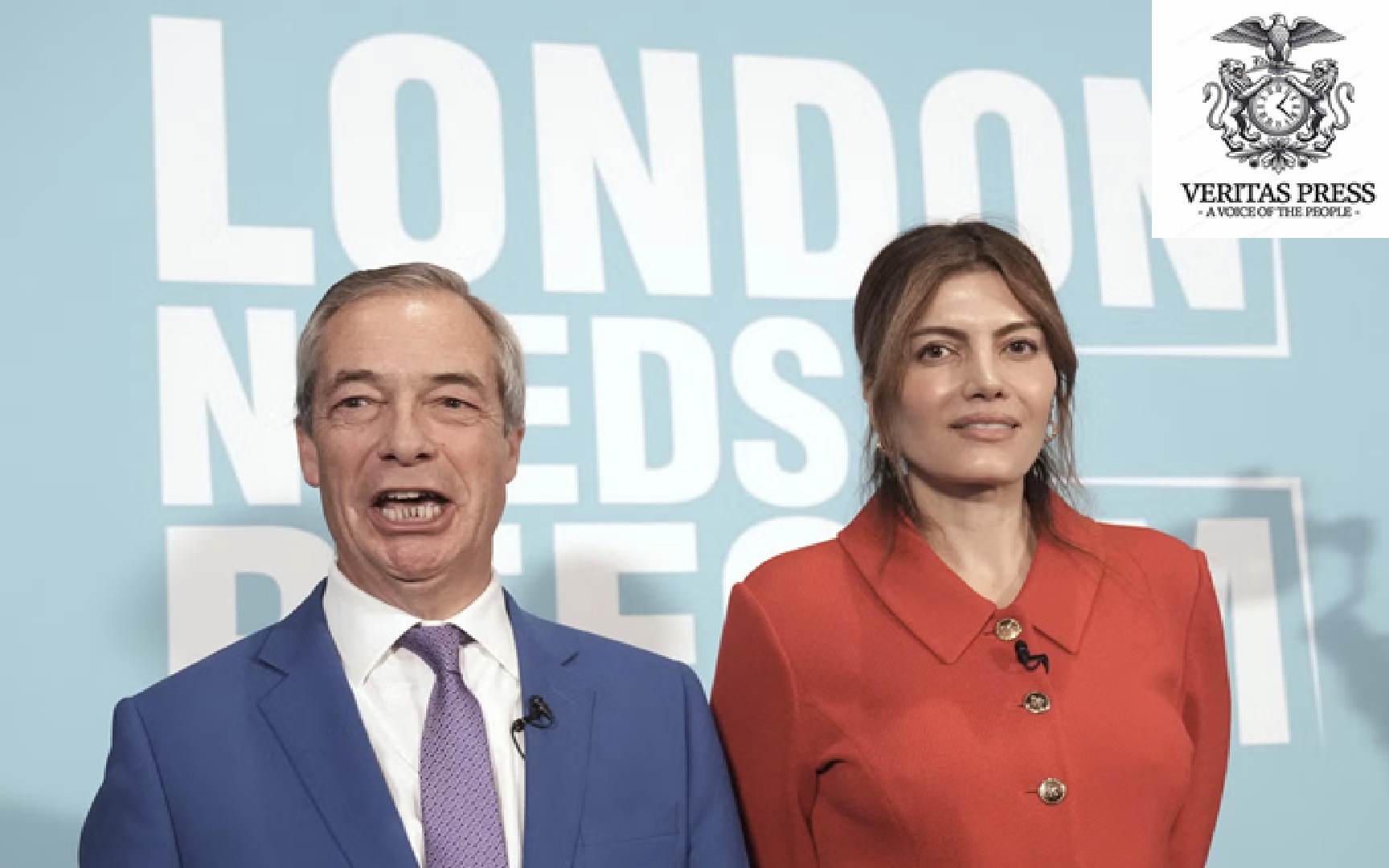
LONDON — In a headline-grabbing press conference this week, Nigel Farage unveiled Laila Cunningham as Reform UK’s candidate for the London mayoral election in 2028, framing the capital as a city in crisis and launching an explicit campaign to “get rid of Sadiq Khan.” Farage cast the upcoming May 2026 local elections as “the single most significant” electoral test before a decisive national poll, a clear signal that Reform aims not merely at City Hall but at national power.
Yet beyond the theatre of soundbites and slogans, critics, analysts and community activists see a deeply polarising strategy that does more than challenge Labour; it risks hardening narratives around crime, immigration and identity that have fuelled political divisions across the UK.
Law And Order As A Mobilising Myth? Scrutinising The Crime Narrative:
At the launch, Cunningham pledged an “all-out war on crime,” promising new policing priorities and calling for a complete overhaul of the Met’s approach to knives, drugs, robbery and sexual offences.
But independent observers point out that official crime data tell a different story: London’s murder and knife crime rates have declined over the last decade, with some metrics at multi-decade lows, figures that even Farage has publicly refused to accept, calling the data “not reliable.”
Dr. Maya Goodwin, senior criminologist at the Centre for Urban Studies, says Reform’s narrative simplifies the complex causes of crime: “Rising crime is not a monolithic ‘wave’ caused by a failed mayor. Economic insecurity, austerity-induced cuts to youth services, and systemic under-resourcing of police play huge roles. Abstracting crime into a foreign‑gang narrative skews public understanding.”
Similarly, the Good Law Project, which has analysed Reform’s hardline anti‑migrant messaging, notes that the party has repeatedly exploited fears around attacks on women to stoke anti‑migrant sentiment, using flawed statistics and emotionally charged language rather than evidence-based policy proposals.
Immigration, Diversity And The Politics Of Fear:
Cunningham’s remarks on integration, including criticism of migrants for allegedly expecting London to “change for them”, have drawn strong reactions.
For many activists, these statements do not exist in a vacuum:
- Stand Up To Racism, an anti‑racism organisation, has repeatedly warned that Reform’s rhetoric overlaps with far-right framing that blames minorities for social problems and seeks to define British identity in exclusionary terms.
- Local community campaigner Amina Rahman, who works with refugee families in East London, said: “Painting migrants as part of a crime problem magnifies fear but ignores the reality of people fleeing war and persecution. It also hides the fact that London’s diversity is a strength, not a weakness.”
Analysts point out that across British politics, immigration discourse has shifted over recent years toward securitised frames, with Reform riding this tide politically. A recent academic analysis of parliamentary debate shows a marked trend toward using migration as a proxy for broad societal anxieties rather than engaging with integration and social cohesion.
Critics On The Left And Right: Broad Political Pushback.
Labour and the Liberal Democrats wasted little time rebutting Reform’s London bid:
- A Labour source close to Sadiq Khan noted Khan’s achievements, including record low homicide rates, new council homes and significantly reduced harmful air pollution, contending that Reform’s depiction of London as unsafe was misleading and politically motivated.
- Luke Taylor, Lib Dem London spokesman, accused Reform of “talking down London” and prioritising division over practical solutions.
Meanwhile, Prime Minister Keir Starmer has publicly criticised elements of Reform’s platform and language, branding some policies as racially divisive and warning that they “would tear the country apart.” His attacks reflect concerns at the centre of UK politics about the normalisation of hardline, identity-based politics.
Media, Coverage And Populism:
Reform’s growing presence in the media has itself become a subject of controversy. Studies have shown that Reform’s media coverage, particularly focused on Farage, has been disproportionately high relative to its size in Parliament, raising questions about how broadcast attention amplifies populist voices.
Independent commentator Sam Bright argues that “media fascination with Farage’s theatrics feeds a cycle: the louder the rhetoric, the more coverage, the more legitimacy is conferred on ideas that should be rigorously challenged.”
Internal Tensions And Extremism Allegations:
Even within Reform’s ranks, tensions flare around controversial views. Farage was recently forced to address objections when he publicly urged a candidate to apologise for a tweet telling an MP to “go home,” an incident that Labour said highlighted a failure of leadership on racist remarks.
Groups such as Hope Not Hate have categorised Reform UK as a far-right party, pointing to its track record on immigration, nationalism and rhetoric that aligns with other European populist movements, casting a long shadow over its appeal to mainstream voters.
What Londoners Really Want: Competing Visions For The Capital.
Behind the high-volume campaigning, public opinion data suggest a deep divide in how Reform is perceived:
- YouGov polling shows Reform enjoys highly favourable views among its voter base, even as the majority of Britons view the party unfavourably. Few have positive opinions among younger, more diverse demographics.
For many Londoners, issues such as affordable housing, public transport, mental health services, and youth opportunity continue to top their concerns, areas where critics argue Reform offers little substantive policy beyond rhetoric.
Housing activist Terence Okoro said: “We need visionary planning for London’s future, homes, living wages, community safety through investment, not fearmongering.”
Bottom Line: Narrative Over Substance?
Reform UK’s London push, encapsulated in Farage’s headline-driven launch, is as much about shaping political discourse as it is about municipal governance. By reframing long-standing debates about crime, identity and migration through a polarising lens, Reform has turned the mayoral contest into an ideological battleground: one about who Londoners are as much as how the city should be run.
But beneath the soundbites lies a patchwork of unanswered questions, critics argue:
- How will projected crime reductions be achieved without clear, fundable policy frameworks?
- Does the party’s messaging unfairly scapegoat minorities and migrants?
- Can divisive national narratives translate into effective local governance in a diverse cosmopolitan city?
These issues, activists and analysts warn, are not just electoral tactics; they shape the future of London’s social fabric and Britain’s political culture at large.