Kamran Faqir is a volunteer investigative journalist and writer committed to exposing hidden truths and amplifying underreported stories. Driven by social justice, he brings sharp insight and fearless truth-telling to independent journalism. NUJ registered.
Title: Storms Ravage Gaza’s Makeshift Shelters As Israel Continues To Block Aid Access, UN Warns.
Press Release: Veritas Press C.I.C.
Author: Kamran Faqir
Article Date Published: 31 Dec 2025 at 10:20 GMT
Category: Middle-East | Palestine-Gaza-West Bank | Storms Ravage Gaza’s Makeshift Shelters As Israel Continues To Block Aid Access, UN Warns.
Source(s): Veritas Press C.I.C. | Multi News Agencies
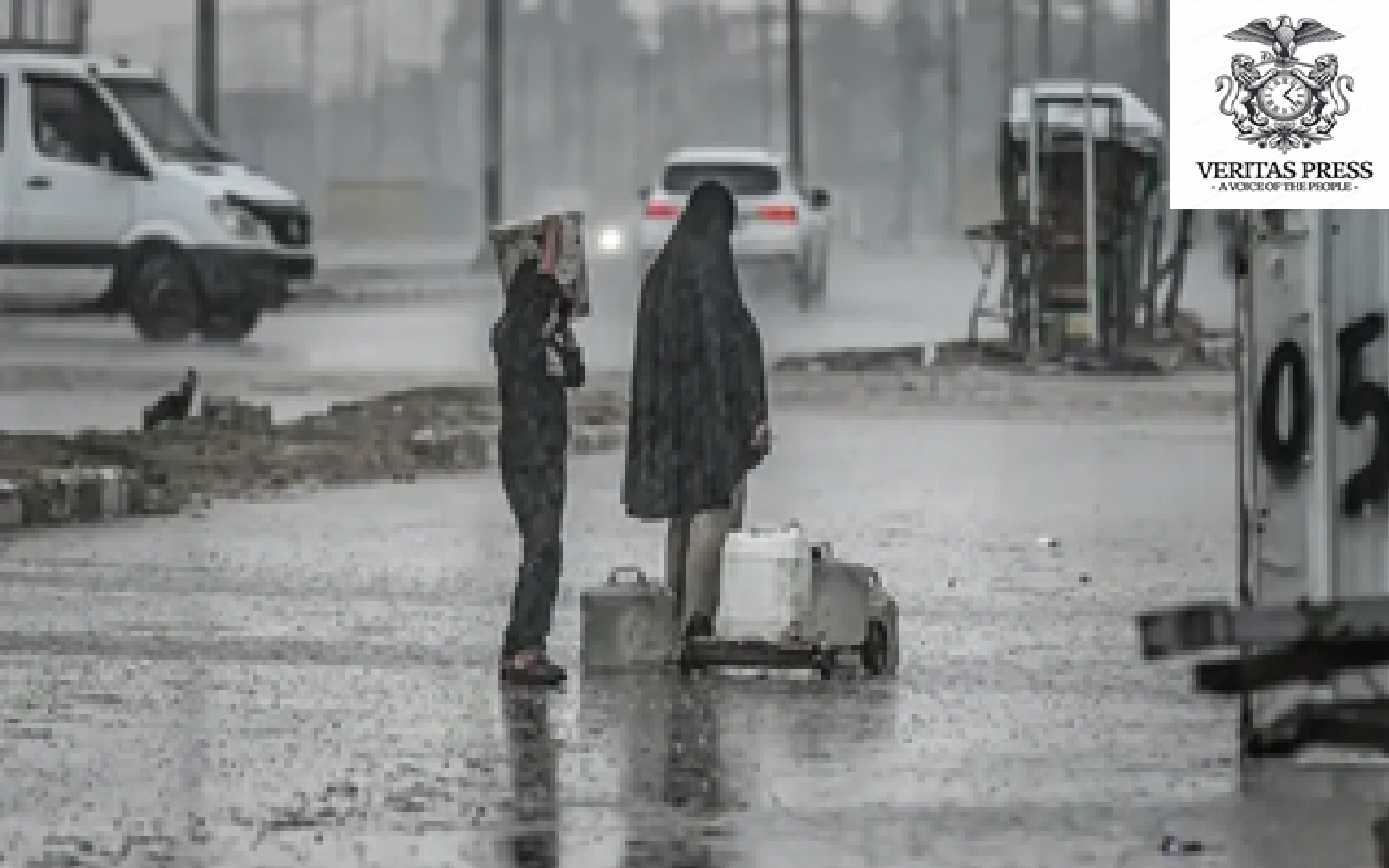
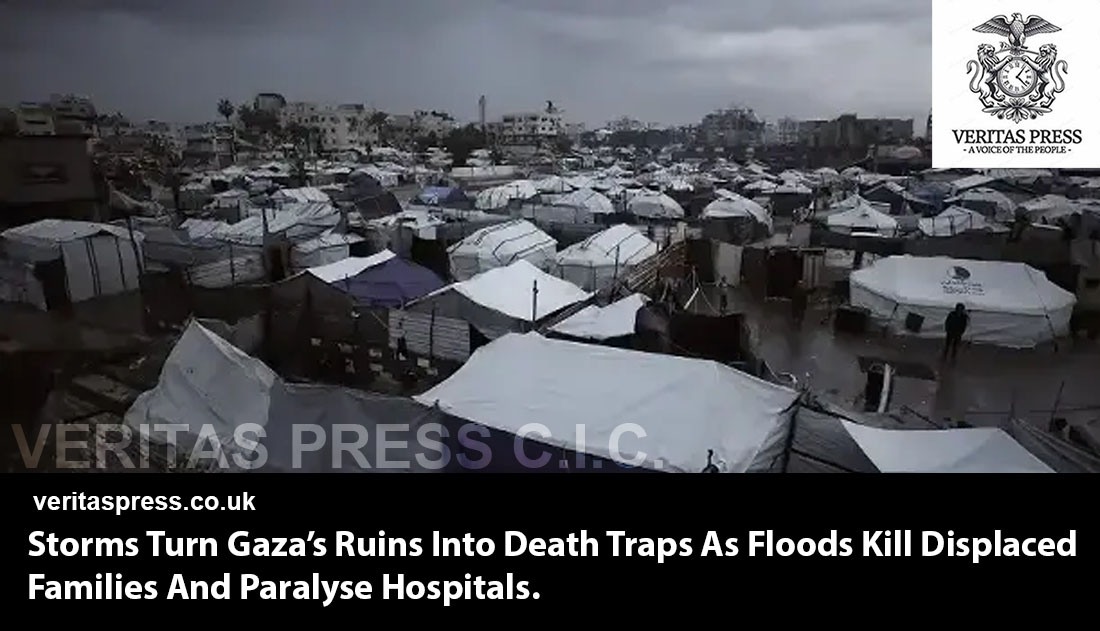
Strong winds and torrential rain have destroyed hundreds of makeshift shelters across the Gaza Strip, leaving already displaced families exposed to freezing temperatures, flooding, and collapsing structures, as Israel continues to block the entry of critical shelter supplies and restrict humanitarian access despite an October ceasefire.
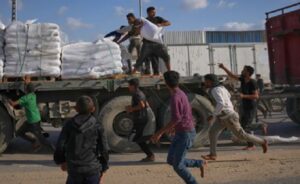
The United Nations Relief and Works Agency for Palestine Refugees (UNRWA) said this week that severe winter storms have torn through Gaza, damaging or completely destroying tents and temporary shelters housing hundreds of thousands of Palestinians displaced by more than two years of war.
“Tents and tarpaulins are desperately needed,” UNRWA said in a statement posted on X, warning that families are now exposed to harsh winter conditions while Israeli authorities continue to block the agency from directly bringing shelter supplies into the enclave.
The storms, marked by strong winds, heavy rain, and coastal flooding, have hit at a time when Gaza’s population remains overwhelmingly displaced, infrastructure is largely destroyed, and humanitarian access remains tightly restricted.
Shelters Washed Away As Winter Sets In:
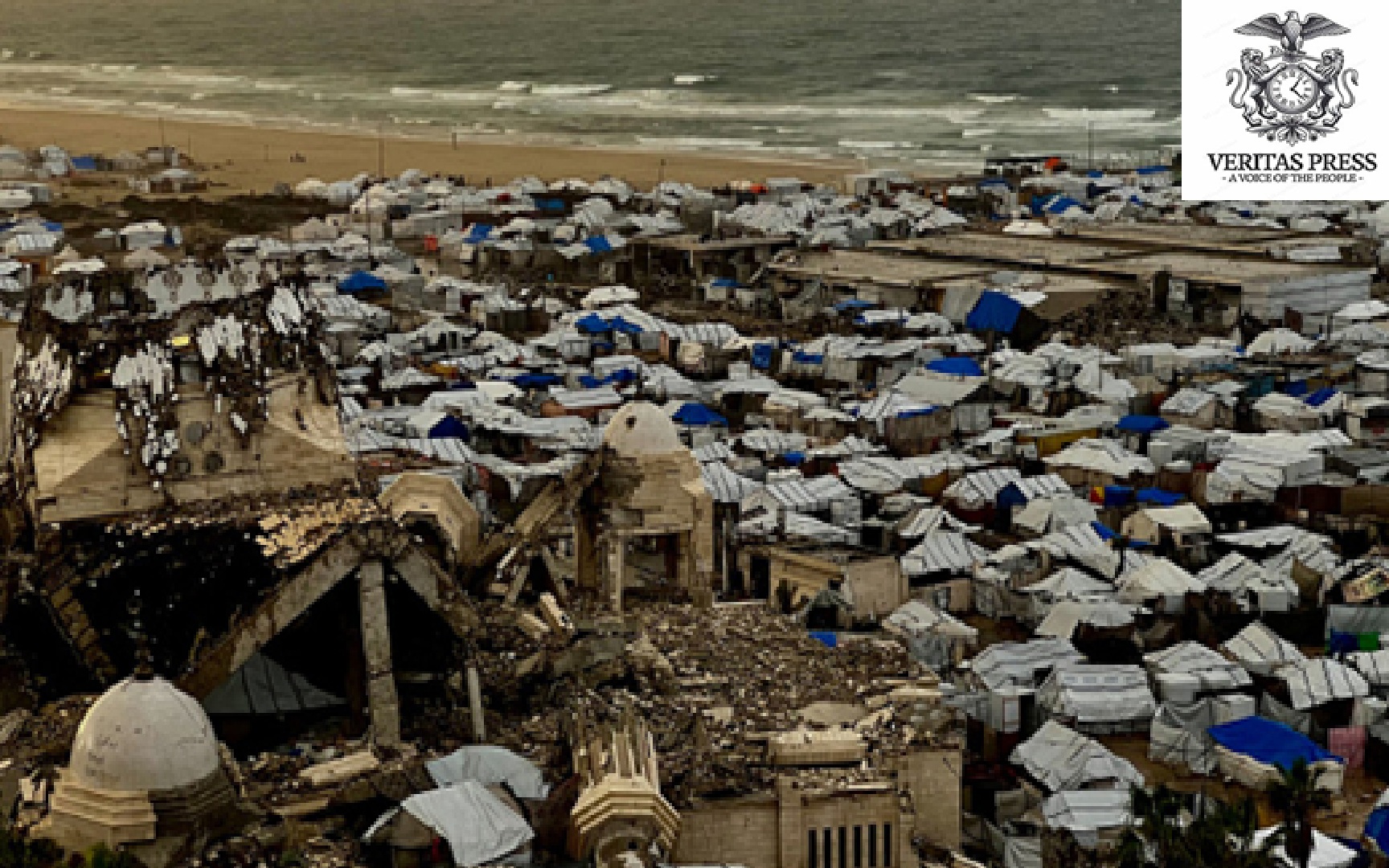
According to UN agencies and Palestinian Civil Defence (PCD), rainfall since late December has triggered flash flooding across low-lying areas, coastal zones, and informal displacement sites, particularly in Al Mawasi, Khan Younis, Gaza City, and parts of Deir al Balah. Seawater has inundated tent encampments, soaking families’ few remaining belongings and forcing many to flee again to higher ground.
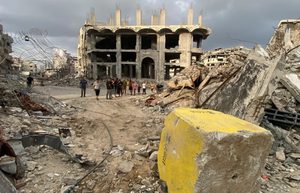
Heavy winds have ripped through tarpaulins and tents, while already-damaged buildings, many weakened by Israeli airstrikes, have collapsed under storm pressure. Since early December, at least 18 residential buildings have completely collapsed, and more than 110 others have suffered dangerous structural damage, according to the PCD.
The human toll has been deadly. Gaza’s Ministry of Health reported that in December alone:
17 people died due to the collapse of buildings
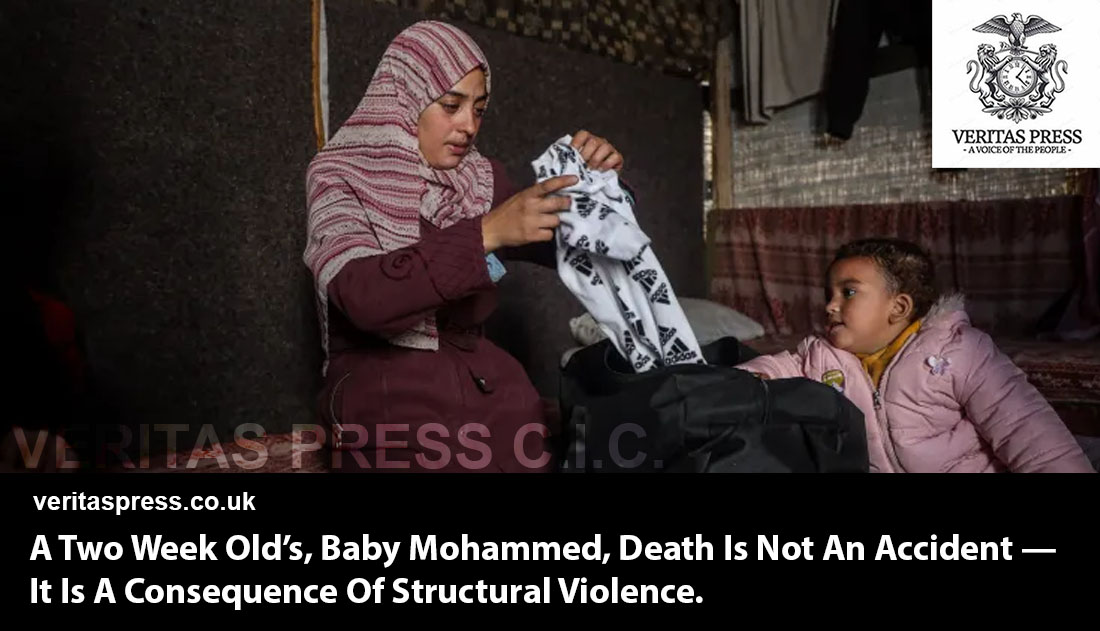
Three children died of hypothermia, including a two-month-old baby who died on 29 December
A seven-year-old child drowned in a flooded well
A 30-year-old woman was killed when a wall collapsed during the storm
Médecins Sans Frontières (MSF) said its teams are reporting persistently high levels of respiratory infections, warning that winter conditions, overcrowding, and exposure will drive preventable illness and deaths, particularly among children under five.
Aid Blocked Despite Ceasefire:
The humanitarian emergency is unfolding despite a ceasefire agreement that came into effect on 10 October, halting the most intense phase of Israel’s war on Gaza, which began in October 2023.
That war killed more than 100,000 Palestinians, most of them women and children, injured over 400,000, and reduced much of Gaza to rubble. Yet the ceasefire has not translated into meaningful humanitarian relief. Despite this, Israel is breaking international law, human rights, and all accords, solely to bolster its colonial ambitions.
According to Gaza’s Health Ministry, at least 414 Palestinians have been killed and more than 1,100 injured since the ceasefire, amid continued Israeli airstrikes, shelling, and ground operations. Israeli forces remain deployed in over 50 per cent of the Gaza Strip, particularly east of the so-called “Yellow Line,” where access to land, the sea, and humanitarian facilities remains restricted or outright prohibited.
Crossings remain largely closed, preventing the entry of mobile homes, reconstruction materials, and adequate shelter supplies, even as winter storms compound suffering.
UNRWA, established more than 70 years ago to support Palestinians forcibly displaced in 1948, says Israel continues to block it from directly delivering aid, severely limiting its ability to respond to weather-related emergencies and ongoing displacement.
EU Warns Israel Over NGO Restrictions:
The crisis has drawn sharp international criticism. On Wednesday, EU Commissioner for Equality, Preparedness and Crisis Management, Hadja Lahbib, warned that Israel’s plans to block or suspend international NGOs operating in Gaza would amount to blocking life-saving assistance.
“Israel’s plans to block INGOs in Gaza mean blocking life-saving aid,” Lahbib said on X. “The EU has been clear: the NGO registration law cannot be implemented in its current form. All barriers to humanitarian access must be lifted. International humanitarian law leaves no room for doubt: aid must reach those in need.”
Her remarks came after Israeli authorities announced plans on 30 December to suspend the operations of some international NGOs. In response, the Humanitarian Country Team in the Occupied Palestinian Territory, representing UN agencies and more than 200 humanitarian partners, urged Israel to reverse the decision, stressing that INGOs are essential for survival-level aid delivery.
Humanitarian Missions Obstructed, Aid Delayed:
Even when aid is approved in principle, access remains unpredictable and dangerous. Between 17 and 29 December, UN agencies coordinated 86 humanitarian missions with Israeli authorities:
46 were facilitated
22 were impeded
Five were denied outright
13 were cancelled due to security or logistical risks
Airstrikes, shelling, and gunfire continue to be reported across Gaza. On 19 December, at least five people were killed when a school sheltering displaced families was hit in At Tuffah, eastern Gaza City.
Meanwhile, detonations of residential buildings and bulldozing operations continue near restricted zones, and access to Gaza’s coastline remains prohibited, depriving communities of livelihoods and food sources.
A Shelter Crisis Affecting Over A Million People:
Humanitarian partners report that hundreds of thousands of Palestinians are currently living in flooded tents or damaged buildings at risk of collapse. While shelter agencies have provided emergency assistance to over 80,000 households since early December, including tents, tarpaulins, bedding, and winter clothing, the scale of need far outstrips supply.
Recent storms alone have affected an additional 65,000 households, pushing total urgent shelter needs to more than one million people, according to the Shelter Cluster.
UN agencies stress that predictable and unimpeded access is essential to shift from emergency survival to early recovery. Instead, restrictions on materials, fuel, and equipment continue to undermine even basic responses.
Food Crisis “Pushed Back,” But Still Critical:
A new Integrated Food Security Phase Classification (IPC) analysis released on 19 December found that famine conditions in Gaza have been temporarily alleviated, largely due to reduced hostilities and increased aid and commercial food entry. However, the gains remain “fragile, perilously so.”
The IPC estimates that:
1.6 million people will face Crisis-level food insecurity or worse through April 2026
571,000 will remain in Emergency (IPC Phase 4)
Nearly 1,900 people will still face Catastrophe (IPC Phase 5)
Over 101,000 children under five are projected to suffer acute malnutrition by October 2026
UNICEF, WFP, FAO, and WHO warned that food availability does not equal food access. Prices remain beyond the reach of most families, cash shortages persist, and dietary diversity is dangerously low.
“Food is now in markets, but many families simply cannot afford to buy it,” said UNICEF emergency director Lucia Elmi. “These fragile gains could vanish overnight if fighting resumes.”
Environmental And Public Health Risks Mount:
Winter rains have also exacerbated Gaza’s solid waste and sanitation crisis. According to the WASH Cluster and UNDP:
Over $66 million in damage has been recorded to waste management systems
More than 200 waste collection trucks have been destroyed or damaged
Gaza’s two main landfills remain inaccessible, forcing reliance on unsafe temporary dumping sites
Flooding risks dispersing waste into densely populated areas, contaminating water sources and heightening disease risks. Restrictions on fuel, spare parts, and specialised equipment continue to block long-term solutions.
A Crisis Of Access, Not Capacity:
As of 30 December, only 40 per cent of the $4 billion requested under the 2025 humanitarian appeal for Gaza and the West Bank had been funded. Yet aid agencies stress that funding alone cannot resolve the crisis without unrestricted access.
The UN Secretary-General has repeatedly emphasised that international humanitarian and human rights law obliges Israel to allow aid to reach civilians and has reaffirmed UNRWA as an “indispensable” actor.
As winter storms tear through Gaza’s tent cities, the reality is stark: the catastrophe unfolding is not the result of weather alone, but of sustained political decisions that continue to block shelter, protection, and recovery for more than two million people living in the ruins of war.
In Summary: Environmental Exposure As A Method Of War.
What is unfolding across Gaza this winter cannot be dismissed as a natural disaster layered onto war. The storms ripping through makeshift tents, the flooding of displacement camps, and the deaths of children from hypothermia are not accidental by-products of conflict; they are the foreseeable and preventable outcome of a system engineered to deny protection, shelter, and recovery. In Gaza, the weather has become another form of erasure, designed into a broader architecture of airstrikes, siege, and genocidal intent pursued by Israel.
The rain did not destroy Gaza’s homes; Israeli bombs did. The wind did not force families into tents made of plastic and cloth; mass displacement under military assault did. And the cold did not kill infants sheltering in flooded camps; the deliberate blocking of shelter supplies, mobile homes, fuel, and reconstruction materials did. Winter is not the cause of this catastrophe; it is exposing, with brutal clarity, what has already been structurally imposed: a civilian population stripped of the means to survive.
Under international humanitarian law, this suffering is not incidental. Israel’s continued obstruction of UNRWA and international humanitarian organisations, even after the October ceasefire, demonstrates that deprivation is not a failure of coordination or capacity but a function of policy. When tents, tarpaulins, water pumps, waste-management equipment, and fuel are barred from entry; when international NGOs are threatened with suspension; when crossings remain closed while storms rage, deprivation becomes systematic. In legal terms, this moves beyond negligence into deliberate harm, particularly when inflicted on a population already devastated by sustained military violence.
The convergence of airstrikes, forced displacement, and environmental exposure forms a continuum of violence. Bombardment destroys homes; blockade prevents rebuilding; winter finishes what explosives began. This is not an unintended sequence but a logic of attrition, one that international legal experts and human rights organisations increasingly warn meets the threshold of collective punishment, prohibited under Article 33 of the Fourth Geneva Convention, and, in its cumulative effect, may amount to the willful infliction of conditions of life calculated to bring about physical destruction, as articulated in Article II(c) of the Genocide Convention. Erasure does not always arrive in the form of a missile; sometimes it comes as rain falling on a tent that should never have been a home.
International humanitarian law leaves no ambiguity. An occupying power is obligated to ensure civilians’ access to shelter, humanitarian relief, and adequate living conditions. Yet in Gaza, law has been subordinated to control, and humanitarian access has been transformed into a bargaining tool. The result is a landscape where children drown in wells, families freeze under plastic sheets, and preventable deaths are normalised under the language of “security,”“coordination,” and “administrative necessity.” In such circumstances, omission becomes a method of harm, and environmental exposure becomes a weapon.
The international community’s response, statements of concern, expressions of alarm, and appeals for restraint have so far failed to disrupt this system. Without enforceable pressure, unrestricted humanitarian access, and accountability mechanisms that address both military violence and siege conditions, Gaza’s winter will remain lethal by design. The crisis demands more than emergency relief; it demands recognition that environmental exposure has been weaponised through policy, and that allowing it to continue constitutes legal and moral complicity.
The storms will pass. The legal record will not. The question is whether the world will continue to allow a people to be erased not only by bombs, but by cold, hunger, and exposure, all made possible by deliberate obstruction. Gaza’s catastrophe is not a test of humanitarian capacity; it is a test of political will, legal integrity, and the credibility of international law itself. So far, that test has failed, and children are paying the price.
Kamran Faqir is a volunteer investigative journalist and writer committed to exposing hidden truths and amplifying underreported stories. Driven by social justice, he brings sharp insight and fearless truth-telling to independent journalism. NUJ registered.
SEATTLE, TEHRAN — The U.S. Department of Homeland Security (DHS) will allow Iran’s national football team to enter the country 48 hours before their critical World Cup match against Egypt on Friday, a modest concession in a tournament where Team Melli’s travel conditions have sparked claims of oppression and competitive disadvantage.