





Title: Unlawful Arrests, Settler Violence And State Complicity: The Broader Struggle Behind The Detention Of Two U.S. Activists In The West Bank”.
Press Release: Veritas Press C.I.C.
Author: Kamran Faqir
Article Date Published: 15 Dec 2025 at 15:45 GMT
Category: Middle-East | Palestine-Gaza-West Bank -OPT |
Source(s): Veritas Press C.I.C. | Multi News Agencies
Website: www.veritaspress.co.uk

Business Ads


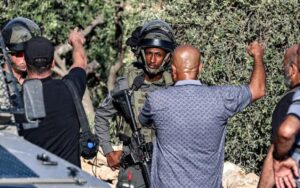
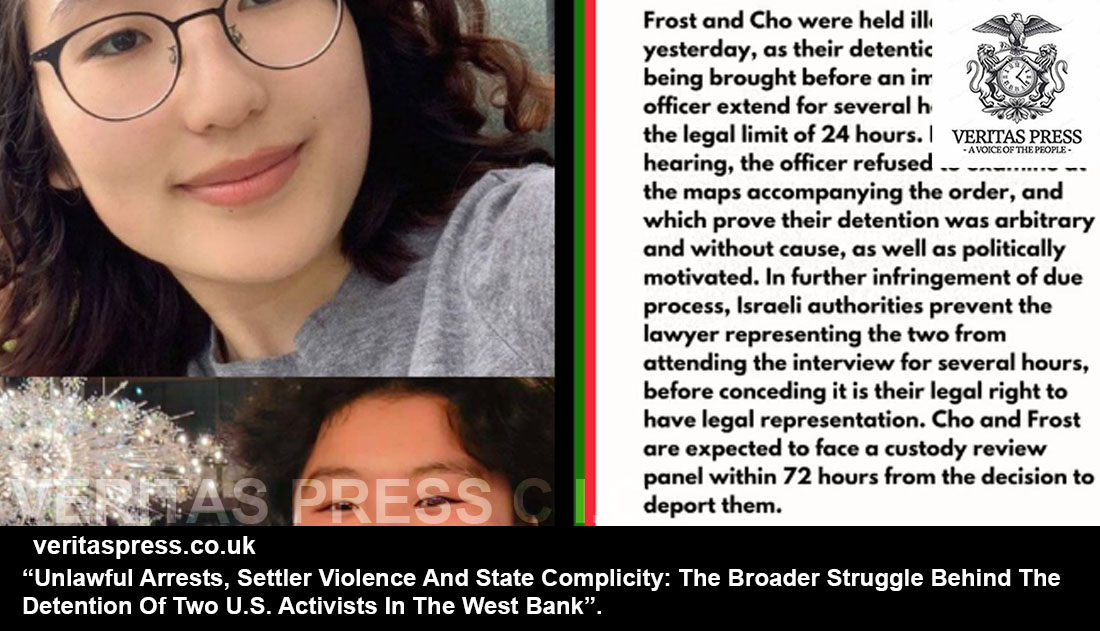
AL‑MUGHAYYER, WEST BANK — On December 12, 2025, Israeli forces arrested two U.S. activists, Irene Cho (New York) and Trudi Frost (Boston), in the small Palestinian village of al‑Mughayyer while they were staying with the Abu Hamam family, who have been resisting sustained settler violence and state-backed displacement for more than a year. The activists, who had been volunteering with the International Solidarity Movement (ISM), are now being held in Givon Prison near Ramla, as their lawyers prepare legal appeals challenging the legality and motivations behind their detention and prospective deportation.
Unlawful Arrests And Legal Suppression:
According to ISM press releases and legal representatives, Israeli authorities revoked the activists’ stay permits via a summary deportation procedure, bypassing established due‑process safeguards. Frost and Cho’s lawyers argue that the military closure order invoked to justify the arrests, described by authorities as a “month-long closed military zone”, did not actually include the Abu Hamam residence in the restricted area, calling the detentions arbitrary and unlawful.
In a statement before her arrest, Frost said she volunteered with ISM because “the ethnic cleansing happening in Palestine goes against international law and against humanity,” framing her work as rooted in human rights and solidarity rather than criminality. Cho, likewise, expressed admiration for “the long legacy of protective presence and collective efforts to reduce settler violence,” highlighting the activist motivation behind their presence.
But this legal case exposes more than procedural irregularities; it highlights how Israeli authorities are using immigration and administrative procedures to suppress international solidarity efforts, effectively criminalising nonviolent accompaniment of vulnerable Palestinian families.
Due Process Violations:
ISM legal teams reported multiple violations of due process:
- The activists were held beyond the legal 24-hour limit without arraignment.
- Authorities initially refused to examine maps proving the activists were outside the closure zone.
- Lawyers were blocked from the hearing for hours, forcing a belated acknowledgement of legal representation rights.
These procedural violations are not isolated bureaucratic errors; they reflect an emerging pattern in which Israeli authorities weaponise administrative controls (such as stay permits) to pre‑empt legal accountability.
The Abu Hamam Family: Targeted By Settlers And Soldiers.
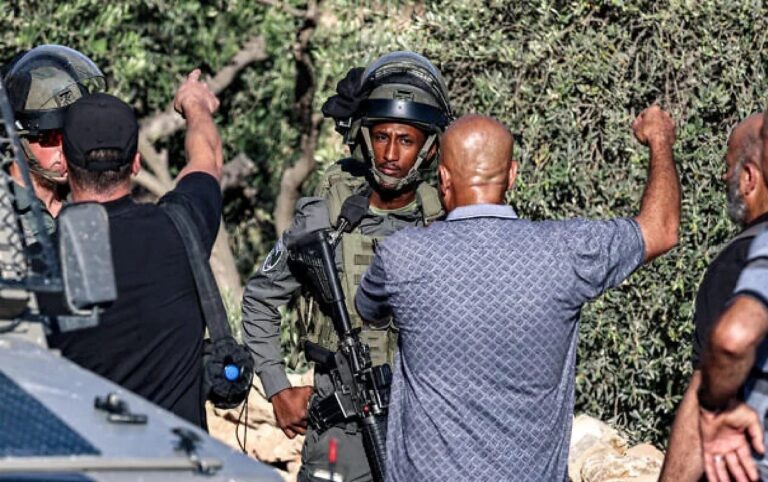
The Abu Hamam family, whose land and home were the site of the arrests, has faced relentless harassment and violence from settlers, often in coordination with, or with the tacit support of, Israeli military forces. The ISM documents injuries to the family’s 59-year-old matriarch, Fadda Abu Naim, and 13-year-old Riziq Abu Naim, alongside foreign volunteers, during a December 7 coordinated assault, which included a military raid that blocked villagers and medics from responding.
An ISM press release paints a vivid sequence of escalating aggressions:
“On December 8, settlers dismantled Palestinian-owned sheds under military protection. On December 10, a military force raided the property, issuing a 24-hour closure order and arresting volunteers. On Friday, the unlawful arrests of Cho and Frost occurred, followed by several additional military raids targeting solidarity activists.”
Crucially, these documented patterns of violence do not occur in a vacuum. United Nations data show that entire Palestinian communities near Ramallah and the surrounding countryside have been forced out of their homes due to settler harassment backed by state inertia or complicity. For example, at least 20 families were displaced from Mughayir al‑Dir after settlers established outposts next to their homes.
This broader context underscores that the Abu Hamam family is symptomatic of a larger strategy, one that combines settler violence with military decrees to force Palestinians off their land, creating corridors for settlement expansion.
Settler Violence And State Backing: A Larger Pattern.
International rights organisations have repeatedly documented similar dynamics across the West Bank. A Human Rights Watch report found that settlers, often acting with the complicity or direct protection of Israeli forces, routinely attack Palestinian homes, livestock, and infrastructure. In one case, a Palestinian family faced threats of death, destruction of water and gas supplies, and violent beatings, all while Israeli soldiers remained unresponsive or present but inactive.
This convergence of settler violence and state power mirrors testimonies from other affected communities:
- Settlers built an illegal outpost just meters from Palestinian homes, leading to harassment and the forced departure of 150 residents, while soldiers and police stood by.
- Multiple villages have reported daily settler attacks that go unpunished, even as Palestinian families lose access to farmland and services.
These patterns are corroborated by international media and UN reporting, which tie the spike in West Bank violence to policy shifts in Israel’s far-right government and a near-total lack of accountability for settler perpetrators.
In this climate, solidarity activists are often the only witnesses capable of documenting abuses, yet the authorities appear determined to silence them through arbitrary arrests, deportations, and administrative harassment.
Voices From The Ground: Palestinian Families And International Solidarity.
Fadda Abu Naim, wounded in recent attacks, has repeatedly described the terror of settler incursions and the impotence of protection from the very forces meant to enforce order. Her family’s testimony shatters official narratives of isolated clashes, revealing a relentless pattern of violence, intimidation, and land theft, escalation that culminated in the arrests of Cho and Frost.
Residents like Fida Rizq, a local elder, recount being physically beaten with tiles and threatened with death if they remain on their land. “They told us: ‘You have only two days to leave; if we see you here, we will burn you in the house and kill all of you,’” she said, illustrating the climate of fear that definitions like “security operation” cannot capture.
For activists like Cho and Frost, the choice to stay with the family was deeply intentional. Frost’s statement that she came “because the ethnic cleansing happening in Palestine goes against international law and humanity” is not rhetorical; it reflects a commitment to protective presence, a practice widely regarded by human rights groups as one of the few tools available to deter violence when state actors fail to protect civilians.
International Law, Settlements, And The Logic Of Displacement:
Forced displacement of Palestinian communities and settlement expansion are not fringe interpretations but are codified as illegal under international law. In a landmark 2024 advisory opinion, the International Court of Justice ruled that Israel’s occupation and settlement enterprise in the West Bank violates international law, obliging the state to “immediately cease all new settlement activities” and to evacuate settlers from occupied land.
Yet on the ground, the opposite is happening: settler outposts are proliferating, violent incursions are escalating, and Palestinian communities are increasingly isolated and displaced.
Conclusion: A Strategic Suppression Of Solidarity And Accountability.
The detention of Irene Cho and Trudi Frost, framed by Israeli authorities as an immigration matter, must be understood within the broader architecture of dispossession, state‑settler collusion, and suppression of dissent in the occupied West Bank. Their arrests are not isolated bureaucratic actions; they are part of a broader strategy to insulate settler violence from scrutiny, to criminalise international solidarity, and to normalise the abandonment of Palestinian communities to unrestrained attacks.
As legal challenges proceed and advocacy efforts intensify, the case of Cho and Frost will likely become a touchstone for debates over freedom of movement, international activism, and the rule of law under occupation, precisely because it exposes how legal instruments can be repurposed to sustain structural violence far beyond the courtroom.