



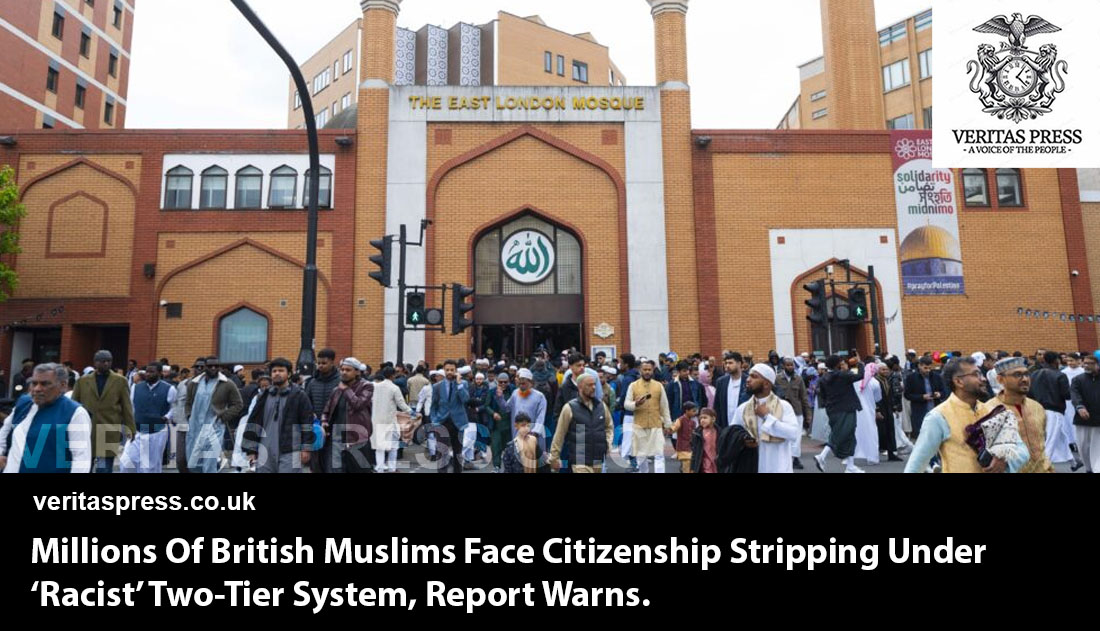

Title: Millions Of British Muslims Face Citizenship Stripping Under ‘Racist’ Two-Tier System, Report Warns.
Press Release: Veritas Press C.I.C.
Author: Kamran Faqir
Article Date Published: 15 Dec 2025 at 12:33 GMT
Category: UK | Politics-Islamophobia | Millions Of British Muslims Face Citizenship Stripping Under ‘Racist’ Two-Tier System, Report Warns.
Source(s): Veritas Press C.I.C. | Multi News Agencies
Website: www.veritaspress.co.uk

Business Ads

LONDON — A British woman stranded in a detention camp in northeastern Syria discovered she was no longer a citizen of the country where she was born only after her requests for consular help were refused.
There was no warning, no court hearing and no chance to challenge the decision in advance. The Home Secretary had stripped her of her British citizenship without notifying her, a power now enshrined in UK law.
Her case is not an anomaly. According to a new report by the Runnymede Trust and legal charity Reprieve, up to nine million people in the UK, around 13 percent of the population, could legally be stripped of their British citizenship, with Muslims and people of colour facing vastly disproportionate risks.
The report warns that the UK has created a “two-tier citizenship regime” in which the nationality of Muslims and people of colour is treated as conditional, revocable and subject to political discretion.
Millions At Risk, Muslims Hit Hardest:
The report, Stripped: The Citizenship Divide, draws on the 2021 census, the Annual Population Survey and Home Office parental nationality data. It finds that people of colour are 12 times more likely to be vulnerable to citizenship deprivation than white Britons.
Three in five people of colour could be stripped of citizenship under the current law, compared with just one in twenty white British people.
By ethnicity, the analysis shows:
- 62 percent of Black British people
- 60 percent of Asian British people
- 62 percent of people classified as ‘Other’ ethnicity
are legally at risk, compared with 5 percent of white British people.
Given that Muslims make up 6.5 percent of the population of England and Wales, around 3.9 million people, and are overwhelmingly drawn from Asian, Black, Arab and North African communities, the report estimates that more than two million British Muslims fall within the highest-risk categories.
“The vast majority of those deprived of citizenship in practice have been Muslims with South Asian, Middle Eastern or North African heritage,” the report states.
From Post-War Taboo To Routine Power:
Citizenship stripping was once regarded as a legal and moral taboo in Europe after the Second World War, following the Nazi regime’s mass denationalisation of Jewish citizens.
In the UK, the power lay largely unused for decades. Between 1973 and 2002, citizenship was stripped only in cases of fraud.
That changed after 2002, as a series of counterterrorism and immigration laws dramatically expanded ministerial authority.
Key changes included:
- extending deprivation powers to British-born dual nationals
- lowering the threshold to conduct deemed “conducive to the public good”
- allowing deprivation based on a belief that a person could acquire another nationality
- removing the requirement to notify individuals of the decision
- preventing the immediate restoration of citizenship even after successful court challenges
Since 2010, more than 200 people have been stripped of British citizenship on “public good” grounds. Only Bahrain and Nicaragua have used such powers more frequently, making the UK the only G20 country to deploy citizenship deprivation at scale.
‘A Racialised Hierarchy Of Belonging’:
Campaigners argue that the law has embedded Islamophobia into the architecture of citizenship.
Under current legislation, only citizens with real or presumed access to another nationality can be stripped of citizenship, a criterion that overwhelmingly affects people with non-white ancestry.
“Citizenship is a right, not a privilege,” said Shabna Begum, chief executive of the Runnymede Trust.
“Yet successive governments are advancing a two-tier approach that makes the citizenship of Muslims and people of colour conditional.”
Maya Foa, chief executive of Reprieve, said the powers are “extreme and secretive” and warned that they reflect long-standing far-right narratives about divided loyalty.
“We are British, not Brit-ish,” Foa said. “Treating people with a connection to another country as second-class citizens is an affront to equality before the law.”
Media Islamophobia And Moral Panics:
The expansion of citizenship deprivation has been accompanied by years of hostile media coverage of Muslim communities, campaigners say.
Tabloid headlines linking Muslims to extremism, “no-go zones” and cultural incompatibility have fuelled repeated moral panics, while broadcast media have often amplified security-focused framings with limited scrutiny. These narratives have been reinforced by politicians who deploy racially coded language and Islamophobic tropes to legitimise suspicion. Former prime minister Boris Johnson infamously described Muslim women wearing the niqab as looking like “letter boxes,” reducing Muslim religious visibility to ridicule and framing it as socially deviant. More recently, former home secretary Suella Braverman cast Muslim-led political expression through the lens of extremism, warning of what she called “Islamist mobs” and portraying pro-Palestine demonstrations as threats to national order. On the populist right, Reform UK figures have argued that “Islam is not compatible with British values” and warned that Britain is becoming “unrecognisable,” framing Muslims as a demographic threat. Each major terrorist attack has triggered renewed calls for tougher laws and fewer rights, calls that rarely distinguish between perpetrators and the wider Muslim population. Campaigners argue that these interlocking media and political narratives normalise the idea that Muslims’ belonging is conditional, creating a climate in which extreme powers like citizenship deprivation and deportation appear not only acceptable, but necessary.
Following major terrorist attacks, we see renewed calls for tougher laws and fewer rights; these calls seldom differentiate between the attackers and the broader Muslim community.
“This didn’t happen in isolation,” said a Muslim community organiser.
“Fear is manufactured, the law tightens, and Muslims pay the price.”
The Prevent–Citizenship–Deportation Pipeline:
Britain’s citizenship stripping regime cannot be understood in isolation. It operates at the end of a systematic pipeline of surveillance, suspicion, and legal coercion, in which Muslims are disproportionately targeted at every stage.
1. Prevent referrals and surveillance
Muslims, especially young people and community organisers, are disproportionately flagged under the Prevent programme, the government’s counter-extremism initiative. Schools, universities, and community organisations routinely report individuals for non-violent or even innocuous behaviour, from critical discussion of foreign policy to religious observance. Critics describe Prevent as a “pre-crime” system, where belief and identity become proxies for risk.
2. Media and political Islamophobia
Tabloid headlines linking Muslims to extremism, “no-go zones,” and cultural incompatibility have fuelled repeated moral panics, while broadcast media often amplify security-focused framings with little scrutiny. Former prime minister Boris Johnson described Muslim women in niqabs as looking like “letter boxes,” while ex-Home Secretary Suella Braverman warned of “Islamist mobs” and Reform UK leaders warned that Islam is “not compatible with British values.” Each major terrorist attack triggers renewed calls for tougher laws and fewer rights, rarely distinguishing between perpetrators and the wider Muslim population. Campaigners argue that these narratives prime the public to see Muslims as a conditional population — suspicious, alien, and politically expendable.
3. Citizenship deprivation
The UK’s legal framework now allows the Home Secretary to strip citizenship from dual nationals and naturalised citizens deemed “conducive to the public good,” even if they have never lived in the other country or identify with it. Between 2010 and 2025, over 200 people, mostly Muslims, have lost their nationality. Legal safeguards are limited: individuals may be left stateless, denied notice, and prevented from regaining citizenship even after court victories. Analysts describe this as the culmination of decades of legislative expansion, where fear-mongering has been converted into law.
4. Deportation and legal limbo
Once citizenship is removed, deportation or abandonment abroad often follows. Dozens of British citizens remain in detention camps in northeastern Syria or face bureaucratic limbo in other countries, unable to access consular support or legal representation. These outcomes are not random; they reflect a structural hierarchy of belonging, in which Muslims with foreign heritage are treated as inherently precarious.
5. The cumulative effect
Taken together, this pipeline, from Prevent surveillance, media Islamophobia, and political rhetoric, to citizenship deprivation and deportation, functions as a racialised system of state control. It transforms suspicion into legal consequence and political narrative into statutory power, reinforcing the two-tiered citizenship regime that the Runnymede-Reprieve report warns is now entrenched. Campaigners argue that millions of British Muslims live under a permanent cloud of insecurity, a warning of what can happen when fear and prejudice become legislative instruments.
The Independent Commission on UK Counter-Terrorism Law has warned that race and identity shape how these powers are applied, resulting in unequal protection for minority citizens.
Shamima Begum And State Abandonment:
The most high-profile case remains that of Shamima Begum, who was stripped of British citizenship as a teenager after travelling to Syria.
The government argued she was Bangladeshi by descent, a claim Bangladesh publicly rejected. UN experts later said Begum was likely trafficked as a child.
Former Irish chief justice Sir Declan Morgan said Britain should not have stripped her citizenship, warning that legal safeguards had been dangerously weakened.
For Muslim advocates, the case symbolised the state’s willingness to abandon its own citizens.
Far-Right Politics And The Risk Of Expansion:
The report’s authors warn that the risk of misuse is growing amid increasingly hardline political rhetoric.
Reform UK has pledged to deport more than half a million people if elected, while senior Conservative figures have floated mass removals of legally settled migrants.
“With these powers concentrated in the hands of one minister, the potential for abuse is enormous,” Foa said.
“Nine million people have reason to be afraid of what the next government might do.”
Calls For Urgent Reform:
Runnymede and Reprieve are calling for:
- an immediate moratorium on citizenship deprivation
- the repeal of Section 40(2) of the British Nationality Act 1981
- the restoration of citizenship to those stripped under “public good” powers
Unless the law is changed, they warn, Britain will continue to operate a citizenship system in which Muslims live with permanent legal insecurity.
“Citizenship should not depend on political fear or racialised suspicion,” Shabna Begum said.
“If it does, then we have lost something fundamental about what democracy is meant to be.”
Conclusion: A State That Decides Who Belongs.
Citizenship deprivation is no longer an exceptional security measure. It is a governing philosophy.
What the Runnymede–Reprieve findings expose is not simply discriminatory lawmaking, but the construction of a racialised architecture of exclusion in which Muslim belonging is treated as inherently provisional. The legal threshold for banishment has been lowered not because of evidence, necessity, or effectiveness, but because Islamophobia has been normalised as policy logic.
Successive governments have deliberately fused counterterrorism, immigration enforcement and nationality law into a single apparatus of control. This fusion allows the state to convert suspicion into punishment, and political optics into legal outcomes, while insulating decision-makers from scrutiny through secrecy, closed courts and ministerial discretion.
In this system, citizenship is no longer a shield against state power, it is a conditional status, withdrawn when a citizen becomes politically inconvenient.
The claim that these powers are narrowly targeted or rarely used is beside the point. Their true function is disciplinary. They establish a hierarchy of belonging in which millions of British Muslims are reminded that their rights are contingent, their loyalty suspect, and their presence revocable. This is not an unintended consequence; it is the mechanism by which fear is governed.
The role of media Islamophobia in enabling this shift cannot be overstated. Years of tabloid scapegoating, broadcast moral panics, and political amplification of fringe narratives have manufactured public consent for laws that would once have been unthinkable. In this climate, Muslims are not reported on as citizens with rights, but as risks to be managed, a framing that renders legal exceptionalism not only acceptable, but necessary.
What emerges is a citizenship regime that mirrors colonial logics of control, in which racialised populations are governed through conditional inclusion and perpetual surveillance. The same state that proclaims equality before the law now quietly reserves the right to unmake citizenship altogether, not through judicial process, but through executive decree.
The danger lies not only in how these powers are used now, but in how easily they can be expanded and exploited. With the far right increasingly setting the terms of political debate, and mainstream parties competing to appear “tougher” on migration and security, the infrastructure for mass denationalisation is already in place. All that remains is political will.
“This is about far more than counterterrorism,” said Maya Foa, chief executive of Reprieve. “It’s about whether the state gets to decide, in secret and without trial, that some citizens are more disposable than others. Once you accept that principle, no one’s rights are secure.”
The question Britain now faces is not whether these powers are being misused. It is whether a country that permits citizenship without security can still claim to be a democracy governed by law rather than fear.
GENEVA — A United Nations fact-finding mission has concluded there are “reasonable grounds to believe”
Iran’s GDP is projected to contract by 5.4 to 6.1% in 2026, its worst performance
The Trump administration is preparing a $2.8 billion weapons package for Israel containing 40,000 2,000-pound

Film alleges mass civilian deaths are routinely built into military decisions amid Israel’s genocidal war

The Israeli rights group says violence, displacement, economic strangulation, and settlement expansion form part of

Houthi forces have captured the historic Red Sea port of Mocha and are advancing on
London’s historic sanctions against Israeli settlements mark a watershed moment in UK foreign policy, but
With 95% of Gaza’s population now wholly dependent on aid and more than 90% stripped
India calls for Kashmir and Ladakh to appear only on its official map after a
ISLAMABAD – In the high-stakes political theatre of Pakistan, the battleground has shifted from the