








Title: NHS ‘Collapse’ Warnings Mask Deeper Failures As Doctors Reject Streeting’s Christmas Strike Ultimatum.
Press Release: Veritas Press C.I.C.
Author: Kamran Faqir
Article Date Published: 13 Dec 2025 at 16:10 GMT
Category: UK | Health-NHS | NHS ‘Collapse’ Warnings Mask Deeper Failures As Doctors Reject Streeting’s Christmas Strike Ultimatum
Source(s): Veritas Press C.I.C. | Multi News Agencies
Website: www.veritaspress.co.uk

Business Ads

ENGLAND/NHS – As England’s hospitals brace for a sharp winter flu surge, a bitter confrontation between the government and resident doctors has escalated into one of the most politically charged NHS disputes in years. Health Secretary Wes Streeting’s warning that Christmas strikes could be “the Jenga piece that collapses the tower” has dominated headlines, but behind the alarmist rhetoric lies a deeper story of workforce attrition, policy failure and a system stretched so thin that a single shock now threatens chaos.
Flu admissions have surged to their highest level for this time of year, with NHS England figures showing a 55 per cent week-on-week increase, leaving an average of 2,660 patients hospitalised with influenza each day, the equivalent of three large hospitals filled entirely with flu cases. NHS leaders warn the numbers are still rising.
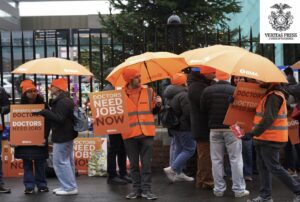
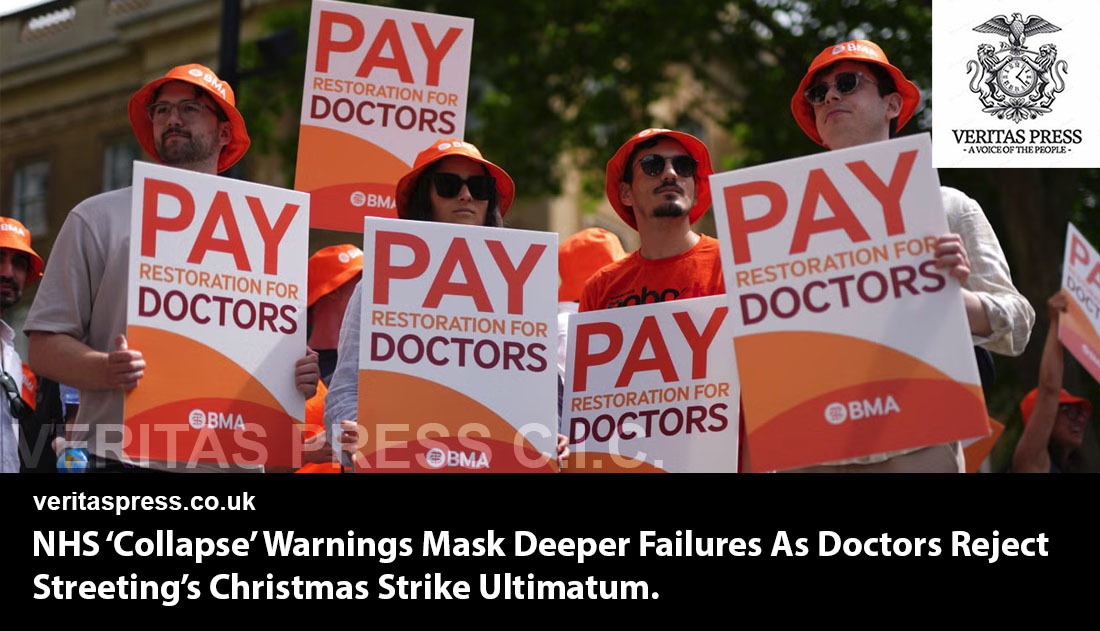
Against that backdrop, resident doctors, formerly known as junior doctors, are planning a five-day strike from 7am on 17 December, unless members of the British Medical Association (BMA) vote by Monday to accept a revised government offer. Ministers insist further pay rises are off the table, while the union says the proposal is inadequate and was delivered in what it describes as a coercive, last-minute manner.
Streeting has framed the dispute as a public safety emergency. In interviews and newspaper columns, he said he could not guarantee patients would not come to harm if strikes went ahead during what he called “probably the worst pressure since Covid”. Writing in The Times, he warned: “Christmas strikes could be the Jenga piece that collapses the tower.”
The health secretary says he offered to extend the BMA’s strike mandate so action could be postponed until January, arguing that the union’s refusal showed it was deliberately targeting the NHS at its most vulnerable point. “I can only assume they know this week will be most painful for the NHS,” he said.
The BMA rejects that characterisation outright. Dr Jack Fletcher, chair of the union’s resident doctors committee, accused Streeting of “scaremongering” and scapegoating clinicians for long-standing systemic failures.
“It is horrible for anyone to be suffering with the flu; we are not diminishing the impact of that,” Fletcher said. “But Mr Streeting should not be frightening the public into thinking the NHS will not be able to look after them. He is laying the blame for the failings of the NHS to cope with an outbreak of flu at the feet of resident doctors.”
Fletcher said the government’s latest offer, delivered with just 24 hours to respond, was “poor” and “cruel and calculated”. While ministers highlight pay rises totalling nearly 30 per cent over the past three years, the BMA argues that resident doctors’ pay has fallen by around 20 per cent in real terms over the past 17 years, driving retention problems that no short-term workforce reforms can fix.
The government’s proposal focuses on structural changes rather than pay. It includes legislation to prioritise UK medical graduates for specialist training places from 2026, an expansion of training posts over the next three years, and funding for mandatory exams and Royal College fees. Ministers argue this represents an “unprecedented” package. Doctors counter that most of those benefits are years away and do nothing to plug immediate rota gaps.
At the heart of the dispute is patient safety, and whether hospitals can function safely during a prolonged winter strike. The BMA insists emergency care will be protected, pointing to contingency arrangements used during previous industrial action.
Dr Tom Dolphin, chair of the BMA council, has written to NHS trust leaders urging them to reschedule non-urgent activity and prioritise urgent and emergency care during strike days. He says senior doctors can be redeployed to cover absent trainees, and that derogations, allowing doctors to cross picket lines, will be granted where genuine emergencies arise.
But NHS leaders warn the scale of this winter’s pressures makes the situation fundamentally different. Daniel Elkeles, chief executive of NHS Providers, said the service is facing a “tidal wave of flu” that requires an “all-hands-on-deck” response.
“This is shaping up to be the most challenging December in many years,” Elkeles said, urging both sides to calm rhetoric while acknowledging that hospitals are already struggling to maintain planned care.
Behind the scenes, frontline staff paint a picture of a system reliant on perpetual crisis management. Consultants expect to cancel clinics and work extra shifts to cover gaps. Nurses and allied health professionals warn that redeploying senior doctors to ward cover risks worsening backlogs and burnout elsewhere. Several clinicians have privately questioned how long this model can be sustained.
Even NHS England officials have pushed back against the most dramatic language. Dr Chris Streather, a regional medical director, said flu admissions were “pretty bad” but “nothing like the scale” of the Covid pandemic. “The NHS is coping at the moment,” he said, while acknowledging that pressures are rising.
Public health factors have compounded the crisis. Flu vaccination uptake among frontline NHS staff is reported to be just over 43 per cent, leaving hospitals vulnerable to staff sickness during peak transmission. Public health experts have warned that prevention measures, including vaccination campaigns and messaging, came too late to blunt the current surge.
Politically, the dispute has exposed fault lines within Labour’s first months in government. Prime Minister Sir Keir Starmer has condemned the planned strikes as “reckless” and “beyond belief”, arguing they place patients at risk during a critical period. Polling suggests the public is largely on the government’s side: a recent YouGov survey found 58 per cent oppose the strikes, while 33 per cent support them.
Yet analysts warn that focusing public anger on striking doctors risks obscuring a more uncomfortable reality. If the NHS is truly one industrial dispute away from collapse, critics argue, then the system was already dangerously under-resourced.
For resident doctors, the choice now lies with their members. The BMA’s online ballot closes on Monday, just two days before the planned walkout. If the strikes proceed, hospitals will enter Christmas week under unprecedented strain. If they are called off, the deeper questions about pay erosion, staffing shortages and winter resilience will remain unanswered.
What this confrontation has laid bare is not just a dispute over pay or timing, but a health service operating with so little slack that political brinkmanship itself has become a risk to patient care. Whether ministers and doctors can move beyond public ultimatums to a durable settlement may determine not just how this winter unfolds, but how many more crises the NHS can survive before the tower finally falls.
Conclusion:
What this confrontation ultimately exposes is not a sudden crisis triggered by five days of industrial action, but a health service that has been deliberately engineered to operate without resilience. If the NHS can be pushed to the brink by a predictable winter flu surge combined with the temporary withdrawal of a single workforce group, then the system’s failure was already baked in long before resident doctors announced strike dates.
Ministers may find it politically expedient to frame this moment as an emergency created by “irresponsible” doctors. But such claims collapse under scrutiny. Flu outbreaks are not acts of God; they are annual events. Workforce shortages are not spontaneous; they are the cumulative outcome of years of pay erosion, rota gaps, delayed training expansion and the quiet normalisation of burnout. What has changed is not the behaviour of clinicians, but the political willingness to acknowledge, or deny, the consequences of those choices.
Streeting’s repeated warnings of imminent “collapse” function less as a clinical assessment than as a negotiating tactic, shifting responsibility away from government policy and onto frontline staff. That strategy may succeed in the short term, bolstered by hostile headlines and unfavourable polling. But it carries a deeper cost: eroding trust between government and the workforce it depends on to stabilise the system. Crisis rhetoric cannot substitute for good-faith negotiation, nor can workforce reform plans scheduled years into the future resolve a staffing emergency unfolding now.
The uncomfortable reality is that the NHS has been sustained through successive winters not by strategic planning, but by the moral injury and unpaid labour of its staff, consultants cancelling leave, nurses working short, trainees absorbing unsafe workloads, and managers firefighting without resources. Strikes do not create this fragility; they merely reveal it. And every time the system survives by stretching staff further, the next breaking point is brought closer.
If the government’s position is that no further pay settlement is possible, it must then explain how retention will be improved, how vacancies will be filled, and how winter surges will be managed without relying on emergency redeployment and cancelled care. If the BMA insists patient safety can be protected through strike mitigations, it must also reckon with how long those stopgaps can plausibly hold in a service already running at saturation.
This dispute will end, either through a late compromise or through the exhaustion of another crisis. What matters more is what follows. Without a credible, funded, multi-year workforce settlement that addresses pay, training capacity, prevention and working conditions together, the NHS will continue to lurch from standoff to standoff, winter to winter, crisis to crisis. The question is no longer whether the tower might fall, but how many warnings will be issued before responsibility for its instability is finally placed where it belongs.