Kamran Faqir is a volunteer investigative journalist and writer committed to exposing hidden truths and amplifying underreported stories. Driven by social justice, he brings sharp insight and fearless truth-telling to independent journalism. NUJ registered.
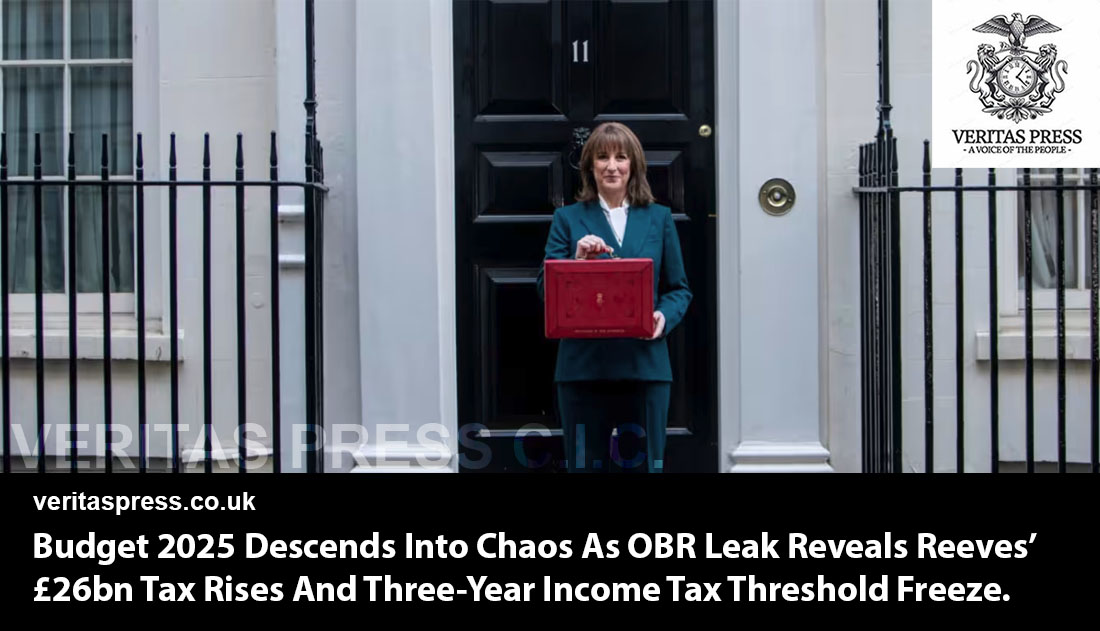
Title: Budget 2025 Descends Into Chaos As OBR Leak Reveals Reeves’ £26bn Tax Rises And Three-Year Income Tax Threshold Freeze.
Press Release: Veritas Press C.I.C.
Author: Kamran Faqir
Article Date Published: 26 Nov 2025 at 13:25 GMT
Category: UK | Politics | Budget 2025: Income Tax
Source(s): Veritas Press C.I.C. | Multi News Agencies
In an extraordinary morning of fiscal drama without precedent in modern British politics, the Office for Budget Responsibility (OBR) accidentally published its full Economic and Fiscal Outlook nearly an hour before Chancellor Rachel Reeves was due to stand up in the House of Commons for her flagship Budget.
The leaked document confirmed what had been heavily rumoured for days: a sweeping package of £26bn of tax rises, a freeze on personal tax thresholds until at least 2030–31, major welfare reversals including scrapping the two-child benefit cap, and a series of long-delayed revenue-raising measures that will not fully bite until 2028.
The OBR described its accidental early publication as a “technical error”, apologising and promising an internal investigation. The link was swiftly taken down, replaced by a stark 404 Not Found page, but not before journalists, investors, and MPs had downloaded the entire document.
Reeves called the leak “deeply disappointing and a serious error” as she began her Budget speech, delivered into a chamber already electrified by the breach.
Headline Measures: A Budget Built on Tax Rises, Welfare Reversals, and Fiscal Tightening
The leaked forecast shows Reeves will double her fiscal headroom compared to March, from £9.9bn to £22bn, largely through tax rises that gradually escalate over the second half of the parliamentary term.
Key Decisions (OBR leaked figures):
£22.9bn headroom in 2029–30 (up from £9.9bn).
£29.8bn raised in tax by 2029.
£11.8bn higher spending by 2029.
Major tax measures are not taking effect until 2028.
The government must still find £2.4bn next year to fund the ongoing fuel duty freeze.
The result is a Budget that is at once fiscally contractionary in the long run and politically explosive in the short term.
Income Tax Thresholds Frozen Until 2031, 1.7m More People Dragged Into Higher Taxes.
The OBR confirms that Reeves will extend the freeze on income tax thresholds, originally a Conservative measure, for a further three years, until 2030–31.
By 2029–30, This Will Create:
780,000 more basic-rate taxpayers
920,000 more higher-rate taxpayers
4,000 more additional-rate taxpayers
Total revenue: £8bn a year.
This Is The Single Largest Tax-Raising Measure In The Budget:
Child Benefit Two-Child Cap Scrapped: £3bn Cost, 560,000 Families Helped
In a landmark welfare reversal, Reeves is lifting the controversial two-child limit on Universal Credit, introduced in 2017.
The OBR Estimates:
£3bn annual cost
560,000 families to gain
Average increase: £5,310 per family per year
The move represents the largest expansion of welfare support in a decade, and a major ideological shift from the previous government’s austerity doctrine.
But it contributes substantially to the Budget’s rising long-term spending profile, with welfare reversals and the two-child cap removal adding £11bn a year by 2029–30.
Markets Jolt as OBR Leak Shows Productivity Downgrade and Backloaded Tax Pain:
Before the leak disappeared, it revealed a grim outlook for the UK’s long-term economic engine:
Productivity forecast cut to 1%
Down from 1.3% in March, pulling average GDP growth down to 1.5% over the forecast period.
This productivity downgrade, long considered Britain’s Achilles heel, sent a shockwave through markets.
Bond buyers rushed into gilts, briefly pushing 10-year borrowing costs down by 5 basis points, before yields rebounded sharply once full tax details circulated.
By Early Afternoon:
10-year gilts: 4.53% (up 0.04 pp)
20-year gilts: 5.6%, with markets expecting 5.8% by 2030, the highest since 2000
ING analysts warned that the Budget’s credibility depends entirely on investor confidence:
“A sharp rise in yields is possible if fiscal consolidation isn’t seen as sufficient, or if political pressure weakens Reeves.”
Gambling Firms Hammered As Remote Gaming Duty Jumps To 40%:
The leaked OBR document confirmed a huge rise in remote gaming duty from 21% to 40% from April 2026.
Effects Were Immediate:
Entain – down 4.44%
Evoke (William Hill/888) – down 14.5%
The OBR expected the measure to raise £1.1bn by 2029–30.
Bingo duty will be abolished, but this is primarily symbolic compared to the scale of the online gaming increase.
Electric Vehicle Mileage Tax: 3p Pay Per Mile From 2028:
In one of the most politically sensitive measures, Reeves will introduce a road-usage tax for electric vehicles starting in 2028–29:
3p/mile for fully electric cars
1.5p/mile for plug-in hybrids
1.5p/mile for fuelled cars
A typical EV driver doing 8,500 miles a year will pay £255 annually.
The measure aims to fill the long-term gap left by collapsing fuel duty revenues as drivers shift to electric vehicles.
Stock Market And Currency Reaction: Calm On The Surface, Turbulence Underneath.
Despite the drama, the FTSE 100 fell only 0.04%, with global factors, particularly expectations of a US rate cut, largely driving the day’s movements.
The pound edged up slightly to $1.3177, with analysts noting that much of the Budget’s pain was already priced in.
Insight Investment’s Francesca Fornasari said markets may even relax once the uncertainty clears:
“Much of the bad news is already reflected. Sterling could rally once the scope for further shocks is gone.”
Farmers Storm Westminster In Tractors Despite Police Ban:
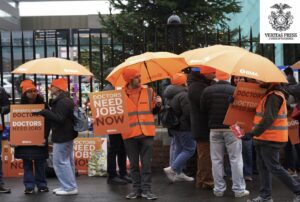
As Reeves prepared to deliver her speech, a convoy of tractors snarled central London traffic. Farmers condemned new inheritance tax proposals and claimed the government had “betrayed the countryside.”
One protester, a farmer dressed as Father Christmas, drove a spruce-laden tractor bearing a sign:
“Farmer Christmas – the naughty list: Starmer, Reeves, Lammy, Abbott, Rayner & the BBC.”
A Budget Under Siege: Speaker Rebukes Government Over Leaks.
Before Reeves spoke, the Speaker issued a rare public reprimand, condemning “extensive briefings” and saying she had “expected better.”
Parliamentary procedure dictates that Budget details must be announced first to MPs, not drip-fed to the media, and certainly not accidentally released by the fiscal watchdog.
Reeves’ Central Message: A “Tight Grip” On The Public Finances.
In a pre-Budget video released hours earlier, Reeves said:
“There is nothing progressive about spending one in every ten pounds of government spending just servicing the national debt.”
She Pledged To:
cut waiting lists
cut debt and borrowing
cut the cost of living
But the leaked document shows the UK’s tax burden rising to a historic high of 38% of GDP by 2030–31, a political gamble for a Labour government that won power on promises of “stability and growth.”
Perhaps the most ominous passage in the leaked document was the OBR’s projection that:
10-year gilt yields could reach 5.8% by 2030
The UK’s debt profile is more vulnerable than at any time since 2000
Rising borrowing costs could choke off growth if fiscal credibility falters
Conclusion: A Budget Already Overshadowed By Its Own Accident.
Even before Rachel Reeves reached the despatch box, her Budget had been blown open, its tax hikes dissected, its political risks exposed, and its narrative hijacked by a “technical error” from the Office for Budget Responsibility. The OBR’s accidental leak did more than undermine parliamentary protocol: it exposed the fragile architecture underpinning the government’s fiscal strategy and stripped away the ceremonial veil behind which Budgets are usually delivered.
The chancellor may have succeeded in creating £22bn of fiscal headroom, more than double what had been projected in March, but she has also triggered:
a record tax burden, with the freeze on personal thresholds and new charges pushing ordinary taxpayers into higher brackets;
a furious farming sector, bringing tractors to Westminster in protest against inheritance and business tax policies;
shaken financial markets, with gilt yields oscillating as investors try to price in backloaded tax measures and weak growth forecasts;
and the most chaotic Budget morning in decades, highlighting vulnerabilities in institutional discipline and communication.
At the heart of Budget 2025 lies a stark tension: the government seeks to maintain fiscal credibility while expanding welfare and implementing long-term tax increases. Freezing tax thresholds, raising duties on pensions, electric vehicles, and gambling, and lifting the two-child benefit cap are all measures that address different pressures, but each carries significant economic and political risks. Deferred revenue, backloaded fiscal adjustments, and a downgraded productivity outlook reveal a fragile strategy heavily reliant on assumptions about economic stability and investor patience.
Markets have reacted cautiously, with gilts rallying initially on weaker growth forecasts before reversing, illustrating that confidence is still tethered more to political credibility than fundamentals. At the same time, public discontent is visible in symbolic protests, reminding policymakers that fiscal decisions reverberate far beyond the numbers in the OBR’s spreadsheets.
The full implications economic, political, and institutional are only beginning to unfold. If productivity growth remains subdued, if tax hikes stifle demand, or if political pressures escalate, Reeves’ “Goldilocks” Budget risks becoming a brittle blueprint, failing to deliver stability, growth, or political consensus. Budget 2025 exposes a government walking a tightrope between market discipline, social expectations, and political survival, and underscores how institutional missteps, structural weaknesses, and policy compromises can collide to magnify both risk and uncertainty.
Critically, the Budget exposes a glaring failure to tax the wealthiest at a time when Britain faces multiple crises, soaring living costs, stagnant wages, and underfunded public services. While ordinary households and the poorest citizens bear the brunt of frozen personal tax thresholds, increased duties, and new charges on pensions and electric vehicles, the richest individuals and largest corporations largely escape proportionate taxation. By shifting the fiscal burden onto the middle and lower classes and further squeezing the poor, Reeves risks deepening inequality and public frustration. The Budget raises urgent questions about the fairness and social sustainability of a strategy that professes to restore economic stability while leaving those with the greatest ability to contribute largely untouched.
Kamran Faqir is a volunteer investigative journalist and writer committed to exposing hidden truths and amplifying underreported stories. Driven by social justice, he brings sharp insight and fearless truth-telling to independent journalism. NUJ registered.
SEATTLE, TEHRAN — The U.S. Department of Homeland Security (DHS) will allow Iran’s national football team to enter the country 48 hours before their critical World Cup match against Egypt on Friday, a modest concession in a tournament where Team Melli’s travel conditions have sparked claims of oppression and competitive disadvantage.