Kamran Faqir is a volunteer investigative journalist and writer committed to exposing hidden truths and amplifying underreported stories. Driven by social justice, he brings sharp insight and fearless truth-telling to independent journalism. NUJ registered.
Title: Budget 2025: Reeves’ Sugar Levy And The First Shot In A Tax Raid.
Press Release: Veritas Press C.I.C.
Author: Kamran Faqir
Article Date Published: 25 Nov 2025 at 15:08 GMT
Category: UK| Politics | Budget 2025
Source(s): Veritas Press C.I.C. | Multi News Agencies
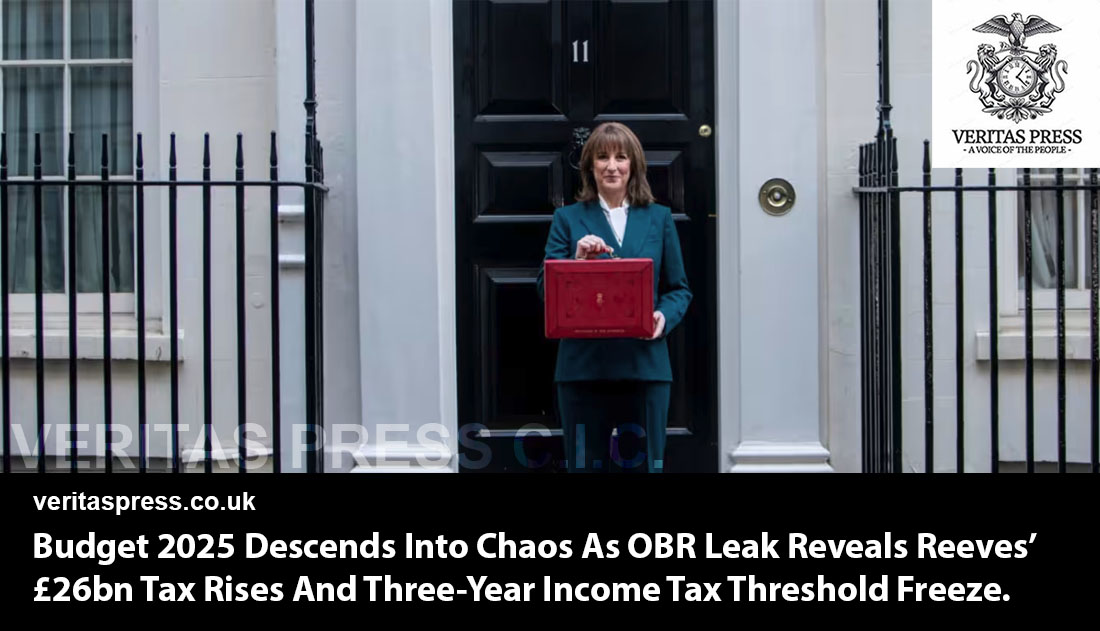
When Chancellor Rachel Reeves unveiled her first Budget in 2025, she promised “discipline with compassion” and a reset of Britain’s economic path. But behind the rhetoric of renewal lies a stark fiscal reality: the public finances are stretched thin, the markets are watching, and Reeves needs revenue quickly.
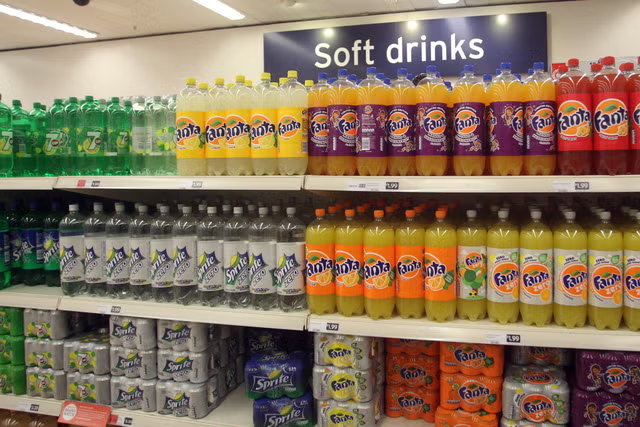
Her first salvo is the newly expanded “sugar levy,” a tax on milkshakes, flavoured lattes, boxed coffees, and other pre-packaged milky drinks long shielded from the Soft Drinks Industry Levy (SDIL). Framed as a public-health measure and quietly briefed to journalists before her Commons address, the move has become a lightning rod, not just for what it taxes, but for what it signals about the entire Budget strategy.
As this investigation reveals, officials, analysts, industry leaders and public-health experts are sharply divided on the policy’s purpose. Some see it as a moral imperative. Others call it a regressive stealth tax timed to soothe bond markets. And within Whitehall, insiders admit this is only “the first of many painful decisions” Reeves will make.
The Sugar Levy Expansion: What The Government Isn’t Saying Publicly.
The government’s headline announcement is deceptively simple: pre-packaged milk-based drinks will lose their exemption from the SDIL from 1 January 2028. That includes supermarket milkshakes, canned iced coffees, and boxed lattes, some of which contain more added sugar per serving than fizzy soft drinks.
But the reforms do more than close an old loophole:
The sugar threshold will drop to 4.5 g per 100 ml, catching products that were previously safe.
A “lactose allowance” will be introduced, ostensibly to prevent natural milk sugars from being taxed.
Plant-based drinks like oat or rice lattes will be included, but only if they contain added sugar.
Freshly prepared drinks in cafés and restaurants remain exempt, creating a divide between Starbucks’ bottled Frappuccino on a shelf and the same drink made at the counter.
The Treasury expects £45m a year in new revenue by 2028.
A senior Treasury official, speaking anonymously, described the measure to this reporter as “a soft launch for the tax-raising agenda. This is not the big one; this is testing the water.”
Another insider from the Department of Health framed it differently: “This is a health intervention that just happens to raise revenue. But yes, Treasury loves it.”
Both may be true.
Health Justification: Evidence or Convenience?
Health Secretary Wes Streeting has been the most vocal defender. In the Commons, he warned that obesity “robs children of the best possible start in life … hits the poorest hardest … costs the NHS billions.” Public-health charities including Action on Sugar, Diabetes UK, and the Obesity Health Alliance echoed his message.
“Milkshakes and flavoured lattes have been the elephant in the room,” said Caroline Cerny, former lead at the obesity alliance. “Some contain more sugar than cola. Removing the exemption is overdue.”
Public Health England’s previous analysis showed the original sugar levy prompted 46% average sugar reduction in soft drinks between 2015 and 2020, one of the most successful reformulation drives in recent decades.
But critics say Reeves’ framing, health and fiscal responsibility, is too convenient. Dr. Stuart Ritchie, a behavioural scientist at KCL, argued that “if the government cared purely about public health, they wouldn’t exempt café drinks. Sugar is sugar.”
Campaigners also worry the levy risks shifting costs downstream without providing adequate support. “The poorest pay proportionately more,” said Imran Hussain of the Child Poverty Action Group. “Unless Reeves couples this with real interventions like free school meals, it becomes punitive.”
Even some NHS clinicians are sceptical. A senior paediatrician at a major London hospital said: “Yes, sugar is a killer long-term. But taxing milkshakes while presiding over collapsing children’s services is not a coherent health strategy.”
The Fiscal Hole: Why Reeves Needs Every Penny.
Behind the health rhetoric is a yawning fiscal gap. Treasury documents and media briefings suggest Reeves must find £20–£30 billion through tax rises and revenue-raising measures to meet her own fiscal rules, chiefly stabilising debt as a share of GDP by 2029.
Economist Michael Jacobs of the LSE told this investigation that Reeves is “walking a tightrope between her political promises and the bond markets’ expectations. Raising taxes is unavoidable. The question is how honest she is prepared to be about that.”
Bond traders have been explicit. A strategist at a major US investment bank said:
“We don’t care what she calls it, sugar levy or social justice, we care about whether the numbers add up. If they don’t, gilts will sell off.”
Reeves has already signalled further tax rises: levies on betting profits, bank profits, and potentially a “mansion tax” on homes worth over £2 million. She is also expected to cut the ISA allowance, prompting outcry from the banking sector and savers’ advocates.
Former Treasury adviser Sonia Khan argued: “This Budget is about reassuring the markets after the Truss disaster. Reeves is terrified of a repeat. Every tax rise is written for bondholders, not households.”
Credibility Issues: Back-Loading And Wishful Thinking.
Several economists, including the Institute for Fiscal Studies (IFS), have questioned whether these tax rises are too back-loaded. The sugar levy’s start date in 2028 means the bulk of the revenue comes years after markets will have assessed her credibility.
“Pushing the hard stuff to 2028 is classic political choreography,” said Paul Johnson of the IFS. “The risk is that by then, either the government has changed or the pressure to water it down becomes overwhelming.”
Other analysts question whether projected revenue is plausible. Reformulation, encouraged by the levy, reduces the tax take over time, something the Treasury often struggles to model accurately.
“Either the tax doesn’t work, and they get the revenue,” said Jonathan Portes, “or it works, and the revenue collapses. Governments can’t have it both ways.”
Industry groups warn the numbers simply won’t materialise. The British Soft Drinks Association (BSDA) noted that achieving the new thresholds will require costly recipe changes. “Two years is not long for a full reformulation cycle,” said its spokesperson, Louise Ashworth. “Small producers may go under.”
The Political Trap: Who Pays, and Who Revolts.
While sugar tax expansions often enjoy public support, this one has exposed new tensions.
Working-class families and “regressive taxation”
Despite the health arguments, levies on everyday items tend to hit low-income households hardest. The Joseph Rowntree Foundation estimates that consumption taxes make up a far greater share of expenditure for poorer households.
A mother in Birmingham interviewed at a supermarket described it bluntly: “They tax everything we buy now. But café drinks get away with it? So this is just a tax on people who can’t afford Starbucks.”
Populist media outlets like GB News and The Sun have seized on exactly this point, branding it a “milkshake tax for the masses.”
Hospitality Exemption Backlash:
Café owners are relieved, for now. “If we were taxed too, many of us wouldn’t survive the year,” said Nadine, owner of a Manchester café. But competitors argue that exempting open-cup drinks distorts the market. Supermarkets say it effectively hands hospitality chains a competitive advantage.
Even some Labour MPs privately admit the distinction is “arbitrary and difficult to defend.”
Industry Resistance:
Producers of flavoured milk drinks, many of them mid-sized British firms, say the levy could lead to job losses. One executive warned MPs in a closed briefing:
“If this goes ahead without compensation or transition support, we will move production overseas. We’re not bluffing.”
That message has been shared with BEIS officials, according to sources.
Public Confusion:
Social-media reactions are mixed. Some applaud the health rationale; others deride it as “nanny state nonsense.” One post that went viral on X read:
“Café caramel latte with cream? Untaxed. Tesco chocolate milk? Taxed. Make it make sense.”
The government has yet to address this inconsistency in detail.
The Mansion Tax, Bank Levies, and Gambling Duties: The Real Fight Is Coming.
The sugar levy is small, politically, financially, and symbolically, compared to what’s coming.
1. Mansion Tax: Labour’s Most Explosive Idea.
Reports suggest a housing levy on properties worth £2m+ could raise several billion. But estate agents, housing economists, and homeowners’ groups warn of distortion.
The National Association of Property Professionals said it could “freeze transactions and shrink high-end construction,” while the Institute of Economic Affairs called it “deeply economically illiterate.”
Even Labour backbenchers in London warn it risks alienating a key part of their voter base.
2. Gambling Levies.
The Betting & Gaming Council warns thousands of jobs could be lost, particularly in struggling high streets.
“Punishing an industry already on the brink is reckless,” said CEO Michael Dugher.
3. Bank Profit Levies
Banks argue these measures discourage investment and undermine London’s competitiveness post-Brexit.
Barclays’ chief UK economist said privately: “The message we’re receiving is: move your profits abroad.”
Reeves is aware that these industries can hit back and hit loudly.
Markets, Bondholders, And The Iron Chancellor Persona.
More than any recent chancellor, Reeves appears attuned, even subordinate, to financial markets. Her advisers speak openly about “building headroom,” “signalling discipline,” and “avoiding shocks.”
A senior fund manager at BlackRock put it starkly:
“If markets believe Reeves is serious about stabilising debt, gilts will rally. If they think she’s another Truss, all hell breaks loose.”
This Budget is less about consumer behaviour and more about investor confidence. Reeves wants to be seen as the anti-Truss: predictable, orthodox, and painfully cautious.
But, analysts warn, this dynamic can force governments into regressive policies to maintain credibility.
Economist Grace Blakeley argued:
“When fiscal policy is written for the bond markets, ordinary people pay the price. Sugar taxes, ISA cuts, gambling levies, they’re not about fairness, they’re about appeasing investors.”
Will the Sugar Levy Work, or Is It a Political Sacrifice?
Experts say the levy will likely reduce sugar intake modestly, push some reformulation, and raise some revenue. But its structural flaws, café exemptions, narrow targeting, and delayed implementation, undermine its stated health purpose.
Its fiscal contribution is so small that its real purpose appears symbolic: a down payment on Reeves’ credibility.
A veteran political strategist close to Labour summed it up to this reporter:
“This is not really about sugar. It’s about sending a message: Reeves is willing to raise taxes. Once she’s crossed that line, the bigger measures follow.”
Conclusion: A Budget For Health, Or A Budget For Bond Markets?
The sugar levy expansion is being sold as an act of public health responsibility. But the evidence suggests it is equally, if not more, a positioning exercise, a prelude to a much broader tax raid designed to close a fiscal black hole and reassure international investors.
Reeves wants to be Britain’s “iron chancellor,” the guardian of fiscal discipline after years of turbulence. But the risk is that she becomes something more brittle: a chancellor whose tax strategy hits ordinary households while sparing wealthier consumers and global markets.
Whether this Budget is remembered as bold or regressive, honest or evasive, will depend on what comes next: the mansion tax, the gambling levy, the bank profits charge. The sugar levy is just the first shot.
Kamran Faqir is a volunteer investigative journalist and writer committed to exposing hidden truths and amplifying underreported stories. Driven by social justice, he brings sharp insight and fearless truth-telling to independent journalism. NUJ registered.
SEATTLE, TEHRAN — The U.S. Department of Homeland Security (DHS) will allow Iran’s national football team to enter the country 48 hours before their critical World Cup match against Egypt on Friday, a modest concession in a tournament where Team Melli’s travel conditions have sparked claims of oppression and competitive disadvantage.