Kamran Faqir is a volunteer investigative journalist and writer committed to exposing hidden truths and amplifying underreported stories. Driven by social justice, he brings sharp insight and fearless truth-telling to independent journalism. NUJ registered.
Title: Winter Deluge Exposes A Deeper Collapse: How Gaza’s Flooded Tent Camps Reveal A Humanitarian Catastrophe In Slow Motion.
Press Release: Veritas Press C.I.C.
Author: Kamran Faqir
Article Date Published: 25 Nov 2025 at 13:40 GMT
Category: Middle-East | Palestine-Gaza-West Bank | Winter Deluge Exposes A Deeper Collapse
Source(s): Veritas Press C.I.C. | Multi News Agencies
The recent heavy rains that have flooded dozens of tents in Khan Younis are not merely a tragic weather event; they are a stark illustration of how Gaza’s displacement crisis has become existential, structural, and deeply political. Behind every soaked mattress, every collapsed makeshift home, lies the accumulation of war-damaged infrastructure, chronic aid shortfalls, and a governance failure that has left hundreds of thousands of displaced Palestinians extraordinarily vulnerable.
The Immediate Picture: Flooded Homes, Drenched Lives.
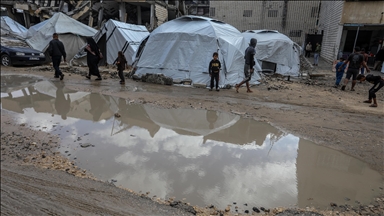
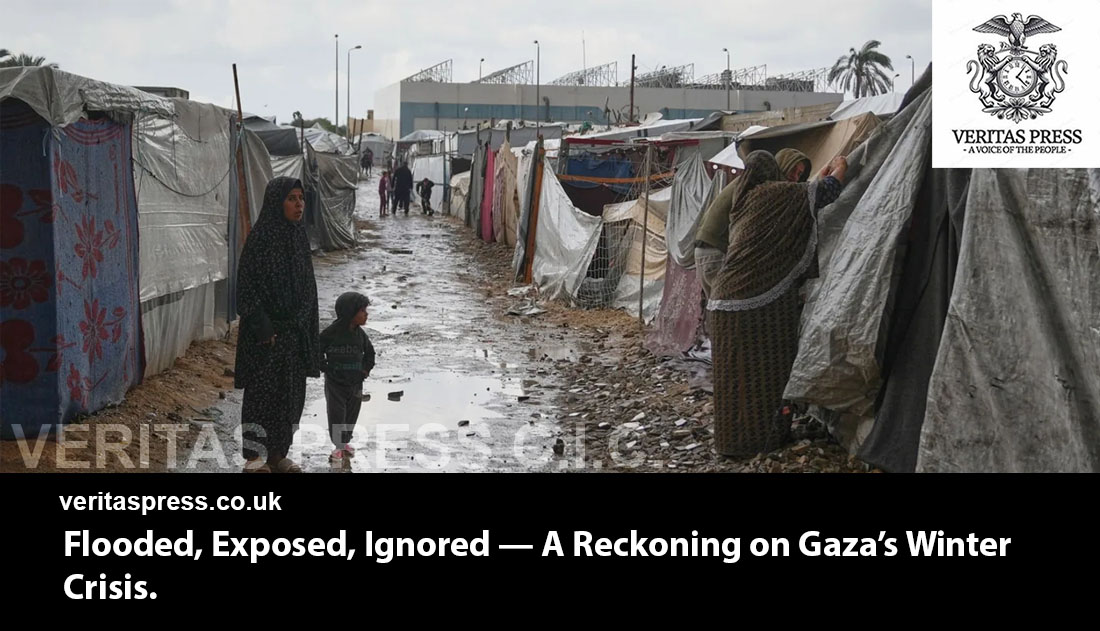
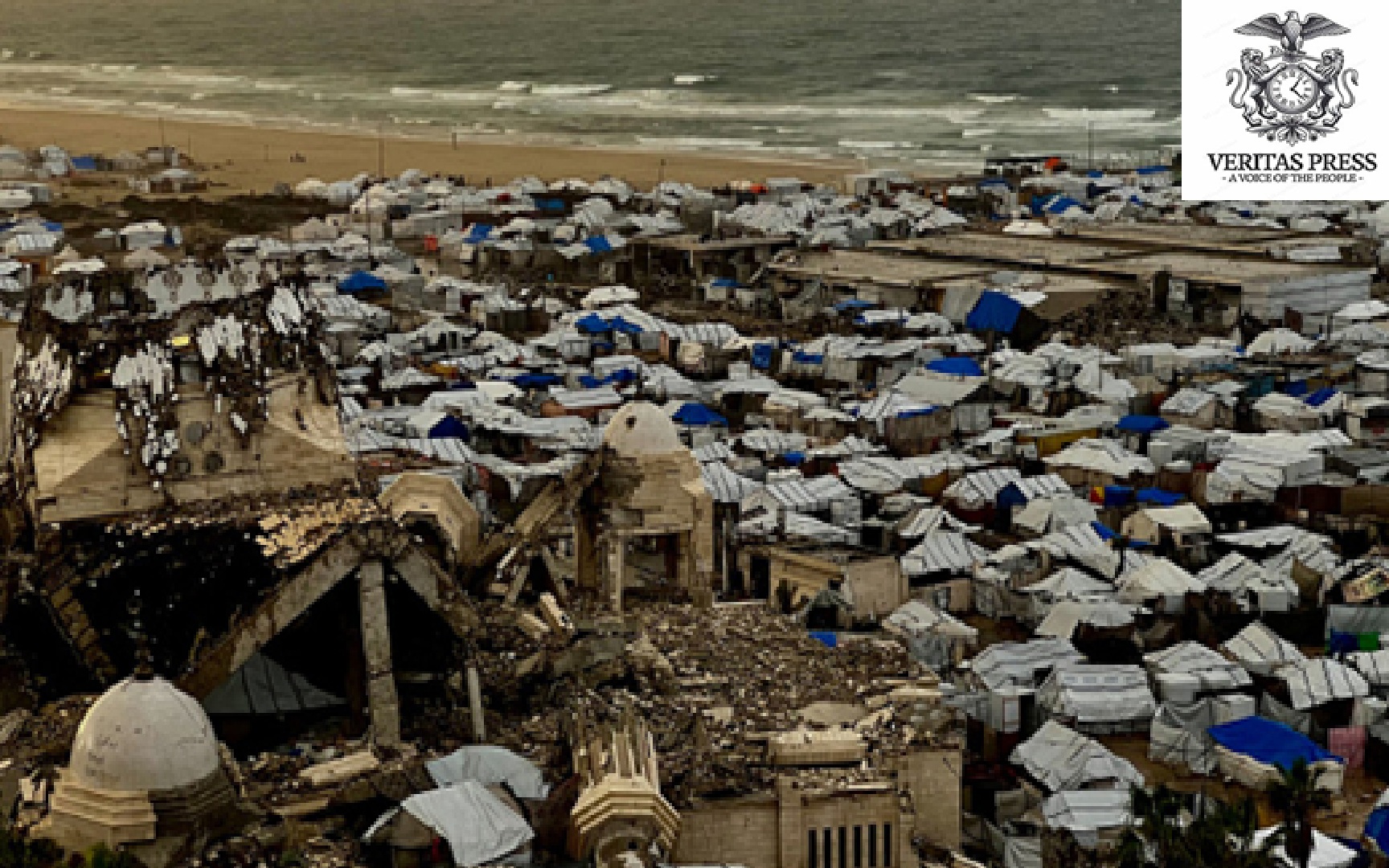
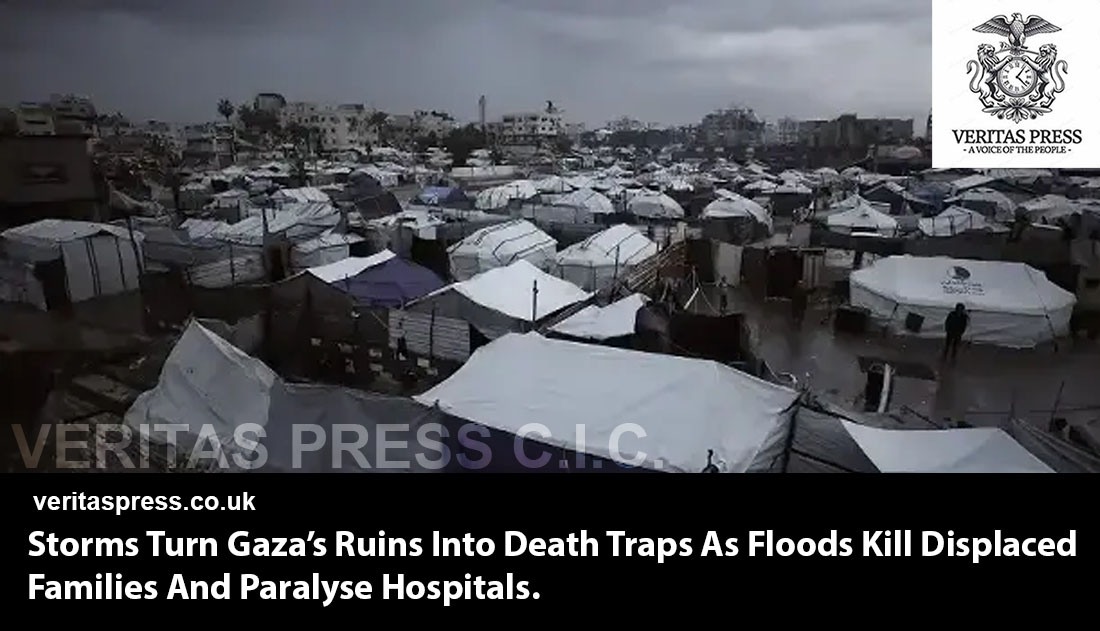
Local officials, displaced residents, and rescue services paint a picture of chaos and desperation. According to the Gaza Civil Defence, dozens of tents in Al-Mawasi (western Khan Younis) have been submerged by standing rainwater as a low-pressure system and cold air mass swept across southern Gaza.
Witnesses described how not just flimsy tarpaulin shelters, but whole tents were destroyed by wind, or flooded outright, forcing families to salvage what they could of their belongings in the middle of a storm. Saib Luqan, a municipal spokesman, warned of the scale: with nearly 900,000 people in Khan Younis alone now in what he called a “tragic and grim” situation.
Voices From The Ground: Grief, Anger, And Fear.
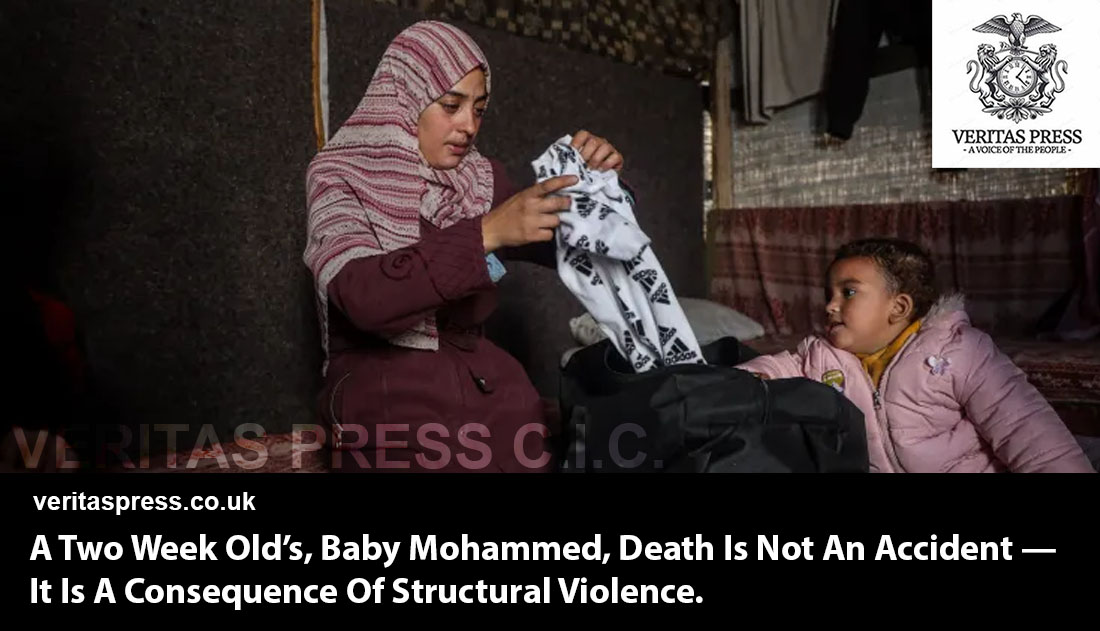
Al Jazeera reports multiple displaced Palestinians recounting how they tried to drain water from their tents for hours. One man, Abdulrahman Asaliyah, said their mattresses, clothes, and personal items were completely soaked. A mother, distraught, told reporters she had been “crying since morning” as water pooled in the family tent, saying they had no other safe place to go.
Another displaced man, Abu Ghassan, said simply: “We don’t even have proper tents.” These testimonies underscore how the first rain of the season, far from being a natural resetting, has amplified people’s trauma, not relieved it.
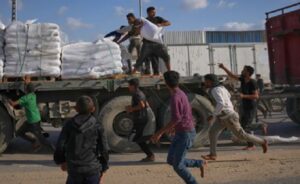
The flooding disaster cannot be separated from the broader systemic breakdown that Gaza has suffered. According to UNRWA and other aid agencies, though they reportedly have enough shelter supplies (tents, tarps, other materials) for up to 1.3 million people, many of these critical supplies remain blocked at crossings.
Aid organisations such as the Norwegian Refugee Council (NRC) have bluntly warned that the blockade of shelter items is compounding what they call “misery on top of misery.” Such restrictions, critics argue, are not simply logistical: they point to a political failure, or even a deliberate strategy, to delay or deny reconstruction, leaving people exposed to the elements to further deepen dependence on humanitarian aid.
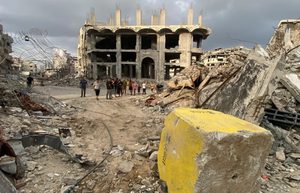
On the infrastructural side, the damage is both vast and shocking. According to local municipal sources, 220,000 linear meters of roads in Khan Younis have been destroyed over two years of war. According to a report by Asylos (citing UNRWA and local municipal data), 80% of sewerage transmission lines, pumps and stations are nonfunctional. Asylos When the rain comes, there is nowhere for water, or sewage, to go.
This has severe public health implications: floodwaters have mixed with sewage, turning displacement camps into toxic zones. Reuters reports that swollen puddles now contain effluent, creating breeding grounds for waterborne diseases.
Health Crisis: Disease, Malnutrition, And Exposure.
Already overburdened hospitals are reporting a surge in illness. According to local NGOs, there’s a sharp rise in gastric illnesses, skin diseases, and other disorders worsened by crowded, unsanitary, and damp living conditions.
Aid organisations warn that the health risks of this flooding may spiral beyond immediate discomfort: soaking clothes and mattresses, limited access to food, clean water, and broken sanitation could trigger outbreaks of cholera-like diseases, leptospirosis, or other infections. These risks are further deepened by malnutrition, as limited food and medicine stocks are already stretched thin. Reuters quotes officials pointing out that health facilities are just not ready for the spike in seasonal or waterborne illness.
Political Accountability: Who Is Responsible?
The flooding is not merely the result of a natural disaster, but the byproduct of a war that has systematically degraded Gaza’s infrastructure, leaving civilians exposed to disease, malnutrition and starvation. When municipal spokespeople such as Saib Luqan decry catastrophic damage to roads, water, and sewage networks, they are implicitly pointing to the long-term responsibility of the warring party, Israel, for the destruction wrought during decades of conflict, and especially intensified in the most recent two years of war.
Moreover, the aid blockade, highlighted by UNRWA, NRC, and other organisations, raises serious moral and political questions. If supplies to prevent suffering are demonstrably stuck due to restrictions, what does that say about the accountability mechanisms in place under the ceasefire deal? The claim by international agencies that they have “the goods but not the access” suggests that the international community, including states that brokered or endorsed the ceasefire, may not be pushing hard enough to ensure that humanitarian obligations are met.
Civil Society, Activists, And Media: Raising The Alarm.
UNRWA’s head, Philippe Lazzarini, has been vocal, calling for an “urgent flow of humanitarian supplies”, of shelter supplies, noting that winter rains are already turning fragile tents into death traps.
Angelita Caredda, Middle East director at the NRC, has also warned that without more aid, “we risk losing a generation to exposure, disease, and psychological trauma.”
Palestinian NGOs networks, represented by Amjad al-Shawa, stress that the worn-out state of existing tents makes them unfit for winter; they “will not protect people against the rain.”
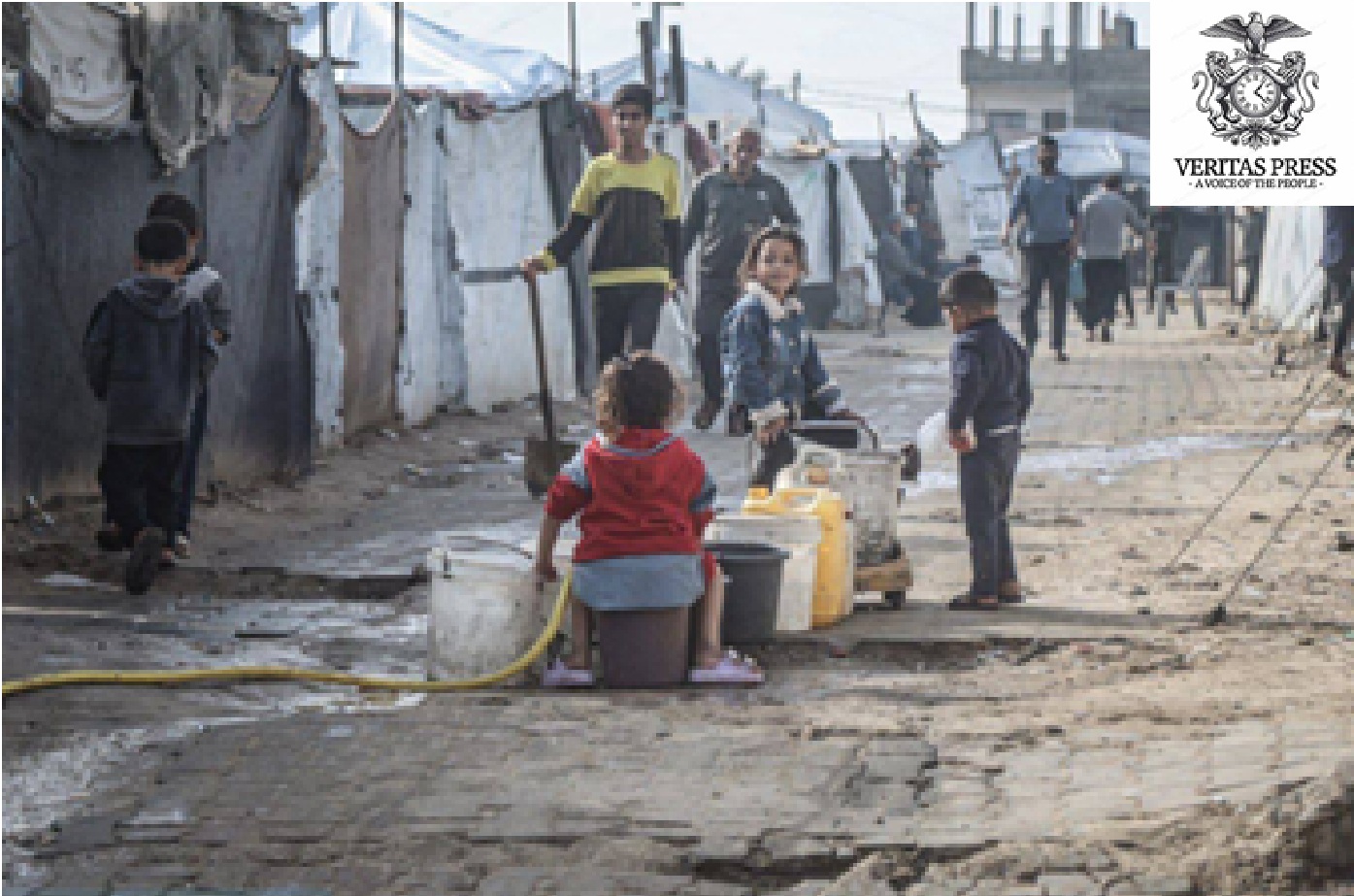
Journalists on the ground, such as Al Jazeera’s Hind Khoudary, have described families walking barefoot in the mud, children with no winter clothes, and people unable to escape their saturated shelters.
Local displaced citizens themselves speak of broken promises: they built their tents after fleeing bombed-out homes, only to feel even more exposed now that the “safe zones” flood and collapse.
Strategic Implications: A Winter Crisis As Political Pressure.
There is a deeper, more structural critique here: this is not just a humanitarian emergency, it is a political crisis, where the weaponisation of aid, infrastructure destruction, and displacement converge. The timing (with winter) amplifies vulnerabilities. The reliance on tents years after the start of the conflict, many now worn, torn, and waterlogged, points to a failure of long-term planning by international actors tasked with reconstruction and stabilisation.
Aid agencies are calling for 300,000 new tents just to address the storm damage. But even that appeals to fill a gap, not to address the root causes: the blockade, the lack of reconstruction, the political stalemate, and the absence of effective accountability.
Conclusion: The Floods Are Not An Accident — They Are Evidence.
What happened in Khan Younis this week is not just the collision of rain with canvas. It is the collision of policy with human life. The winter deluge did not merely expose vulnerabilities; it exposed the architecture of a system that has, for years, engineered those vulnerabilities into permanence.
The flooded tents are not the failure of weather forecasting. They are the predictable outcome of a war strategy that has pulverised Gaza’s civilian infrastructure, choked off reconstruction materials, and kept an entire population suspended in a state of sanctioned precarity. Every drowned mattress is an indictment. Every tent swallowed by mud is a ledger entry in a long list of avoidable harms.
If the destruction of roads, sewage systems, and drainage networks ensures that rain becomes sewage, and sewage becomes disease, then the question is no longer whether Gaza is facing a humanitarian crisis, it is whether the crisis is being perpetuated by design. Israel’s ongoing restrictions on humanitarian supplies, particularly shelter materials, spare parts, medicines, food and reconstruction equipment, appear not merely as bureaucratic obstacles but as part of a deliberate attempt to constrain civilian survival, entrench mass displacement, and do so without any credible claim of military necessity or proportionality. And if international agencies insist they “have the goods but no access,” then the blockade must be understood as a form of structural violence, not administrative delay.
Meanwhile, the suffering of Gaza’s displaced children shivering in sewage water, women trying to hold together collapsing tents, and men digging trenches with their bare hands, cannot be sanitised by the language of “constraints” or “coordination challenges.” It is suffering that is beyond bureaucratic rhetoric, and it represents an absolute failure of accountability and legal enforcement upon Israel by the very international bodies meant to uphold humanitarian law. The gap between global condemnation and meaningful action has become a chasm that civilians fall into, literally, in this case, as their shelters sink into mud.
This disaster, therefore, cannot be “fixed” with more tarpaulins or another convoy of emergency tents. These are stopgaps in a system built on stopgaps. What is needed is not just relief, but accountability, not just supplies, but the political will to end the conditions that make every raincloud a threat.
Ignoring the political roots of this catastrophe allows the world to pretend that nature is to blame. But nature did not destroy Gaza’s sewage lines. Nature did not bomb its drainage systems. Nature did not block trucks carrying winterised shelters. These are political decisions, and political decisions can be changed.
The winter floods should be understood for what they truly are: a warning, not only that Gaza’s displaced population is on the brink, but that the international system tasked with protecting them is failing, or worse, enabling the conditions of their ongoing dispossession. Unless structural justice replaces emergency management, the next storm will bring the same outcome: children wading through sewage, families rebuilding the same fragile tents, and officials issuing the same warnings into a void of political indifference.
The catastrophe in Gaza is not gathering, it is already here, unfolding in slow motion, one flooded, preventable, politically manufactured tent at a time.
Kamran Faqir is a volunteer investigative journalist and writer committed to exposing hidden truths and amplifying underreported stories. Driven by social justice, he brings sharp insight and fearless truth-telling to independent journalism. NUJ registered.
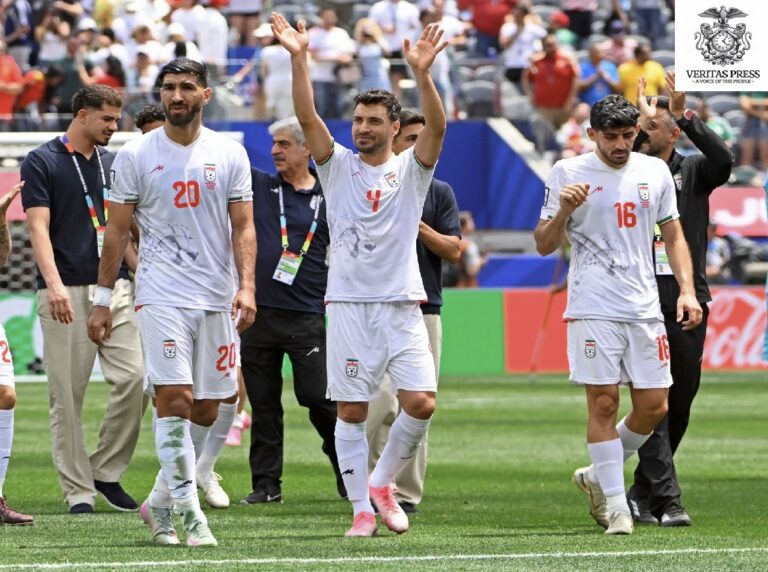
SEATTLE, TEHRAN — The U.S. Department of Homeland Security (DHS) will allow Iran’s national football team to enter the country 48 hours before their critical World Cup match against Egypt on Friday, a modest concession in a tournament where Team Melli’s travel conditions have sparked claims of oppression and competitive disadvantage.