Kamran Faqir is a volunteer investigative journalist and writer committed to exposing hidden truths and amplifying underreported stories. Driven by social justice, he brings sharp insight and fearless truth-telling to independent journalism. NUJ registered.
Title: From Kurdish Centres To Palestine Protests: How Proscription Laws Are Fueling Britain’s New Era Of Political Policing.
Press Release: Veritas Press C.I.C.
Author: Kamran Faqir
Article Date Published: 23 Nov 2025 at 11:05 GMT
Category: UK | Politics| From Kurdish Centres To Palestine Protests
Source(s): Veritas Press C.I.C. | Multi News Agencies
The UK government’s proscription of Palestine Action is intensifying long-standing fears that anti-terror legislation is being repurposed to suppress political dissent, a pattern activists say mirrors the aggressive treatment of Kurdish, environmental, and Palestine solidarity groups over the past decade.
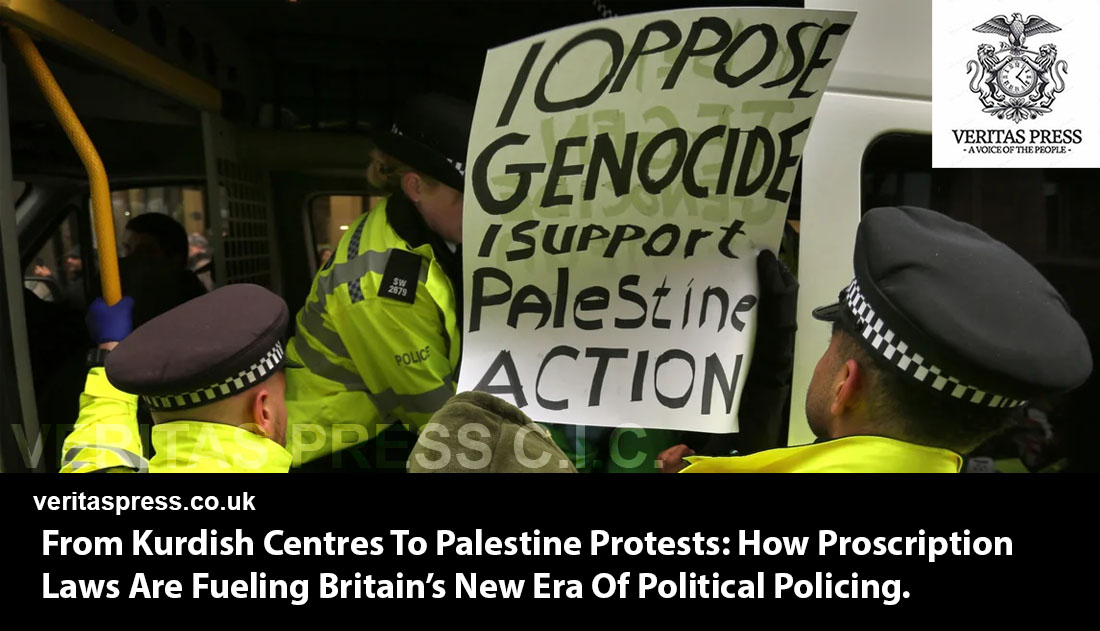
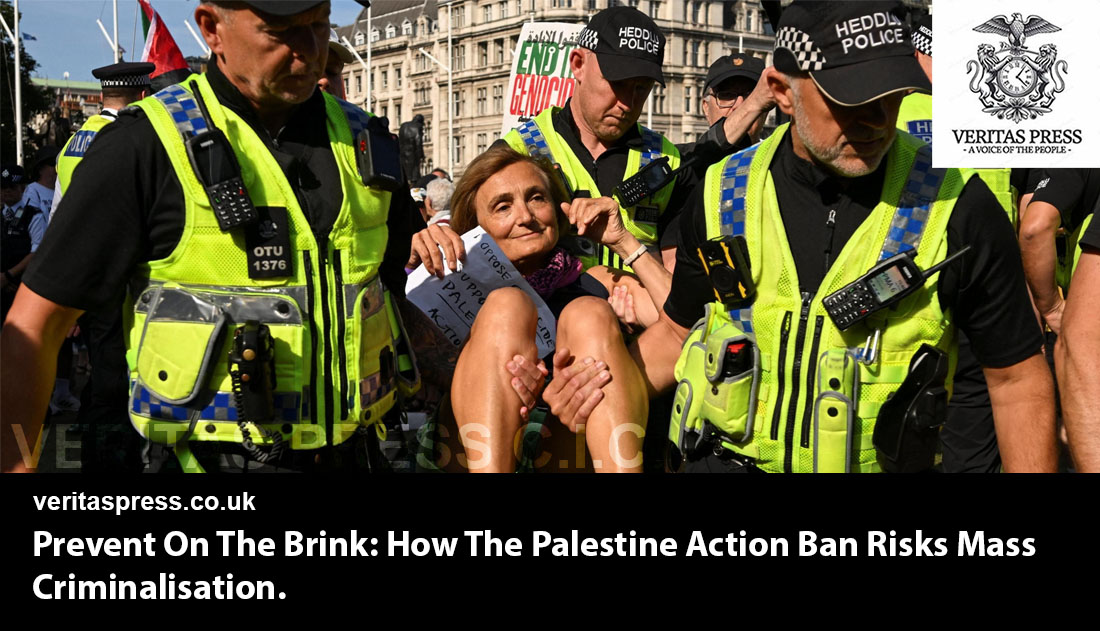
This weekend’s protests laid bare the stark geographical contradictions in UK policing. While the Metropolitan Police arrested at least 90 people in London’s Tavistock Square for holding signs stating “I oppose genocide, I support Palestine Action”, police in Belfast and Derry stood back as activists displayed identical placards. No arrests were made.
Amnesty International’s Northern Ireland director Patrick Corrigan, who observed the Belfast demonstration, called the proscription “absurd” and said the PSNI had taken a “markedly different approach” from their counterparts in England.
Defend Our Juries, which organised the nationwide demonstrations, said the glaring contrast “shows the arbitrary nature of enforcement”.
Veteran civil rights icon Eamonn McCann, speaking in Derry, said history was repeating:
“In 1968, civil rights activists were charged under the Special Powers Act. It is horrifying to be back on the same streets fighting the same battles.”
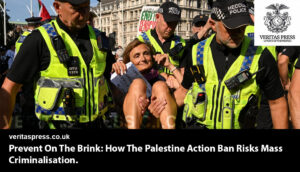
More than 2,100 arrests have been made across England and Wales since July as part of mass civil disobedience actions challenging the Palestine Action ban. Legal observers say the scale of detentions is unprecedented for a political protest movement in modern Britain.
The Kurdish Precedent: Counterterror Policing As Geopolitical Instrument.
Concerns about political policing long predate the Palestine Action ban.
On 27 November 2024, hundreds of heavily armed Metropolitan Police officers descended on the Kurdish Community Centre (KCC) in Haringey as part of a “significant” terror investigation into alleged PKK links. Riot vans, police dogs and helicopters created what community leaders described as a “military-style occupation”.
The PKK is proscribed in the UK, but Kurdish activists say the designation criminalises an entire community. Lawyers accused the Met of effectively acting on behalf of the Turkish government, a key NATO ally. The Met denied the allegation, but the perception of foreign influence persists.
Foreign Secretary David Lammy himself has faced scrutiny for once praising PKK-linked figures before adopting a hard line since taking office.
Activists argue the Kurdish case established a template: if a group or diaspora is geopolitically inconvenient, proscription law becomes a tool of repression.
Lord Walney’s Expanding Net Of Extremism.
Much of the ideological groundwork for the Palestine Action ban has been driven by Lord Walney, the government’s former (and controversial) extremism adviser. Walney has repeatedly claimed, without evidence, that mainstream organisations like the Palestine Solidarity Campaign (PSC) have “strong links” to Palestine Action.
Walney is now pushing amendments to the Crime and Policing Bill to expand police powers against environmental groups, including Extinction Rebellion, Just Stop Oil, and Youth Demand.
The Times recently grouped these organisations with “extreme protest groups such as Palestine Action”, signalling an emerging narrative that frames diverse activist movements as part of a single extremist ecosystem.
Legal experts describe this as “strategic conflation”: once activism is categorised as a threat, caring about multiple issues becomes suspicious.
Foreign Pressure And British Policing:
Evidence has already emerged that the UK government shared details of a Palestine Action investigation with the Israeli embassy, heightening concerns that British policing is being shaped by foreign diplomatic priorities.
A former counter-terror intelligence analyst told this publication:
“We are witnessing a dangerous alignment between UK domestic security policy and geopolitical alliances. Counterterror policing is at risk of becoming a tool of foreign policy rather than public safety.”
If the Kurdish precedent is any guide, activists warn that pro-Palestine demonstrations, marches, vigils, student actions, and even charity events could face escalating repression based on tenuous associations drawn by counter-extremism officials.
A New Era Of Arbitrary Policing:
From Belfast’s hands-off approach to London’s mass arrests, the UK is rapidly entering an era of selective, politically driven enforcement. Even police forces seem uncertain how to interpret the law, or how far they are expected to go.
Activist Rosemary Jenkinson, speaking in Belfast, said:
“Northern Ireland police aren’t arresting people because they know it’s ridiculous. We have a good chance of overturning the proscription, and we won’t stop organising.”
As the High Court reviews the legality of the ban, the wider question is now impossible to ignore: is Britain criminalising dissent? And if so, is Palestine Action only the beginning?
Kamran Faqir is a volunteer investigative journalist and writer committed to exposing hidden truths and amplifying underreported stories. Driven by social justice, he brings sharp insight and fearless truth-telling to independent journalism. NUJ registered.
SEATTLE, TEHRAN — The U.S. Department of Homeland Security (DHS) will allow Iran’s national football team to enter the country 48 hours before their critical World Cup match against Egypt on Friday, a modest concession in a tournament where Team Melli’s travel conditions have sparked claims of oppression and competitive disadvantage.