Kamran Faqir is a volunteer investigative journalist and writer committed to exposing hidden truths and amplifying underreported stories. Driven by social justice, he brings sharp insight and fearless truth-telling to independent journalism. NUJ registered.
Title: Beneath The Metro: The Hidden Human Cost Of Riyadh’s Crown Jewel.
Press Release: Veritas Press C.I.C.
Author: Kamran Faqir
Article Date Published: 18 Nov 2025 at 15:40 GMT
Category: Middle-East | Saudi Arabia | Beneath The Metro
Source(s): Veritas Press C.I.C. | Multi News Agencies
A decade-long investigation exposes the exploitation of South Asian migrant workers who built Saudi Arabia’s flagship public transport megaproject, revealing a system still defined by debt bondage, extreme heat, meagre pay, and the entrenched control of kafala.
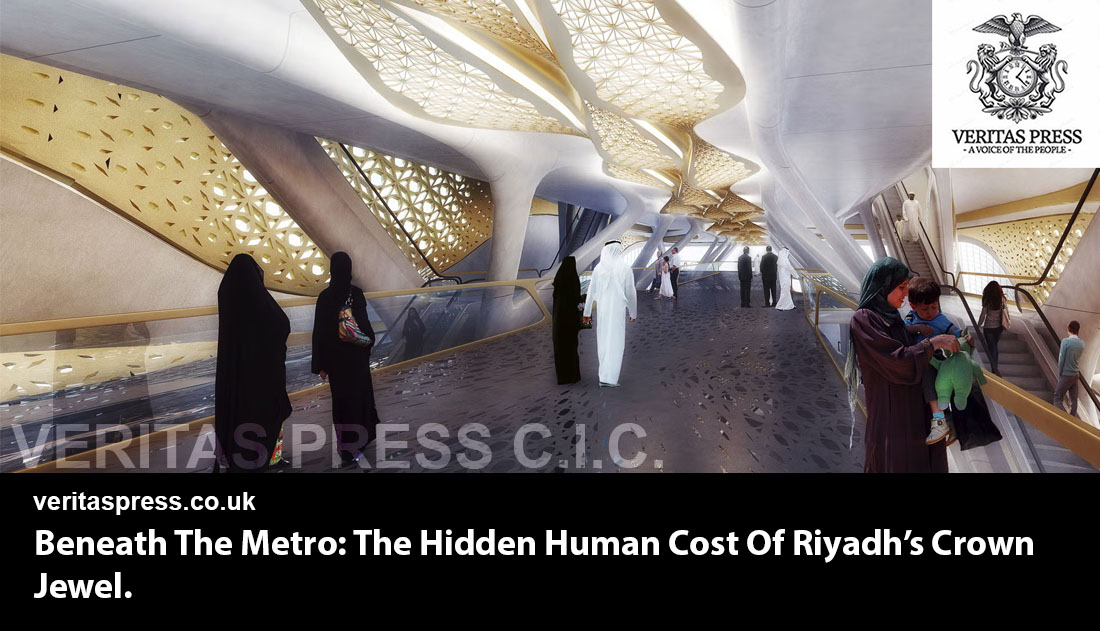
When the Riyadh Metro finally opened to fanfare in December 2024, the gleaming stations, air-conditioned skybridges, and sleek driverless trains were hailed as the future of urban mobility in the Gulf. Saudi officials called it the “backbone” of Riyadh’s transport transformation and a triumph of Vision 2030. International contractors praised their engineering prowess. Foreign dignitaries toured the lines with admiration.
But behind the polished marble and immaculate steel lies a much darker story, one written not by executives or ministers, but by the tens of thousands of migrant workers who built the network in punishing conditions and often at devastating personal cost.
A new report by Amnesty International, released on 18 November 2025, exposes what the organisation calls a “decade of exploitation” on the Riyadh Metro, revealing how migrant labourers from India, Nepal, and Bangladesh endured recruitment debt, extreme heat, poverty wages, and degrading living conditions while constructing the $22 billion megaproject.
This is the story Saudi Arabia does not put in its promotional videos.
This is the story that unfolded out of sight, in labour camps, underground tunnels, and sun-scorched worksites far from the public eye.
“Nobody Wants To Work In These Situations”: The Amnesty Report.
Over five years, Amnesty International conducted interviews with 38 former and current migrant workers employed between 2014 and 2025 on the metro’s construction. Their testimonies reveal a brutally consistent pattern:
Workers were exploited before arriving, exploited while working, and left with nothing when they returned home.
Debt Begins Before Departure.
Most workers paid recruitment agents between USD 700 and 3,500, a catastrophic sum for families in rural Nepal, Bangladesh, or India, where average monthly incomes can be $100–200.
Saudi Arabia prohibits worker-borne recruitment fees.
Origin countries regulate them.
Yet in practice, the entire burden falls on the worker.
For many, the only way to raise the money was to sell assets, mortgage land, or borrow at high interest.
One worker, 28-year-old Suman from Nepal, told Amnesty he had no choice but to sell the gold his wife’s family had saved over decades:
“To pay the agent, I borrowed gold from my wife’s parents and sold it. I paid twice the amount back because gold prices had risen. It took me six months just to clear the debt. And then… the salary was only 266 dollars.”
For others, the debt repayment stretched into years, and any hope of saving for the future evaporated long before their contracts ended.
Building The Metro For $2 An Hour.
When workers arrived in Saudi Arabia, the reality was stark.
Wages that barely cover survival.
Most were paid less than $2 per hour, a figure that would be illegal in their home countries, let alone on a billion-dollar infrastructure project overseen by multinational corporations.
Cleaners and basic labourers earned even less.
Although overtime was technically voluntary, workers told Amnesty they felt compelled to exceed 60 hours a week just to survive.
Nabin, a Nepali construction worker, explained:
“Due to inflation in Nepal, this salary is too little. My money disappears. School fees, food, bills, everything is expensive now. But what could I do? I had to keep working. I had no choice.”
Saudi Arabia does not enforce a universal living wage.
The result is predictable: a workforce trapped between poverty in Saudi Arabia and poverty at home.
Heat Like “Being In Hell”:
Temperatures in Riyadh routinely exceed 40°C, with heat waves often pushing past 45°C. The Saudi government bans outdoor work between 12:00 and 15:00 in summer, but workers say this rule is both inadequate and routinely ignored.
“How did I end up here? Is God punishing me?”
Indra, a worker from Nepal, described the heat as “hell”:
“When I work in the extreme heat, I feel like I’m in hell. Sometimes I think, did I do something wrong that God is punishing me? Nobody chooses to work like this. We suffer because we have families to feed.”
Another worker, Janak from India, said supervisors regularly ordered them to continue working even during peak heat:
“We would say it’s too hot, it’s dangerous. But they told us, ‘keep working.’ What can poor men do? We have to obey.”
As climate change intensifies, Gulf summers are becoming longer, hotter, and more humid. Amnesty warns that extreme heat deaths will likely increase unless Saudi Arabia radically strengthens protections.
Passport Confiscation, Dirty Camps, Rotten Food:
Beyond wages and heat, the workers described a litany of abuses:
Passports confiscated upon arrival
Overcrowded, unsanitary labour camps
Spoiled or insufficient food
Discrimination in pay, treatment, and basic living conditions
While international contractors managed executive offices in modern compounds, thousands of workers remained in dilapidated housing blocks, with poor ventilation and limited access to clean water.
One Bangladeshi worker described their dormitory:
“We slept 12 men in a room meant for four. Cockroaches everywhere. No privacy, no rest. We built a modern metro but lived like animals.”
The Kafala System: Reforms On Paper, Control In Practice.
Saudi Arabia claims to have “reformed” the kafala sponsorship system, which for decades tethered migrant workers to their employers, preventing them from switching jobs or leaving the country without permission.
But Amnesty found the reality unchanged.
Workers still lived in fear:
If they filed complaints, they risked termination.
If they fled abusive jobs, they risked arrest or deportation.
Employers retained vast power over contracts, housing, and mobility.
Amnesty concludes that kafala remains deeply entrenched in practice, enabling employers to operate with minimal accountability.
Gigaprojects, Global Conglomerates, And A Culture Of Denial:
The Riyadh Metro was built through a vast web of contractors and subcontractors, including:
Multinational engineering firms,
Saudi construction giants,
labour supply agencies.
Each layer added opacity. Each layer diluted responsibility. Each layer created opportunities for abuse.
Amnesty warns that weak labour enforcement, reduced penalties for violations, and the absence of independent unions make Saudi Arabia a high-risk environment for any company engaging in construction.
Marta Schaaf, Amnesty’s Programme Director, issued a blunt warning:
“For companies operating in Saudi Arabia, human rights due diligence is not optional. Without robust processes, businesses risk being directly linked to systematic labour abuses.”
A Gulf-Wide Pattern: Abuse Beyond The Metro.
The plight of Riyadh Metro workers echoes a long-standing pattern of abuse across the Gulf.
Recent cases include:
A Pakistani worker died while constructing a World Cup stadium in Al-Khobar in 2025.
Hundreds of workers in Mecca are going unpaid for 8 months, and some have been arrested after demanding their wages.
Widespread wage theft across Aramco-linked projects.
Deaths from electrocution, falls, and onsite accidents, documented by Human Rights Watch throughout 2025.
Severe abuse of migrant domestic workers, including forced confinement and violence.
These cases are not anomalies; they are symptoms of a regional labour model built on disposable labour from South Asia.
World Cup 2034: A Looming Human Rights Crisis.
Saudi Arabia is preparing to host the 2034 FIFA World Cup, a project that requires:
new stadiums,
hotels,
transport hubs,
highways,
entertainment districts.
Human Rights Watch has already warned of a surge in migrant worker recruitment, raising the risk of:
debt bondage,
wage theft,
heat-related deaths,
fatal construction accidents.
Rights groups fear the abuses documented on the Riyadh Metro will repeat on a far larger scale.
Countries Of Origin: Complicity By Neglect.
Amnesty emphasises that the governments of India, Nepal, and Bangladesh also bear responsibility.
Recruitment agencies in these countries operate with limited oversight, while officials rely heavily on remittances to bolster national economies.
The result is a silent complicity, where:
Abusive recruiters go unpunished,
Victims struggle to file complaints,
Accountability is rare.
Amnesty urges origin countries to impose stricter monitoring, blacklist abusive agencies, and support workers in seeking compensation.
A Decade Of Exploitation, A Lifetime Of Loss:
For many workers interviewed by Amnesty, the Riyadh Metro project did not bring prosperity; it brought years of debt, trauma, and shattered expectations.
Some returned home permanently injured. Some left empty-handed after months of unpaid wages. Some died anonymously on worksites far from home.
Their labour transformed Riyadh. But their own lives often changed for the worse.
Conclusion: The Human Cost Buried Beneath The Rails.
Saudi Arabia’s leadership proudly showcases the Riyadh Metro as a symbol of progress and modernisation. Yet Amnesty’s investigation exposes a harsh truth:
The metro was built on exploitation, systematic, prolonged, and preventable.
As Saudi Arabia pushes ahead with ever grander giga-projects, including World Cup infrastructure, the world faces a defining question:
Will global companies, governments, and organisations demand real labour protections?
Or will they remain complicit, choosing profit, prestige, and geopolitical alliances over the rights of the migrant workers who build the Gulf?
The workers have spoken. Their testimonies are clear. Now the world must decide whether to listen.
Kamran Faqir is a volunteer investigative journalist and writer committed to exposing hidden truths and amplifying underreported stories. Driven by social justice, he brings sharp insight and fearless truth-telling to independent journalism. NUJ registered.
SEATTLE, TEHRAN — The U.S. Department of Homeland Security (DHS) will allow Iran’s national football team to enter the country 48 hours before their critical World Cup match against Egypt on Friday, a modest concession in a tournament where Team Melli’s travel conditions have sparked claims of oppression and competitive disadvantage.