Kamran Faqir is a volunteer investigative journalist and writer committed to exposing hidden truths and amplifying underreported stories. Driven by social justice, he brings sharp insight and fearless truth-telling to independent journalism. NUJ registered.
Press Release: Veritas Press C.I.C.
Author: Kamran Faqir
Article Date Published: 11 Nov 2025 at 17:20 GMT
Category: Middle-East | Palestine-Gaza-West Bank | Approved: Israel’s Death Penalty
Source(s): Veritas Press C.I.C. | Multi News Agencies
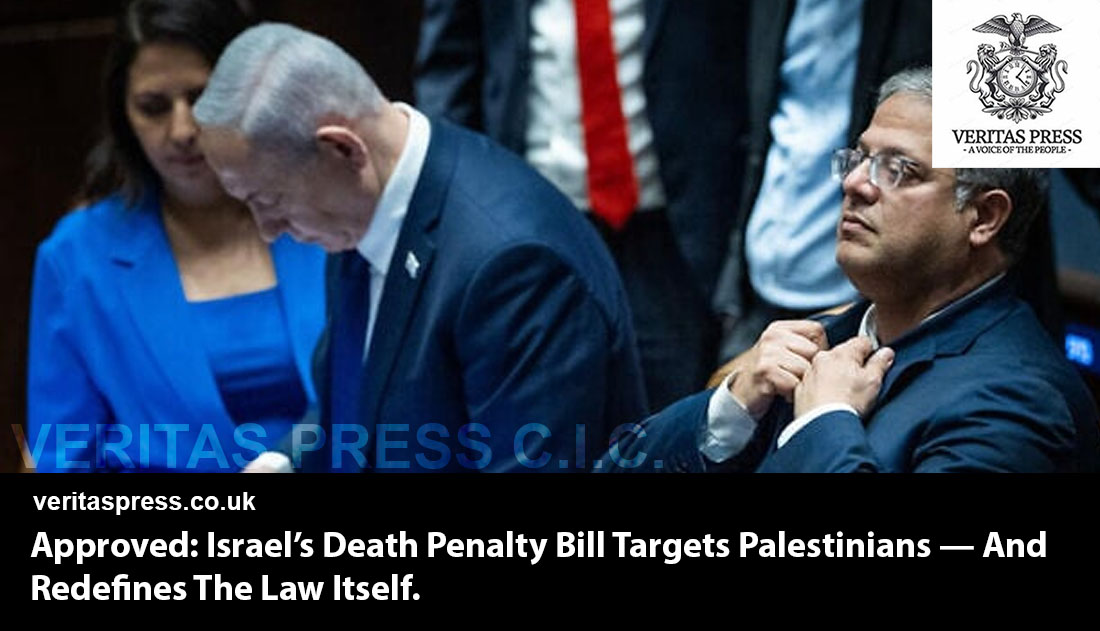
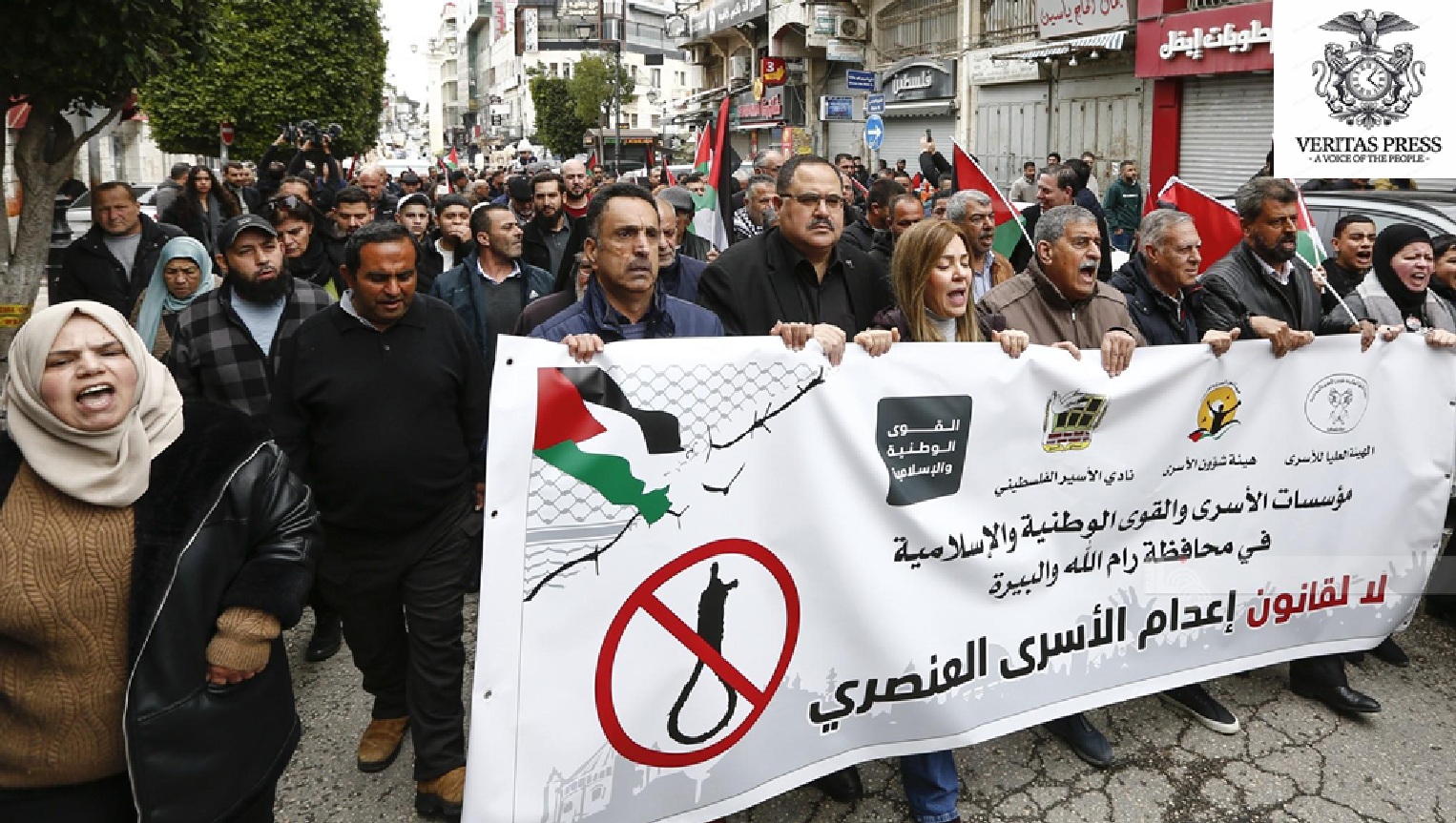
TEL-AVIV, November 2025 – Israel’s parliament has advanced one of its most extreme legislative packages in decades, reviving the death penalty for Palestinians accused of killing Israelis and empowering police to arrest citizens for “incitement” without judicial oversight. Together, the two bills mark a dramatic legal shift: embedding racialised punishment, weakening due process, and giving near-unchecked power to a far-right security establishment that already polices Palestinian life with impunity.
Human rights organisations, opposition lawmakers, and legal experts warn that these measures, both championed by National Security Minister Itamar Ben-Gvir, risk turning emergency war rhetoric into a permanent legal order of apartheid. Critics call it the Institutionalisation Of Vengeance, Not Justice.
“We Promised And Delivered”
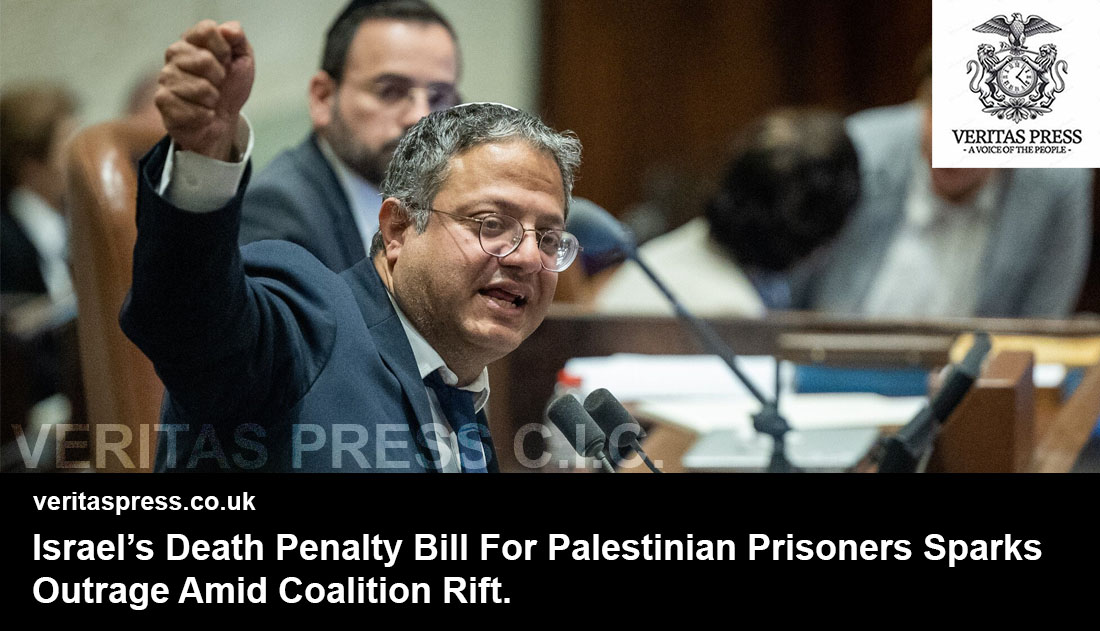
When the Knesset voted 39–16 to approve the Death Penalty for Terrorists Bill on first reading, Ben-Gvir declared triumphantly on X (formerly Twitter):
“Jewish Power Is Making History. We Promised And Delivered.”
The bill, backed by Prime Minister Benjamin Netanyahu’s coalition under heavy far-right pressure, would allow, and in certain cases require, courts to impose mandatory execution sentences on those convicted of “nationalistically motivated” killings of Israelis. It removes the possibility of presidential commutation and lowers the threshold for conviction in military courts, where the vast majority of Palestinian defendants are tried.
A second, related bill passed the Knesset Internal Affairs Committee by a narrow 6–5 margin. It grants police the power to arrest and open investigations into alleged “incitement to terrorism” without prior approval from the Attorney-General, a safeguard introduced decades ago to prevent politically motivated arrests. The measure also broadens the legal definition of incitement to include “praise” or “sympathy” for acts deemed terroristic, even on social media.
Opposition lawmaker Gilad Kariv of the Democrats warned:
“The bill will lead to countless wrongful arrests of citizens and the abuse of arrest and investigation powers by officers lacking proper training, who will seek to curry favour with politicians.”
Designed For One Group Of People, Palestinians:
Although the bill’s language refers generically to “terrorists,” its application is unambiguously one-sided. It applies only to those convicted of killing Israeli citizens “out of hatred for Israel or the Jewish people.” In practice, legal analysts note, this category excludes Jewish Israelis who kill Palestinians, including settlers convicted of premeditated murders.
Legal scholar Dr. Keren Michaeli, writing in Haaretz, observed that “the law is written so narrowly and ideologically that it could never be used against a Jewish perpetrator.” She added that it “introduces an ethno-national hierarchy into criminal sentencing, the death penalty only applies to one people.”
That hierarchy is already visible in law enforcement. A Haaretz investigation found that since Ben-Gvir took office, 96% of incitement investigations opened by Israeli police have targeted Arabs, either Palestinian citizens of Israel or residents of East Jerusalem.
“Giving the police more powers under such conditions,” said Adalah, a Palestinian legal centre in Haifa, “will only formalise what is already a discriminatory practice.”
A Weaponised Judiciary:
The military court system, which governs Palestinians in the occupied West Bank, is already notorious for its near-total conviction rate. Proceedings are conducted in Hebrew, trials often rely on secret evidence, and judges are serving Israeli officers. By lowering the threshold for death sentences from unanimous to majority verdicts, the new law effectively makes executions administratively simple.
Suhad Bishara, legal director of Adalah, described the reform as “a legal instrument for ethnic punishment.”
“Palestinians are prosecuted by military judges, often without access to defence counsel or transparent evidence. Now, those same courts could impose irreversible sentences under political pressure. It’s the final collapse of the pretence of equality before the law.”
Human Rights Watch (HRW) warned that implementing the death penalty in this context “would constitute a grave breach of Israel’s obligations under international law.” HRW’s regional director Omar Shakir said the bill “cements an apartheid legal regime in which the same act is punished by imprisonment for one citizen and execution for another, solely on ethnic grounds.”
A Global Outlier And A Political Tool:
The death penalty has not been used in Israel since 1962, when Nazi war criminal Adolf Eichmann was executed. Every government since has rejected its reintroduction, citing moral and legal risks. But the political calculus has changed under Netanyahu’s far-right coalition.
Ben-Gvir and his ultranationalist allies from Otzma Yehudit and Religious Zionism have long campaigned for reinstating executions for Palestinians, claiming it will deter attacks and prevent future prisoner exchanges. In February, Ben-Gvir publicly threatened to boycott coalition votes unless Netanyahu advanced the bill, calling it “a red line for national honour.”
Analysts say the move is less about deterrence than political survival.
“Ben-Gvir needs to show symbolic victories to his base after months of internal coalition fractures,” said Dr. Dahlia Scheindlin, a political scientist and pollster. “The death penalty bill is pure populist theatre, a message to his supporters that Jewish lives are valued above Palestinian ones.”
Reuters reported that the bill was drafted “to ensure those convicted of killing Israelis cannot be included in future prisoner swaps”, a key demand of hostage families and the far-right bloc. But legal experts say the law undermines Israel’s negotiating flexibility and risks incentivising retaliatory violence.
“This legislation is not deterrence; it’s desperation,” said Dr. Hagar Shezaf, an Israeli journalist covering security affairs. “By making execution mandatory, Israel forecloses future diplomatic options and signals to Palestinians that the state no longer distinguishes between punishment and revenge.”
Criminalising Speech And Thought.
The incitement bill, which moved in tandem with the death penalty proposal, extends the same logic of punitive nationalism to the realm of speech. Under the new framework, police can arrest individuals suspected of “encouraging” or “praising” terrorism, even by sharing social media posts or attending protests, without the Attorney-General’s approval.
The result, warn civil-liberties groups, is a blank cheque for political policing. Adalah noted that since October 2023, dozens of Arab university students and municipal workers have been arrested for social media posts expressing sympathy with Gaza’s civilians. “The state is conflating empathy with incitement,” said Bishara. “This bill makes that conflation permanent.”
Haaretz reported that one Arab student was detained after merely posting “Stop the killing” on Instagram. Under the new law, such arrests could occur without oversight or the right to immediate legal counsel.
Opposition MP Kariv said the law was “the Ben-Gvir doctrine codified, a doctrine of suspicion, fear, and collective guilt.”
Human Rights Defenders Fund, an Israeli NGO supporting political detainees, called it “a devastating escalation of state repression under the cover of national security.”
International Alarm:
The legislative package has drawn sharp international criticism. Amnesty International described the death penalty bill as “a cruel, inhuman, and discriminatory punishment weaponised to repress an occupied population.” Amnesty researcher Hebh Jamal noted that similar laws worldwide “are overwhelmingly used as political theatre in moments of domestic crisis, to project control, not to achieve justice.”
The UN Office of the High Commissioner for Human Rights (OHCHR) said it was “deeply concerned” by Israel’s apparent move toward institutionalising capital punishment, warning that it may breach Article 6 of the International Covenant on Civil and Political Rights, which prohibits arbitrary deprivation of life. A spokesperson added that the law’s ethnic framing “raises serious concerns of discrimination and apartheid.”
The European Union, while more muted, urged Israel to “reconsider measures inconsistent with its democratic values.”
Privately, EU diplomats told Middle East Eye that the bloc feared “irreversible reputational damage” to Israel if executions were carried out under military jurisdiction.
The Numbers Behind Repression:
Data gathered by Haaretz and civil-society groups shows how the apparatus of “national security” policing already functions:
96% of all incitement investigations target Arabs.
86% of those charged are convicted, most through plea bargains coerced under administrative detention.
0 Jewish Israelis have been prosecuted under similar charges despite dozens of public social media posts calling for “flattening Gaza” or “erasing Rafah.”
“Police already have the tools to arrest Palestinians arbitrarily,” said Rania Muhareb, a legal researcher with Al-Haq. “Now they have political cover to call that justice.”
What This Means On The Ground:
For Palestinians in the West Bank and inside Israel, the new bills codify a reality long felt in practice.
Military law will now carry the explicit threat of execution. Civil law will criminalise even symbolic dissent. And both are administered by the same political elite that has vowed to “restore Jewish sovereignty” from the Jordan River to the Mediterranean.
Families of prisoners fear what comes next.
“We already fear our sons being tortured or disappearing in prison,” said Um Ahmed, whose nephew has been held in Ofer prison without trial since February. “Now we fear they will not come home alive.”
Lawyers warn that the legal changes could have a chilling effect far beyond Israel and the occupied territories. Palestinian students abroad, already facing surveillance and deportations, particularly in the United States and UK, could see online expression weaponised against them in extradition or visa cases.
“This Is Apartheid Law-Making”
“This is not just another right-wing law,” said Michael Sfard, an Israeli human-rights attorney. “It’s apartheid law-making, the deliberate construction of two legal systems defined by ethnicity and political loyalty. The death penalty is the endgame of that project.”
Sfard noted that Israel’s shift echoes other authoritarian trends worldwide: “When the law begins to serve the politics of revenge, democracy is already gone.”
B’Tselem, the Israeli rights organisation, issued a blunt statement:
“Israel’s leaders are legislating death in the name of deterrence. This is vengeance codified into law — an apartheid state openly declaring who may live and who may die.”
A Dangerous Precedent:
Even some former security officials have broken ranks. Retired Shin Bet director Carmi Gillon told Yedioth Ahronoth that “executions will not deter attacks but will radicalise the next generation.” He added that the incitement law “turns intelligence work into political policing.”
The Association for Civil Rights in Israel (ACRI) warned that the bills “invite international condemnation and potential ICC scrutiny,” especially as they are likely to be applied within occupied territory.
Under the Rome Statute, executions following discriminatory trials could amount to “wilful killing”, a war crime.
Conclusion: From Occupation To Execution, Law As An Instrument Of Control.
The Knesset’s new death penalty and incitement bills are not isolated acts of legislation. They are the culmination of a decades-long process through which Israel’s legal system has been systematically weaponised to preserve Jewish supremacy and suppress Palestinian resistance, political, armed, or symbolic. What began as “temporary security measures” under military occupation has evolved into a permanent legal infrastructure of domination. These new laws merely strip away the last pretence of equality before the law.
For decades, Israel’s use of military law, administrative detention, and targeted killings has blurred the line between justice and repression. The new death penalty and incitement bills erase that line altogether.
By giving the state the power to kill and silence Palestinians under the guise of legality, Israel is not just expanding punishment, it is redefining who counts as human within its legal order.
As Amnesty International wrote in a recent global report:
“Some governments have shown renewed determination to use this cruel punishment as a tool of repression and control.”
In Israel’s case, that determination now has the full force of parliamentary law.
In practice, these bills codify what has long existed in the field: the power of the state to determine Palestinian life and death without accountability. They institutionalise a system in which the same act, the taking of a life, the posting of a message, is punished or pardoned not on the basis of justice, but identity. For Palestinians, the message is clear: your existence itself is subject to criminalisation and extermination.
“Israel’s apartheid is no longer hidden behind bureaucratic language,” said Michael Sfard, the Israeli human rights attorney. “It is being written into the law books, in bold letters and in Hebrew.”
The death penalty bill reflects not only an intensifying racism but also a deep crisis of legitimacy within Israel’s governing order. Facing mounting accusations of genocide in Gaza and growing international isolation, Netanyahu’s coalition is retreating into an explicitly ethno-nationalist framework, a state that rules by fear rather than law, and by vengeance rather than justice.
As Amnesty International further warned, “Israel is using the language of security to legislate the machinery of oppression.”
The implications extend beyond Israel’s borders. Once a state normalises execution and censorship along ethnic lines, it signals that international norms, from the Geneva Conventions to the Universal Declaration of Human Rights, are optional. This legislative turn invites not only moral condemnation but potential legal consequences under the Rome Statute, where discriminatory executions and political persecution qualify as crimes against humanity.
For many Israelis, these bills also mark a profound internal rupture. The same judiciary that once claimed to balance “security needs” with democratic restraint is being rewritten as a political instrument of the far-right. Legal scholars describe it as a “constitutional coup by legislation.” What was once done extrajudicially, assassinations, torture, and censorship, is now being rendered lawful. The law no longer restrains power; it sanctifies it.
For Palestinians, meanwhile, this is another escalation in a century-long continuum of dispossession, from land theft to occupation, from blockade to starvation, and now, the return of the executioner. As Rania Muhareb of Al-Haq observed, “The Israeli regime’s violence has always sought legitimacy through law. These bills make that violence explicit, unapologetic, and permanent.”
Israel’s defenders may frame these measures as a deterrent against terrorism. But history suggests the opposite. The execution of a people’s sons and daughters does not extinguish resistance; it fuels it. Every death sentence handed down under occupation will echo as another chapter in a story of systemic dehumanisation, one that no wall, bomb, or law can erase.
In the end, these bills do not strengthen Israel’s security; they expose its moral collapse. They represent the moment when the state, once content to control Palestinian life, claims the legal right to extinguish it, in the courtroom, in the prison cell, in the algorithm of surveillance. It is the law itself, now, that carries out the occupation.
Across the international stage, the backlash is growing. UN human rights experts have warned that Israel’s legislative path is “further entrenching apartheid and paving the way for state-sanctioned executions.” The European Union has called for “an immediate halt to discriminatory legal measures incompatible with international human rights law,” while Human Rights Watch described the new bills as “the legalisation of racial vengeance.” Meanwhile, at The Hague, prosecutors at the International Criminal Court are weighing evidence of systematic targeting and persecution of Palestinians, a context in which these laws could serve as proof of intent.
If the world fails to act, these bills may stand as precedent, not just for Israel, but for every state seeking to mask repression as legality. What is at stake is not only the lives of Palestinians under occupation and erasure, but the very idea that law should protect the oppressed rather than empower their oppressor.
How long can a state claim the language of democracy while writing execution into its laws and humanity out of its constitution?
Kamran Faqir is a volunteer investigative journalist and writer committed to exposing hidden truths and amplifying underreported stories. Driven by social justice, he brings sharp insight and fearless truth-telling to independent journalism. NUJ registered.
SEATTLE, TEHRAN — The U.S. Department of Homeland Security (DHS) will allow Iran’s national football team to enter the country 48 hours before their critical World Cup match against Egypt on Friday, a modest concession in a tournament where Team Melli’s travel conditions have sparked claims of oppression and competitive disadvantage.