





Press Release: Veritas Press C.I.C.
Author: Kamran Faqir
Article Date Published: 07 Nov 2025 at 19:10 GMT
Category: Americas-Brasil | COP30 | The Consensus Is Gone
Source(s): Veritas Press C.I.C. | Multi News Agencies
Website: www.veritaspress.co.uk

Business Ads

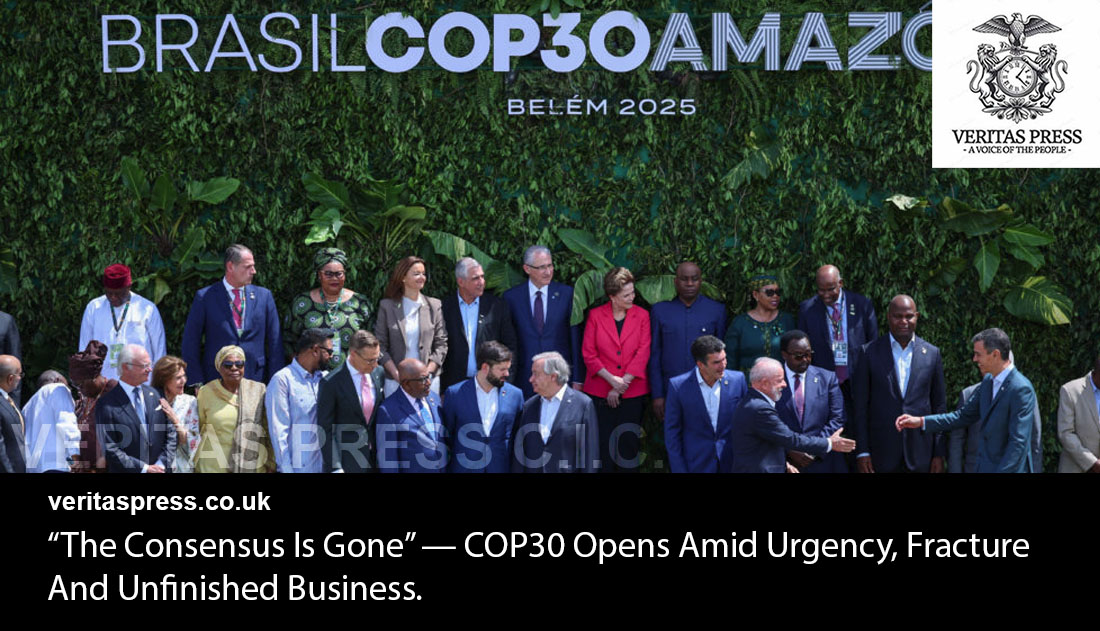
COP30, BRAZIL – As the world’s climate‑diplomacy machinery grinds into gear in the Amazon city of Belém for COP30 (10 – 21 November 2025), the tone has shifted from cautious consensus to alarm, recrimination and a reckoning over how far off course the global climate trajectory now is.
1. From Paris hope to Belém despair: the collapse of consensus
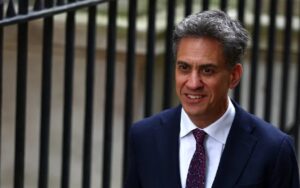
Ten years after the landmark Paris Agreement of December 2015, the gathering at COP30 opens not with optimism, but with a stark admission of failure. UK Prime Minister Keir Starmer told the world:
“Ten years ago, the world came together in Paris … united in our determination to tackle the climate crisis. The only question was how fast we could go. Today, however, sadly, that consensus is gone.”
Starmer compounded the message by insisting the UK remains “all in”, doubling down on a domestic net‑zero agenda he cast as “win-win”.
What has gone wrong?
- Scientific warnings are worsening, not easing. The World Meteorological Organisation (WMO) reports 2025 is set to be one of the three hottest years on record, and that the 11-year period 2015‑25 will individually be the 11 warmest ever.
- The WMO further states it is now “virtually impossible” to limit warming to 1.5 °C above pre-industrial levels without a temporary overshoot.
- Meanwhile, national climate plans (NDCs) and mitigation pledges continue to fall far short of the science-based thresholds required.
In short, the bedrock of multilateral climate action, a shared belief in urgency and collective purpose, has cracked, leaving a sense of drift and inertia.
2. The moral reckoning: the 1.5 °C target is slipping.
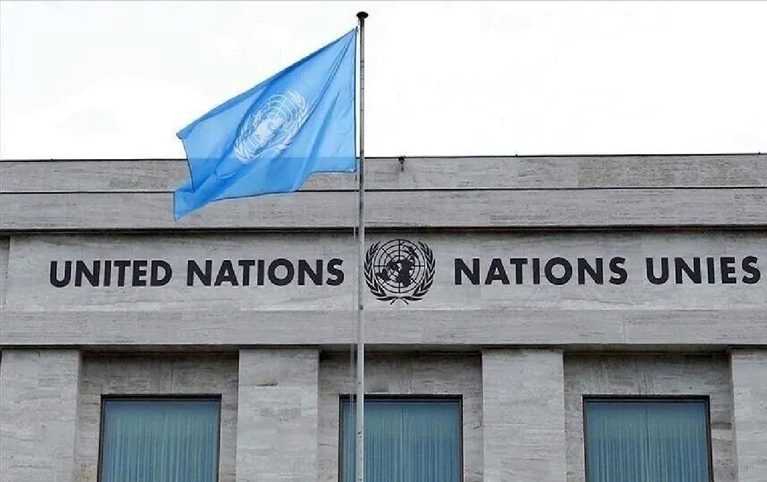
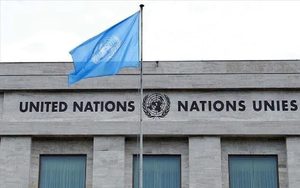
At the opening of the leaders’ summit, António Guterres, Secretary‑General of the United Nations, delivered one of the most uncompromising speeches in recent COP history:
“This is moral failure – and deadly negligence.”
Key facts:
- From January to August 2025, the near-surface temperature average was ~1.42 °C above pre-industrial levels.
- Greenhouse gas concentrations are at their highest in 800,000 years, according to the WMO.
- The WMO states that limiting warming to 1.5 °C without overshooting is practically out of reach, though bringing temperatures back down remains essential.
The implication: The 1.5 °C guardrail in the Paris Agreement is no longer a realistic near-term target. The debate has shifted to controlling an overshoot, minimising damage, and delaying irreversible tipping points.
3. Key messages from summits, leaders and blocs.
UK & Starmer
Starmer’s message was simultaneously realist and resolute. He acknowledged the breakdown of consensus, addressed domestic critics of net‑zero policy and linked green investment to jobs, energy security and economic growth.
China
Ding Xuexiang, China’s Vice‑Premier, used the occasion to emphasise greener trade and supply chains:
“We must strengthen international collaboration on green technology and industry, remove trade barriers, and ensure free flow of high-quality green products.”
China also reminded developed nations to “lead in emissions reductions and honour their funding commitments.” In effect, China is signalling it will cooperate, but not at the expense of its growth goals or global position.
Royal Voice
Prince William, representing the UK, urged “urgent optimism” and unity:
“The Earth is edging dangerously close to tipping point … the threat of climate change is fast approaching.”
His message: even where consensus fades, hope and action must persist.
Host Nation & Context
Brazil, led by Luiz Inácio Lula da Silva, emphasises implementation: the agenda is less about new promises and more about delivering on old ones.
Yet Brazil’s credibility is challenged by the simultaneous approval of Amazon oil drilling near the rainforest mouth, a contradiction many delegates noted.
4. Why The Breakdown Matters: Stakes, Geopolitics And Finance.
Emissions Gap & Tipping Risk
The expert community warns that the world is already on course for warming well beyond 1.5 °C, likely 2.5‑3 °C or more if business as usual continues.
This overshoot has serious implications: more frequent and intense heatwaves, storms, coral reef collapse, sea‑level rise, displacement and inequality. Guterres emphasised that every fraction of a degree matters.
Geopolitical Fragmentation
The absence of the US (with Donald Trump’s administration openly scornful of climate science) leaves a leadership vacuum.
Emerging economies like China, India and Brazil are asserting more independence, but also emphasising development, fairness and “common but differentiated responsibilities”.
Finance, Adaptation & Forests
For many vulnerable countries, the failure is not just about emissions, it’s about adaptation finance, loss and damage, and forest protection. Brazil’s “Tropical Forests Forever Facility” is a flagship effort, but initial funding is modest and commitments hazy.
5. What COP30 Must Deliver, And Likely Won’t.
According to analysts, these are the four critical tests for COP30:
- Close the emissions gap — bring NDCs and policies in line with at least 1.5 °C compatible trajectories.
- Accelerate implementation — shift from ambition to execution.
- Scale finance — especially for adaptation, loss and damage, and developing countries’ just transitions.
- Fossil fuel phase‑out — still the weakest link: most governments talk renewables but avoid hard commitments on coal, oil and gas.
Realistically, many observers believe COP30 will yield incremental progress at best. There is a risk that it becomes more about preserving the system than strengthening it.
6. Investigative Angles & Unresolved Questions.
Given your investigative lens, the following are worth deeper digging:
- Accountability: Which major emitters are missing or under‑represented? How will they be held to account?
- Finance flows: Where exactly are the promised funds going? Is there transparency around the Tropical Forests Forever Facility and other mechanisms?
- Trade and green supply‑chains: China highlighted the need to remove trade barriers. But does this reflect genuine leadership, or simply positioning for economic advantage?
- Overshoot strategy: If 1.5 °C is now “virtually impossible” in the near term, what contingency plans exist to minimise damage and eventually bring the temperature back down?
- Political backlash: With consensus fractured, how will populist or fossil‑fuel-friendly forces exploit the frustration?
- Hidden infrastructure risks: Brazil’s hosting of COP30 is symbolically potent, but concerns remain about logistical readiness, rainforest protection, and the tension between oil‑drilling authorisations and climate credibility.
Conclusion – The Age Of Climate Denial 2.0: Collapse Of Consensus, Crisis Of Accountability.
The tone from Belém is not one of triumph or unity but of exhaustion, fragmentation, and quiet alarm. COP30, convened ten years after the Paris Agreement, has laid bare the hollowness of international promises. What should have been a milestone for climate progress has instead revealed a movement divided, distracted, and dangerously out of touch with the accelerating human cost of its own inaction.
When UK Prime Minister Keir Starmer warned that “the consensus is gone,” it was not only a political reality check, it was an admission of failure on a planetary scale. From COP20 to COP30, the pattern has been clear: lofty declarations, incremental pledges, and systemic blindness to the deeper, intertwined causes of the crisis, pollution, war, fracking, and unrestrained industrial expansion. World leaders have failed to comprehend that climate change is not a single issue but a symptom of a global economic model built on extraction, violence, and environmental neglect.
Pollution, once dismissed as a technical problem, is now a humanitarian catastrophe. It seeps into every breath, every drop of water, every meal. Across continents, from the smog-choked skylines of Delhi and Beijing to the poisoned rivers of the Amazon and the plastics washing up on Mediterranean shores, the human toll is mounting. The World Health Organization estimates that air pollution alone kills over 7 million people each year, a silent genocide unfolding beneath the radar of political urgency. Children develop asthma before they can read; entire generations grow up under skies turned toxic; and still, governments permit the expansion of coal mines, refineries, and chemical industries in the name of economic stability.
Meanwhile, the world’s militaries, the single largest institutional polluters, continue to burn through oil and gas reserves with impunity. Wars from Ukraine to Gaza not only destroy lives but also decimate ecosystems, release massive carbon emissions, and divert billions in climate finance to weaponry. Fracking and oil exploration, often marketed as “bridges to transition”, are accelerating the very warming they claim to offset. Each policy of convenience is a betrayal disguised as progress.
UN Secretary-General António Guterres’ indictment that missing the 1.5 °C target is a “moral failure and deadly negligence” underscores a grim truth: this is no longer a crisis of ignorance, but of indifference. Climate diplomacy has become a theatre of contradictions, where pledges of “net zero” coexist with new drilling approvals, and where leaders praise “adaptation” while ignoring the communities already displaced by floods, droughts, and fires.
This is Climate Denial 2.0, a more insidious form of evasion. No longer denying the science, leaders now deny responsibility. They speak of “pragmatism,” “energy security,” and “national interest,” while millions breathe toxic air, drink contaminated water, and bear the psychological scars of living on a dying planet. The denial is not of facts, but of empathy.
For Indigenous guardians of the Amazon, for Pacific islanders watching the tides swallow ancestral homes, for African farmers losing their soil to desertification, climate change is not a future threat; it is a lived reality. The world’s poor are paying with their lungs, their land, and their lives for the pollution, wars, and extraction of the wealthy. The promised climate finance remains trapped in bureaucracy and political leverage, while the human cost continues to multiply.
The crisis of consensus is therefore not only political, it is moral, economic, and deeply human. The pollution that clouds our cities mirrors the moral pollution clouding global leadership. Unless governments recognise that the struggle against climate change is inseparable from the fight against war, inequality, and exploitation, every new COP will simply measure humanity’s descent into self-destruction.
In Belém, amid the fading echoes of once-bold promises, the choice has never been starker: reclaim the moral clarity to act as one species on one fragile planet, or continue to breathe in the dust of denial until there is no air, or time left.
Tags: