Kamran Faqir is a volunteer investigative journalist and writer committed to exposing hidden truths and amplifying underreported stories. Driven by social justice, he brings sharp insight and fearless truth-telling to independent journalism. NUJ registered.
Press Release: Veritas Press C.I.C.
Author: Kamran Faqir
Article Date Published: 06 Nov 2025 at 13:23 GMT
Category: Americas | Politics | Trump’s Fiscal Threat To New York City
Source(s): Veritas Press C.I.C. | Multi News Agencies
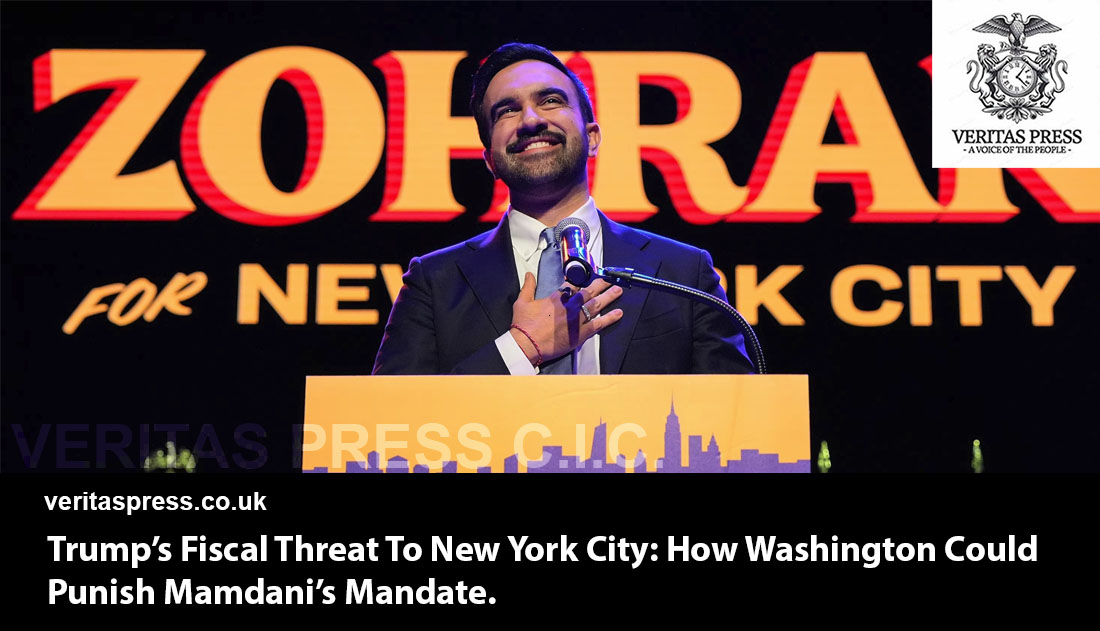
When President Donald Trump warned that federal funds could be “re-evaluated” for New York City following Zohran Mamdani’s landslide victory as mayor-elect, it sounded at first like familiar bluster. But inside City Hall and the state attorney general’s office, officials heard something different: a coded declaration of fiscal war.
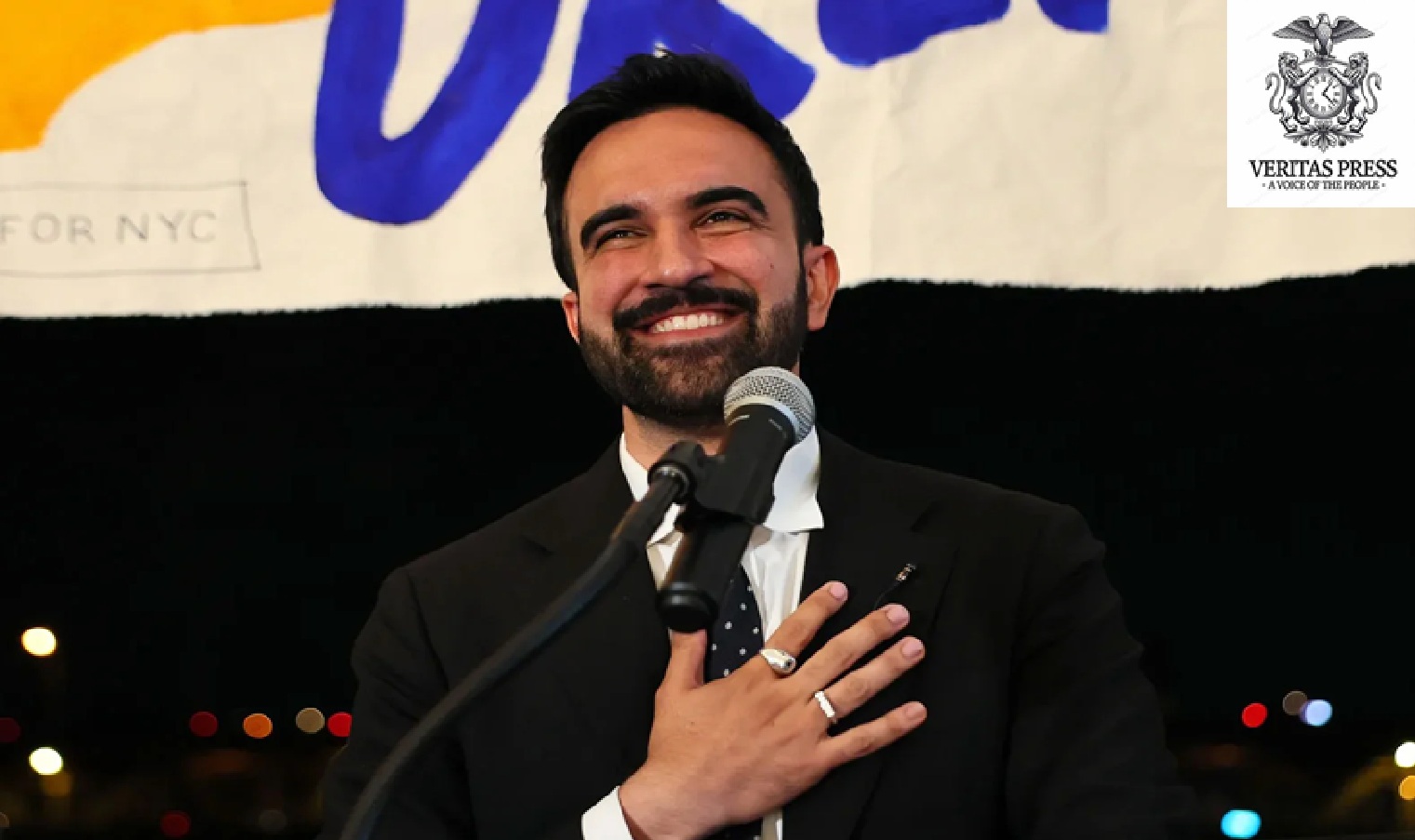
Mamdani, the 33-year-old democratic socialist and state assemblyman from Queens, represents the sharpest ideological break from the neoliberal and technocratic traditions that have defined New York’s mayors for decades. His campaign promised to decommodify housing, expand municipal broadband, and make public transit free, a platform funded by taxing luxury real estate and redirecting public-private subsidies.
Trump’s warning wasn’t just about policy disagreements. It was about disciplining a city that dared to reject federal orthodoxy, using the oldest tool in the playbook of executive power: money.
The Fiscal Trail: Federal Leverage Points In A City Under Siege.
A review of federal budget data and discretionary grant mechanisms shows that several key funding streams, particularly within the Department of Housing and Urban Development (HUD), Department of Transportation (DOT), and Department of Homeland Security (DHS), are especially vulnerable to executive interference.
HUD oversees programs that channel over $7.2 billion annually to New York City, including the Community Development Block Grant and public housing modernisation funds. These can be “suspended for compliance review” with little public notice. Under Trump’s first term, the same justification was used to delay disbursements to sanctuary jurisdictions.
DOT’s RAISE (Rebuilding American Infrastructure with Sustainability and Equity) grants, vital to Mamdani’s transit electrification and street-safety initiatives, are highly discretionary. A DOT official, speaking on background, acknowledged that such grants are “politically flexible” and “can be redirected under new guidance”.
DHS, through FEMA and the Urban Area Security Initiative (UASI), provides over $200 million annually for emergency readiness and counterterrorism. Should the White House reclassify New York as “non-cooperative,” those funds could be quietly reduced.
Behind the scenes, Mamdani’s transition team is reportedly mapping every federal inflow dependent on executive discretion, a kind of defensive budgeting meant to anticipate political punishment before it lands.
Historical Parallels: Nixon’s Shadow Over The 2020s.
This isn’t the first time Washington has punished New York for defiance. In the early 1970s, President Richard Nixon ordered the Office of Management and Budget to delay or reroute grants to liberal mayors like John Lindsay and Carl Stokes.
Declassified memos from 1973–74 show Nixon’s advisors explicitly recommended starving “non-cooperative urban centres” of federal cash. That fiscal throttling helped drive cities into debt, paving the way for Wall Street’s control over municipal finance, a crisis that birthed the austerity politics of the late 20th century.
Trump’s latest warning echoes that precedent: a revival of Nixonian retaliation under the banner of fiscal responsibility. His administration is already hinting that cities “failing to comply with federal guidelines” on housing, immigration, or policing could face funding reviews. The message is clear: ideological opposition has financial consequences.
The Corporate Connection: Donors Turned Enforcers.
If the federal government’s power is the stick, business influence is the hand guiding it.
According to Federal Election Commission (FEC) filings, major donors who bankrolled Mamdani’s opponent, former Comptroller Scott Stringer, are now lobbying Congress and the White House to block or condition aid to New York.
These include:
The Real Estate Board of New York (REBNY) PAC, which poured $1.8 million into anti-Mamdani super PACs.
Hudson Atlantic Partners, a private equity firm with major housing bond holdings, registered new federal lobbyists days after the election.
The Metropolitan Business Alliance which warned the House Financial Services Committee that “excessive municipal socialism could undermine credit markets”.
These same financial entities that once dominated city policy through campaign donations are now leveraging federal power as an extension of private interest, blurring the line between bureaucratic oversight and economic coercion.
As one former HUD regional administrator put it, “This isn’t just a political fight, it’s a fiscal containment strategy. The business elite can’t afford Mamdani’s agenda to succeed, because it would upend their entire investment logic.”
Immigration Enforcement: ICE As Political Messaging.
Meanwhile, immigrant-rights groups report a spike in ICE presence in immigrant-heavy boroughs since election night.
Organisations like Make the Road New York and the New Sanctuary Coalition documented at least 27 unannounced enforcement visits in Queens, the Bronx, and Staten Island between October 30 and November 5.
While DHS denies any link to the election, local advocates see the pattern as familiar: targeted intimidation to undermine sanctuary city policy. Similar surges followed Trump’s clashes with mayors in Oakland and Chicago during his first term.
If confirmed, these enforcement spikes would suggest the use of immigration policy as a political signal, a form of administrative retaliation meant to sow fear among Mamdani’s immigrant base while portraying the city as lawless in right-wing media narratives.
The Legal Front: Preparing For Retaliation.
Sources inside the New York Attorney General’s Office say that Letitia James’s staff are quietly preparing for a constitutional showdown.
Legal teams are reportedly revisiting City of San Francisco v. Trump (2018) and New York v. U.S. Department of Justice (2019), both of which blocked Trump’s earlier attempts to defund sanctuary jurisdictions.
The AG’s office is considering preemptive litigation against politically motivated funding cuts, arguing they violate the Tenth Amendment, the Spending Clause, and the Administrative Procedure Act.
Constitutional scholars at Columbia and NYU agree that selective federal defunding on ideological grounds could constitute “viewpoint discrimination”, an unconstitutional form of coercion.
“We’re not just talking about budget numbers,” one constitutional law expert told The Intercept. “We’re talking about whether cities still have the right to self-govern without being extorted by Washington.”
Echoes Of Empire: Fiscal Coercion As Domestic Foreign Policy.
Trump’s threat fits into a longer tradition of using economic pressure to enforce ideological obedience, a domestic version of the foreign policy tools the U.S. often deploys abroad. Just as Washington imposes sanctions on non-compliant governments, it now appears ready to financially isolate defiant cities.
New York City, under Mamdani, represents the ultimate test case: a global city rejecting neoliberal governance in favour of democratic socialism. Its defiance risks inspiring imitators in Chicago, Los Angeles, and Atlanta, cities where left-wing coalitions are already gaining ground.
By starving New York, Trump can send a warning: social democracy will come at a cost.
Resistance Economics: Planning Around Federal Retaliation.
Mamdani’s transition advisors are reportedly exploring strategies to mitigate potential funding cuts, including:
establishing a municipal rainy-day fund for housing and transit projects reliant on federal grants,
pursuing direct bond issuances through public banks, and
expanding state-level tax coordination with progressive allies in Albany.
A senior member of the transition team described the moment as “a fiscal siege, but one we anticipated.” The team is reportedly drafting emergency budgets assuming a 5–10% reduction in federal transfers, a scenario some analysts view as “nearly inevitable.”
A Test Of Democracy Itself:
Beyond policy, the confrontation between Trump and Mamdani poses a deeper constitutional question: Can a city democratically elect a government that Washington dislikes without being punished for it?
The historical pattern, from Nixon’s cutoffs in the 1970s to Trump’s sanctuary-city battles, suggests that executive power increasingly operates as a veto against urban democracy. Cities like New York, overwhelmingly multiracial, immigrant, and working-class, are treated not as autonomous political entities but as administrative dependencies subject to ideological discipline.
As Mamdani told supporters in his victory speech:
“We are told to govern responsibly, but responsibility without freedom is just obedience. New York’s freedom is what they fear most.”
That freedom now faces its most sophisticated attack in half a century, one waged not with soldiers, but with spreadsheets.
A City Bracing For Retaliation:
As federal agencies quietly review grant allocations and lobbyists swarm congressional offices, the outlines of a confrontation are taking shape.
New York, a city that survived fiscal collapse in the 1970s, terrorist attacks in 2001, and a pandemic that hollowed out its budget in 2020, now faces a new kind of siege, one fought through the politics of austerity and the weaponisation of bureaucracy.
Whether it withstands that siege will depend on how quickly it can transform resistance into governance, and whether the public recognises Trump’s threats not as routine politics but as what they truly are: a campaign to make federal funding conditional on political obedience.
Conclusion: The New Face Of Federal Authoritarianism.
Donald Trump’s warning to Zohran Mamdani may appear like a petty feud between a right-wing president and a left-wing mayor-elect. But peel away the theatrics, and what emerges is a revealing portrait of how power operates in America’s so-called democracy: through financial coercion masquerading as governance.
Trump’s threat to withhold funding from New York City is not an isolated tantrum. It is a calculated escalation of a decades-long project, one that treats cities as economic colonies of the federal government, punished whenever they attempt to govern on behalf of the working class rather than Wall Street. In this light, the conflict between Trump and Mamdani is not just about one man’s ideology; it’s about whether local democracy can survive under an imperial presidency.
The fiscal mechanisms Trump now wields, HUD grants, DOT funding, and DHS programs, are instruments of control perfected over time by both Republican and Democratic administrations. From Nixon’s defunding of liberal mayors to Reagan’s dismantling of public housing, from Clinton’s welfare reforms to Trump’s current threats, Washington’s relationship to cities has remained consistent: money flows only when cities submit.
Mamdani’s platform, free buses, rent controls, city-run groceries, taxing the rich, is an explicit rejection of that bargain. It challenges the bipartisan consensus that urban governance must serve property markets, not people. For the federal establishment, that makes him dangerous. His policies threaten to show that another economic model is possible, one where public wealth serves public needs, and where cities can thrive without corporate patronage.
That possibility is what Trump, his billionaire donors, and the bureaucratic machinery behind him are trying to suffocate before it takes root. The weapon is not tanks in the streets or martial law; it’s the quiet violence of withheld grants, delayed reimbursements, frozen approvals, and bureaucratic audits. It is austerity deployed as punishment, targeting the very populations Mamdani represents: immigrants, tenants, low-wage workers, and the poor.
If New York becomes the testing ground for this new phase of authoritarianism, the stakes extend far beyond the five boroughs. Every city that defies federal orthodoxy, from Chicago to Los Angeles, will be watching how Mamdani responds. If he bends under pressure, Washington will have reaffirmed its power to discipline democracy through debt. If he resists, he could ignite a new model of urban resistance rooted not in slogans but in fiscal independence and solidarity.
The confrontation also exposes a constitutional fault line that has long been ignored: can the federal government legally coerce cities into compliance by threatening their budgets? The courts may once again be asked to decide whether financial blackmail violates the Tenth Amendment and the Spending Clause. But beneath the legal arguments lies a deeper truth, that democracy means nothing if the threat of starvation can silence dissent.
In the coming months, as Trump’s administration reviews grant allocations and right-wing media brands Mamdani’s city “a communist experiment,” the battle for New York will double as a battle for the American future. One path leads to an increasingly centralised and punitive state, where federal funds are wielded as political weapons. The other envisions a federation of cities asserting their right to self-govern, to care for their people without permission from Washington.
Trump may believe he can make an example out of New York, but history has a habit of reversing such lessons. In trying to choke off Mamdani’s agenda, the president may instead expose the very fragility of the system he commands, a system where democracy exists only on paper, and freedom depends on the federal chequebook.
Mamdani’s challenge now is not merely administrative but existential: to prove that a city can defy the empire without collapsing under its weight. His victory speech may have sounded defiant, “to get to any of us, you will have to get through all of us”, but behind those words lies a warning as much as a promise. The real test of that collective defence begins now.
If Trump’s America is a lesson in how power punishes dissent, then New York’s response under Mamdani could become the counter-lesson: how cities learn to govern themselves even when the empire turns off the lights.
Postscript Scenario: If Trump Turns Off The Tap.
What happens if the White House follows through on its threat and freezes federal funding to New York City?
The answer is both technical and devastating. Federal transfers account for roughly $11–14 billion of the city’s annual operating budget, covering everything from public housing to homeland security, food assistance, and transportation infrastructure. While much of that money is formally protected by a statutory formula, the Trump administration retains wide executive discretion over disbursement schedules, grant renewals, and compliance audits, loopholes that can be weaponised to quietly suffocate city programs.
1. The Fiscal Pressure Points:
HUD (Housing and Urban Development): The most immediate target. Over $1.6 billion in annual HUD funds flow to the NYC Housing Authority (NYCHA) and community development grants. The administration could suspend or delay payments under the pretext of “programmatic review” or “performance evaluation,” starving public housing repairs and tenant assistance.
DOT (Department of Transportation): New York’s ambitious free-bus pilot and expanded subway upgrades depend heavily on federal capital grants. DOT can freeze project reimbursements or slow down approvals for state-federal joint infrastructure contracts, effectively halting Mamdani’s transit equity agenda under “budgetary review.”
DHS (Department of Homeland Security): Though framed as “security” spending, DHS funds often cover vital social functions, emergency shelters, disaster relief, and counterterrorism coordination. The White House could restrict grants to punish New York’s sanctuary city status, echoing the 2017–18 legal battles where courts temporarily blocked Trump’s attempts to condition funding on immigration cooperation.
In each case, the attack would be bureaucratic, not bombastic: no executive order, just a cascade of delayed checks, suspended approvals, and unreturned calls.
2. Legal And Constitutional Fallout:
New York’s Attorney General is reportedly preparing for preemptive litigation, citing potential violations of the Tenth Amendment and the Spending Clause, which prohibit the federal government from coercing state or local entities through conditional funding cuts unrelated to the original grant purpose.
But even with favourable precedent, lawsuits take months or years, while budget shortfalls hit instantly. City agencies may face payroll crises and stalled capital projects long before courts rule.
Legal scholars warn that Trump’s approach represents a de facto override of local democracy, transforming federal funding into a partisan weapon. As one Columbia constitutional law professor put it, “This isn’t fiscal management, it’s a form of domestic sanctions policy.”
3. Historical Parallels:
The move echoes Richard Nixon’s 1970s campaign against urban liberalism, when federal revenue-sharing was curtailed to weaken Democratic city governments. Then as now, financial punishment served a political purpose: to make progressive governance look fiscally impossible, and to discipline local leaders who threatened the national consensus on capital and control.
But Mamdani’s New York is not the same as John Lindsay’s or Ed Koch’s. The city’s new coalition, transit unions, tenant movements, immigrant networks, and climate activists, has far deeper grassroots infrastructure and digital reach. If the Trump administration starves New York, it could inadvertently catalyse a national solidarity movement linking progressive cities across the U.S. in a new urban front.
4. Human Cost And Political Consequence:
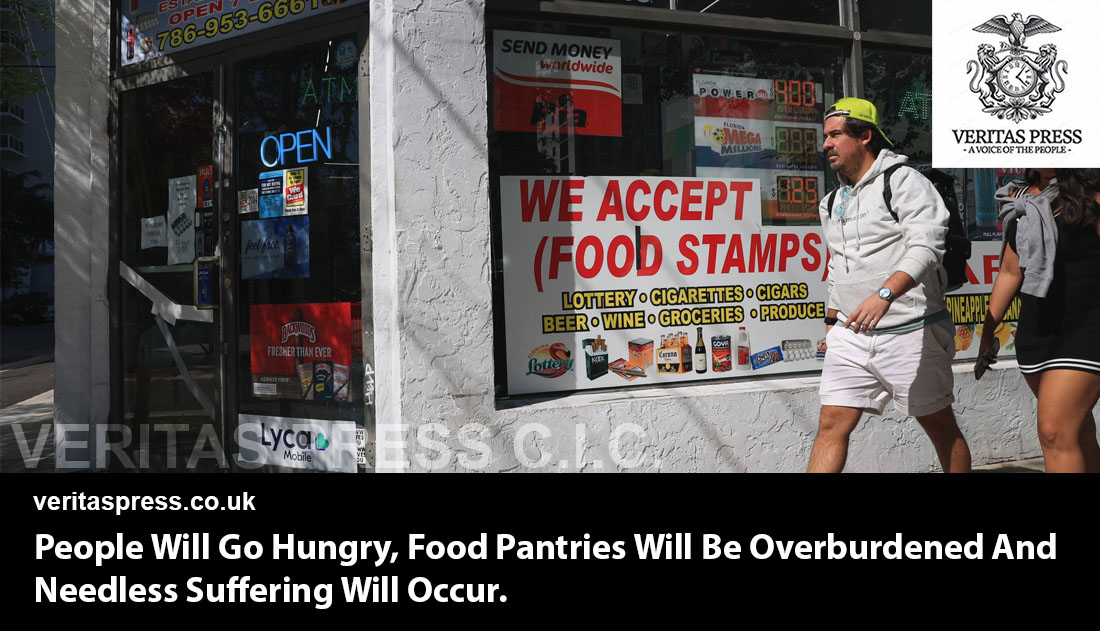
The victims of fiscal retaliation won’t be mayors or bureaucrats, but the 3 million New Yorkers dependent on federally linked programs: public housing residents waiting for repairs, low-income families receiving SNAP benefits, asylum seekers in city shelters, and bus riders relying on subsidised transit.
Starving a city into compliance means forcing its poorest residents to pay for its political independence. It’s a test of how much human suffering the federal government is willing to inflict to maintain ideological control.
5. The Next Battlefront:
For now, Mamdani’s transition team is quietly coordinating with municipal finance experts and sympathetic governors to build contingency reserves and explore municipal bond-based self-funding, a potential first step toward genuine fiscal sovereignty.
Whether that’s sustainable remains to be seen. But if Trump proceeds with his threats, the crisis may push New York toward the radical act of self-financing its democracy, something no American city has attempted in a century.
And in that sense, Trump’s assault may produce its opposite: not a silenced city, but a reborn one, forced to imagine freedom beyond the federal chequebook.
Kamran Faqir is a volunteer investigative journalist and writer committed to exposing hidden truths and amplifying underreported stories. Driven by social justice, he brings sharp insight and fearless truth-telling to independent journalism. NUJ registered.
SEATTLE, TEHRAN — The U.S. Department of Homeland Security (DHS) will allow Iran’s national football team to enter the country 48 hours before their critical World Cup match against Egypt on Friday, a modest concession in a tournament where Team Melli’s travel conditions have sparked claims of oppression and competitive disadvantage.


















 Business & Finance, Economy, Europe, Health Insights, Human Rights, Public Opinion, UK News, World News