Kamran Faqir is a volunteer investigative journalist and writer committed to exposing hidden truths and amplifying underreported stories. Driven by social justice, he brings sharp insight and fearless truth-telling to independent journalism. NUJ registered.
Press Release: Veritas Press C.I.C.
Author: Kamran Faqir
Article Date Published: 14 Aug 2025 at 12:37 GMT
Category: UK | Politics | Poverty Crisis
Source(s): Veritas Press C.I.C. | Multi News Agencies
“It’s not just hunger anymore. It’s cold, it’s damp, it’s mental health falling apart… and the government still tells us to just ‘get a job’.” — Maria, 43, single mother, Nottingham
The Myth Of Modern Prosperity:
In the official narrative, Britain is still a wealthy, developed democracy, the kind of country where poverty is rare, or at least temporary. But behind the façades of semi-detached homes and supermarket car parks, an economic collapse is quietly eroding lives.
Poverty in Britain today is not a sudden tragedy; it is the outcome of deliberate political choices spanning decades. Austerity policies since 2010, pandemic fallout, war-driven inflation, and a cost-of-living crisis have combined to create levels of deprivation worse than the 1970s, according to the Joseph Rowntree Foundation (JRF).
The numbers are staggering: 14.3 million people, one in five, live in poverty, including 4.3 million children. And for the poorest, things are deteriorating fast. The incomes of those in “very deep poverty” are now on average 57% below the poverty line, up from 23% in the mid-1990s.
Paul Kissack, JRF’s chief executive, does not mince words:
“Going without basic essentials strips people of dignity. It damages health. It isolates people socially. Poverty is the enemy of opportunity, and this is a story of moral and fiscal irresponsibility.”
Working, But Poorer Than Ever:
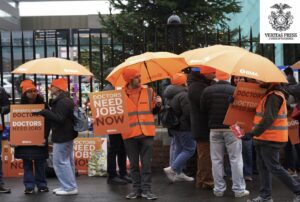
The old assumption that work protects against poverty has collapsed. Government ministers continue to argue that employment is the “best route out of poverty,” yet the data says otherwise: 68% of working-age adults in poverty live in households where at least one person has a job. Half of children in poverty have working parents.
These are not just low-income workers; they are carers, teachers, and NHS staff. David, a hospital porter in Manchester, works 42 hours a week yet visits a food bank twice a month.
“I’ve got two jobs and I’m still in debt. My rent takes half my pay. If I buy new shoes for my daughter, I skip dinner.”
Housing costs are a silent driver of this crisis. In London, 46% of private renters fall into poverty after paying rent. Social renters are a little better off, with 44% below the poverty line post-housing costs.
The Human Rights Framing And The UN Challenge:
For campaigners, this is not simply about economics; it’s about rights. Amnesty International UK has joined forces with the Growing Rights Instead of Poverty Partnership (GRIPP), a coalition of grassroots groups, to take the UK government to task on the international stage.
Their joint submission to the UN Committee on Economic, Social and Cultural Rights (CESCR) is blunt: Britain is in breach of its treaty obligations to ensure an adequate standard of living.
The report, authored by people with lived experience of poverty, documents policies that actively perpetuate deprivation, from banning asylum seekers from working, forcing them to survive on as little as £10 a week, to benefit deductions that leave families without enough to heat or feed themselves.
One contributor, Samiha, 32, a refugee from Sudan now living in Birmingham, told the panel:
“They keep us poor on purpose. They take away the chance to work, then tell us we’re lazy. It breaks you.”
GRIPP accuses the government of submitting a “whitewashed” account to the UN, glossing over deep structural failures. The UN’s final review, expected in 2025, could be a diplomatic embarrassment, though without enforcement powers, campaigners fear it may be ignored.
Policy Failure Or Political Choice?
While Westminster blames global headwinds, analysts say the UK’s poverty levels are rooted in domestic policy. Jonathan Portes, professor of economics at King’s College London, notes:
“The UK’s safety net has been systematically eroded in real terms for over a decade. It is not an accident. It’s a political decision to tolerate higher poverty.”
The real-terms value of benefits is now at a 40-year low, a collapse made more brutal by a 40-year high in inflation. Universal Credit leaves the average claimant £35 short each week of covering essentials, according to JRF.
Disabled people are hit hardest. Elaine, a nurse in Glasgow with multiple sclerosis, describes skipping medication to afford heating:
“I feel guilty for being alive. My kids don’t deserve to live like this.”
The Geography Of Inequality:
The crisis has a postcode pattern, but it’s not limited to the traditional “deprived” areas. According to ONS and JRF data:
Child poverty rates are 30% in England and 29% in Wales, but under 25% in Scotland, thanks to targeted welfare schemes.
Inner-city boroughs in London, Birmingham, and Manchester see some of the worst poverty after housing costs, but rural areas in Cornwall, Cumbria, and the North East are also in deep distress.
Scotland’s Child Payment scheme, soon to be expanded, is projected to reduce child poverty there to 21.8% by 2029. Analysts say adopting a similar approach UK-wide could lift 800,000 children out of poverty.
The Cost Of Doing Nothing:
The social consequences are severe and expensive. Local councils are spending record sums on temporary accommodation as homelessness rises. NHS services are overwhelmed by preventable illnesses linked to poor housing and nutrition. Teachers report pupils arriving hungry, unable to concentrate, widening the attainment gap.
Michael Clarke of Turn2us warns:
“These aren’t abstract numbers. They are families, children, pensioners, real lives being diminished. And the longer this continues, the more entrenched and expensive it will be to fix.”
Economists agree the long-term fiscal cost of deepening poverty, in lost productivity, higher health spending, and social instability, dwarfs the short-term savings from cutting welfare.
2025: A Political Reckoning.
With a general election looming, the poverty crisis is a political test. Paul Kissack challenges all parties:
“Any party serious about governing must be both practical and ambitious if we are to turn the tide of deepening poverty of the past 26 years.”
But campaigners fear the issue will be weaponised in culture wars rather than addressed in policy. Becca Lyon of Save the Children UK insists:
“Children deserve more than corrosive, deepening poverty. We need a child poverty strategy in law, and we need it now.”
The Verdict:
The UK’s poverty crisis is not an accident, nor is it inevitable. It is the cumulative product of political decisions, underfunded safety nets, and a refusal to treat poverty as a rights violation. The UN review offers a rare chance to hold the government accountable, but change will depend on whether voters, not just campaigners, demand it.
“We’ve been told to be patient for decades,” says Maria in Nottingham. “But patience doesn’t feed kids. Patience doesn’t heat a home. We need action, not pity.”
In Summary: Poverty is a Policy, Not an Accident.
Britain’s deepening poverty crisis is not an unfortunate byproduct of economic cycles or global inflation. It is a direct consequence of deliberate policy choices, austerity, welfare cuts, stagnant wages, and housing neglect, sustained over decades. Work no longer guarantees security, benefits fail to meet basic needs, and millions of children grow up in conditions that violate fundamental human rights.
Eyewitnesses, parents, and frontline workers report a grim reality of hunger, cold homes, and chronic exclusion. Analysts, NGOs, and UN bodies repeatedly warn that the UK is failing its obligations to protect a basic standard of living. Yet Westminster continues to frame poverty as personal misfortune rather than structural failure, masking the impact of deliberate inaction and institutional corruption.
Institutional corruption, manifested in mismanagement of public funds, opaque contracting, and regulatory neglect, acts as a multiplier, worsening deprivation. A 2024 report by Transparency International UK identified systemic bias, opaque accounting, and uncontrolled pricing in the government’s handling of COVID-19 procurement, raising serious questions over billions in public spending. Similarly, the UK’s development finance institution, British International Investment (BII), faced criticism for spending over £7 million on business-class flights and high salaries, prompting concerns about the value for money and impact of its investments amid budget cuts and poverty alleviation efforts.
Foreign investments and international alliances further exacerbate the crisis. Government policies often prioritise corporate profits and international partnerships, in finance, energy, and arms deals, over the welfare of citizens. A financial analyst explained:
“The government treats citizens as expendable costs while foreign investors are sacrosanct. Decisions that harm people domestically are justified in the name of global competitiveness.”
NGOs, watchdogs, and human rights organisations warn that these intertwined factors, structural neglect, corruption, and global economic entanglements, create a dual-tier society: one protected for investors and foreign allies, the other left in systemic deprivation.
The human toll is immense. Chronic deprivation erodes health, stunts opportunity, and deepens social inequality. Economically, neglect is costly: preventable illness, lost productivity, and rising demand for social services will continue to burden taxpayers for generations.
As one mother in Birmingham put it:
“They take away what little we have, then call us lazy. This is not poverty, this is policy, corruption, and betrayal all at once.”
Britain’s crisis is both moral and political. Poverty is not an accident; it is engineered, reinforced by corruption, and underpinned by international economic and political priorities. The solution requires systemic, rights-based reforms, from transparent governance and anti-corruption measures to comprehensive social support, and accountability at the highest levels of government.
The question is no longer whether the country can afford to act. The question is whether it can afford not to, as long as corruption and foreign interests continue to dictate domestic policy at the expense of millions of vulnerable citizens.
Kamran Faqir is a volunteer investigative journalist and writer committed to exposing hidden truths and amplifying underreported stories. Driven by social justice, he brings sharp insight and fearless truth-telling to independent journalism. NUJ registered.
SEATTLE, TEHRAN — The U.S. Department of Homeland Security (DHS) will allow Iran’s national football team to enter the country 48 hours before their critical World Cup match against Egypt on Friday, a modest concession in a tournament where Team Melli’s travel conditions have sparked claims of oppression and competitive disadvantage.




























Leave a Reply